


















Lesson 18 of 47 · Indeterminate Structures
The force method: compatibility and superposition
Solve indeterminate beams with the force method: release a redundant, write the compatibility equation and superpose. Includes propped cantilever, continuous beam and settlement.
The force method, also called the flexibility method, is the most direct way to solve an indeterminate structure. The idea is simple: remove enough supports to make the structure determinate, compute how much it moves where the support was, then push it back with an unknown force until it is where it should be. The unknown force is the redundant, and the "pushing back" is called compatibility.
What you will learn
- The steps of the force method for one redundant.
- How to solve a propped cantilever and a two-span continuous beam.
- How to include support settlement.
- How to check a result with equilibrium and a limiting case.
Key terms
Redundant (X): the unknown force or moment chosen to be removed. Released (primary) structure: the determinate structure left after removing the redundant. Flexibility coefficient (f): the displacement at the redundant's location caused by a unit redundant force. Compatibility equation: the displacement condition that the real structure must satisfy. Superposition: adding results of separate load cases for a linear structure.
The steps
- Choose the redundant. Pick a reaction (or internal moment) whose removal leaves a stable, determinate structure.
- Analyze the released structure under the real loads. Find the displacement at the redundant's position, called δ10 (the "0" for the real load, "1" for the position of redundant 1).
- Analyze the released structure under a unit redundant. Find the displacement f11 at the same position caused by a unit force X = 1.
- Write compatibility. The total displacement must equal what the real support allows (zero for a rigid support): δ10 + f11 X = 0 (with signs chosen so both displacements are positive in the same direction).
- Solve for X, then superpose: any quantity = (value in released structure) + X × (value due to unit X).
- Check with equilibrium and a plausibility test.
Example 1: propped cantilever
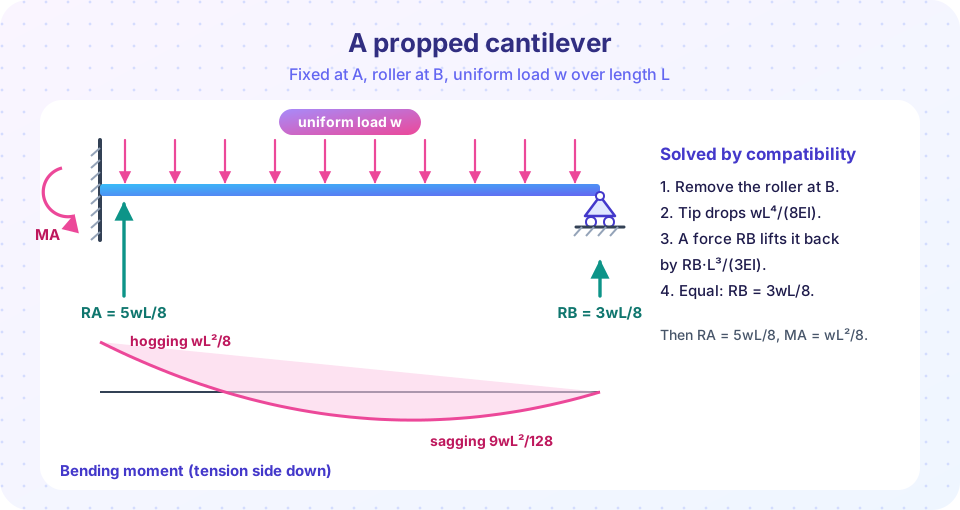
Beam fixed at A (x = 0), roller at B (x = L), uniform load w. Choose the roller reaction R_B as the redundant. Remove it. The released structure is a cantilever.
- Under the load: the tip deflects downward by δ10 = wL⁴/(8EI).
- Under a unit upward force at the tip: the tip rises by f11 = L³/(3EI).
- Compatibility (the tip must not move): δ10 − X f11 = 0, so
X = δ10 / f11 = [wL⁴/(8EI)] / [L³/(3EI)] = 3wL/8
Now equilibrium gives the rest: R_A = wL − 3wL/8 = 5wL/8, and the fixed-end moment M_A = wL²/2 − (3wL/8)L = wL²/8 (hogging). The sagging moment peaks at 3L/8 from the roller with a value of 9wL²/128. You can see them in the figure.
Check. Take moments about the roller: R_A L − M_A − wL²/2 = (5/8 − 1/8 − 1/2) wL² = 0 ✓. And the limiting case is sensible: the prop carries 3/8 of the load, the fixed end 5/8.
Press Run (or Ctrl + Enter) to see the result here.
Program input · what you'd type while the program runs
Type the answers before you press Run, one per line. Each time the program reads a line (with input()), it gets the next line from this box.
The output confirms R_B = 3wL/8 for the propped cantilever, 5wL/4 at the middle support of two equal spans (so each outer support carries 3wL/8), and wL²/12 at the ends of a fixed-end beam with wL²/24 at midspan.
Example 2: a continuous beam
Two equal spans L under uniform w. Remove the middle support: the released structure is a simple beam of span 2L. It sags at midspan by 5w(2L)⁴/(384EI) = 5wL⁴/(24EI). A unit upward load at midspan lifts it by (2L)³/(48EI) = L³/(6EI). So
X = (5wL⁴/24EI) / (L³/6EI) = 5wL/4
Each end support carries (2wL − 5wL/4)/2 = 3wL/8, and the support moment is M_B = (3wL/8)L − wL²/2 = −wL²/8, so the hogging moment is wL²/8. The middle support attracts most of the load: it carries five-eighths of the total, which is why interior columns are often bigger than exterior ones.
Support settlement
If the support at B settles by Δ, the compatibility equation becomes δ10 − X f11 = Δ, so
X = (δ10 − Δ) / f11 = 3wL/8 − 3EIΔ / L³
for the propped cantilever. The sinking support sheds load. If the beam is stiff (large EI) or the span short, even a small settlement relieves the prop of much of its force; for a flexible beam the effect is small. Differential settlement is one of the big reasons indeterminate structures can crack when foundations move.
Press Run (or Ctrl + Enter) to see the result here.
Program input · what you'd type while the program runs
Type the answers before you press Run, one per line. Each time the program reads a line (with input()), it gets the next line from this box.
For this beam, every millimetre of settlement removes about 0.23 kN from a 45 kN prop reaction, but 50 mm of settlement would remove more than a quarter of it.
Several redundants
With two or more redundants you get two or more compatibility equations written in matrix form: F X = −Δ0, where F is the flexibility matrix (entries f_ij, the displacement at redundant i from a unit redundant j) and Δ0 the displacements in the released structure under the real loads. Maxwell's reciprocal theorem makes F symmetric (f_ij = f_ji). The method stays the same; the arithmetic grows, which is why computers take over for large structures.
Common misconceptions
"The redundant must be the roller reaction." Any release that leaves a stable determinate structure works: you could instead release the fixed-end moment of the propped cantilever and solve for it. Choose the one that makes the displacements easy.
"Sign errors do not matter, since the answer will look right." An incorrect sign on the compatibility equation can still give plausible numbers. Always check by equilibrium and by a limiting case.
Check your understanding
Quick check · 5 questions
of 5 answered You scored / 5 · perfect!
-
1. In the force method, what does the compatibility equation express?
Compatibility restores the geometric condition that was removed by releasing the redundant. -
2. For a propped cantilever under uniform load w and length L, the prop carries
X = δ10/f11 = (wL⁴/8EI)/(L³/3EI) = 3wL/8. -
3. For two equal spans of L under w, the middle support carries
The middle support carries five-eighths of the total load 2wL. -
4. If the prop of a propped cantilever settles, its reaction
X = 3wL/8 − 3EIΔ/L³, so settlement relieves the prop. -
5. What is the midspan moment of a fixed-fixed beam under uniform load?
The simple-beam moment wL²/8 reduced by the end moment wL²/12 leaves wL²/24.
Summary
- Release redundants to get a determinate structure, compute the displacements δ10 and f11, and impose compatibility.
- Propped cantilever: RB = 3wL/8, RA = 5wL/8, MA = wL²/8. Two equal spans: middle support 5wL/4.
- Support settlement enters the compatibility equation and relieves the settling support.
- With several redundants the equations form a symmetric flexibility matrix.
- Always check with equilibrium and a limiting case.
Next: Moment distribution
Track your progress
Create a free account to tick off lessons and pick up where you left off on any device.
of Structural Engineering lessons completed