


















Lesson 1 of 47 · Getting Started
Course map: how to learn structural engineering
Who this structural engineering course is for, what you need first, how the nine chapters fit together and how to study them, with a first live beam demo.
Every building, bridge, tower and tunnel has one job before any other: stay up. Structural engineering is the craft of making sure it does, under its own weight, under people and furniture, under wind, snow, earthquakes and time, and doing it with as little material and money as safety allows. This course walks you from the first force diagram to the design of steel beams, concrete slabs, foundations and earthquake-resisting frames.
What you will learn
- What structural engineers do and how a design moves from a brief to a checked set of drawings.
- How to find the forces in beams, trusses and frames, and how to deal with structures that statics alone cannot solve.
- How steel, reinforced concrete, soil and earthquakes change the way a member is sized.
- How to read a design standard without being afraid of it.
- A repeatable way of checking your own answers.
Who this course is for
The course is written for learners of about 16 and up, for first-year engineering and architecture students, and for adults who want to understand how the things around them stand up. You do not need to be an engineer. You do need to be willing to calculate: structural engineering is a numerate subject, and every idea here comes with a worked example.
Prerequisites are modest:
- Algebra and trigonometry: solving equations, sine, cosine and tangent, the Pythagorean theorem.
- Basic physics: what a force is, Newton's laws, the idea of a moment (a turning effect).
- A little calculus, only in the chapters on beam deflection and the matrix method. A short refresher is given there.
If you have already worked through the site's tracks on statics and strength of materials, you will recognize the opening chapters and can move faster. If not, nothing here depends on them.
Key terms. A load is anything that pushes on a structure. A reaction is the force a support pushes back with. A member is one bar, beam or column. Equilibrium means all forces and moments balance, so nothing accelerates.
The nine chapters
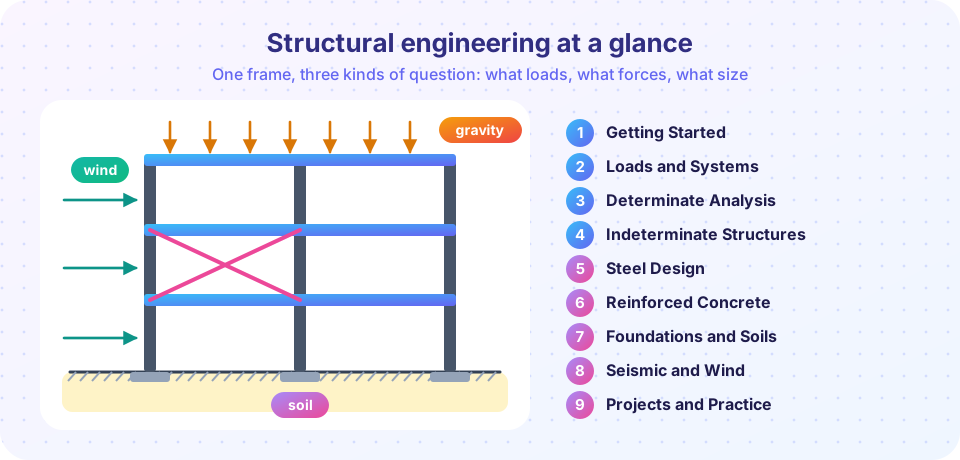
The course follows the order in which an engineer meets a problem. First you describe the structure and the loads, then find the internal forces, then size the members, and finally you check the whole thing against the ground and against rare events.
Part 1: set the scene
Part 2: find the forces
Part 3: size the members
Part 4: the big picture
How a load travels
Think of a structure as a chain that carries weight to the ground. A person walks across a floor. The floor slab passes the force to a beam, the beam to a girder, the girder to a column, the column to a footing, and the footing to the soil. Wind and earthquakes push sideways, so frames, walls and bracing must pass those forces down as well. At every link the engineer asks the same three questions: how big is the force, can the member resist it, and does it move too much?
Those three questions give the course its rhythm. Strength means the member does not break. Stiffness means it does not deflect or vibrate unpleasantly. Stability means it does not buckle or tip. Almost every design check you will ever do is a version of one of these.
How to study this course
- Read with a pencil. Redraw every figure. Writing the free-body diagram yourself is worth ten readings.
- Always write units. Mixing kN, N, m and mm is the most common source of wrong answers in the profession. This course uses SI units: forces in newtons (N) or kilonewtons (kN), lengths in metres (m) or millimetres (mm), stresses in pascals (Pa) or megapascals (MPa).
- Check every answer two ways. For example, find a reaction with a force equation and confirm it with a moment equation about another point.
- Estimate first. Before using a formula, guess the answer to within a factor of two. A guess that is wildly different from the result means something is wrong.
- Run the code. The Try it blocks are small working programs. Change a number and predict what happens before you press Run.
A first taste
Here is the smallest structural question there is. A beam rests on two supports and carries one load. Where does the load go? Slide the load and watch the two supports share it.
Notice that the closer the load is to a support, the more of it that support carries. At the middle, each support takes half. You will prove this with equations in the lesson on forces and equilibrium.
Press Run (or Ctrl + Enter) to see the result here.
Program input · what you'd type while the program runs
Type the answers before you press Run, one per line. Each time the program reads a line (with input()), it gets the next line from this box.
The peak moment is the number that sizes the beam. By the end of Chapter 3 you will draw this diagram by hand for any simple beam.
Common misconceptions
"Heavier structures are stronger." Not necessarily. Weight is also a load, and the structure must carry it. Good design uses material only where it is needed.
"If it has not fallen down, it is safe." A structure can stand for years while carrying only a fraction of its capacity, or while slowly losing it. Safety is a margin you calculate, not an outcome you observe.
Check your understanding
Quick check · 4 questions
of 4 answered You scored / 4 · perfect!
-
1. What does a support's reaction do?
A reaction is the force a support supplies to keep the structure in equilibrium. -
2. Which of these is a question about stiffness?
Stiffness is about deformation and movement. Snapping is strength and buckling is stability. -
3. In the beam demo, what happens to the left reaction as the load moves toward the right support?
The farther the load is from the left support, the less of it that support carries, so the left reaction falls. -
4. Why should you write units on every line of a calculation?
Units expose mistakes early. A force in kN divided by a length in mm gives a nonsense unit that signals a slip.
Summary
- A structure is a chain that carries loads to the ground; every member must be strong, stiff and stable enough.
- The course moves from forces, through analysis and design of steel and concrete, to foundations, earthquakes and projects.
- Study by drawing, writing units, checking twice and running the code.
- A beam with a load between two supports shares it according to distance, and its largest bending moment sizes the member.
Track your progress
Create a free account to tick off lessons and pick up where you left off on any device.
of Structural Engineering lessons completed