


















Lesson 33 of 47 · Foundations and Soils
Chapter 7 overview: foundations and soils
A map of foundation design: soil layers and effective stress, shallow and deep foundations, site investigation, and the three checks of bearing, settlement and stability.
Every load that a building carries ends in the ground. Beams and columns can be chosen from a catalog with known properties, but soil is a natural material: it varies from one site to the next, from one meter to the next, and it changes with the water table and the seasons. That is why foundation engineering is part mechanics and part judgment. This chapter gives you the mechanics.
What you will learn
- The main types of foundations and when each is used.
- Basic soil quantities: unit weight, void ratio, effective stress.
- What a site investigation provides.
- The three questions every foundation must answer, and what the chapter's lessons cover.
Key terms
Bearing capacity: the pressure the soil can carry without shear failure.
Settlement: the downward movement of a foundation as the soil compresses.
Effective stress σ′: the stress carried by soil grains, σ′ = σ − u, where u is pore water pressure.
Spread footing: a pad or strip that spreads a column or wall load over a larger area.
Pile: a slender element driven or cast into the ground to carry load to deeper layers.
Foundation types
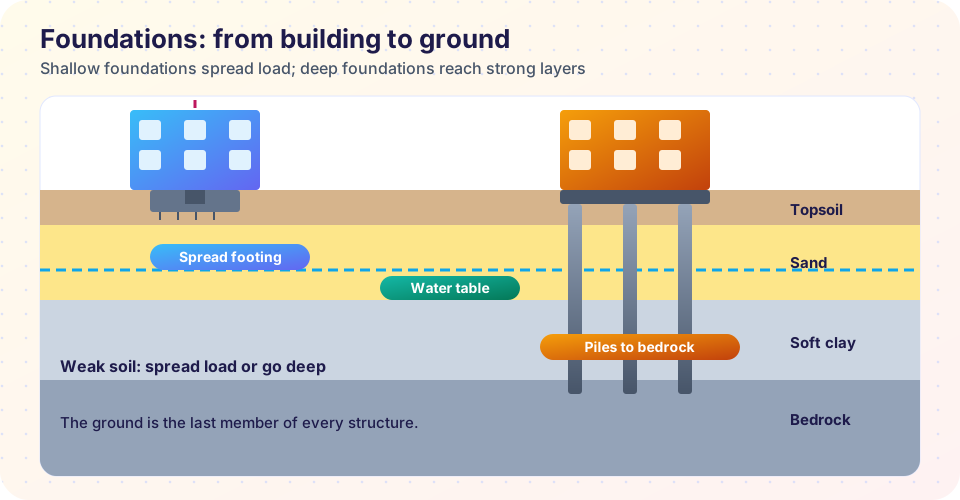
Shallow foundations place the footing near the surface, usually at a depth less than its width.
- Isolated (pad) footings carry single columns.
- Strip footings carry walls or rows of columns.
- Mat (raft) foundations are one big slab under the whole building, used where soils are weak or footings would almost touch each other.
Deep foundations pass through poor soil to reach a better layer.
- Driven piles of steel, concrete or timber are hammered or vibrated in.
- Drilled shafts (bored piles) are drilled and filled with reinforced concrete.
- Piles carry load by end bearing on a strong layer, by skin friction along the shaft or by both.
The choice depends on loads, the soil profile, the water table, the cost and the available equipment. A building of two stories on dense sand uses spread footings; a tower on soft clay uses piles or a mat on piles.
Soil basics you need
Soil is a three-phase material of solid grains, water and air. A handful of relationships describe it.
Void ratio       e = Vv / Vs
Porosity         n = Vv / V = e / (1 + e)
Degree of sat.   S = Vw / Vv
Unit weight      γ = (Gs + S e) γw / (1 + e)       γw = 9.81 kN/m³
Gs is the specific gravity of the grains, about 2.65 for quartz sand. For a saturated soil (S = 1) with e = 0.8, γ = (2.65 + 0.8) × 9.81 / 1.8 = 18.8 kN/m³.
Effective stress
Karl Terzaghi's great insight (1920s) was that soil strength and compression depend on the effective stress, not the total stress. Under a water table, pore pressure u = γw × (depth below the water table) carries part of the total stress σ, and only the remainder, σ′ = σ − u, squeezes the grains together. Dropping the water table raises σ′ and can cause the ground to settle, as happened in several famous cities pumping groundwater.
Sand and clay behave differently
Sands and gravels are granular and drain quickly. Their strength comes from friction, measured by the friction angle φ (about 28° to 40°). They settle fast, mostly during construction.
Clays are fine-grained and drain slowly. Their strength is often described by cohesion c (or undrained shear strength su) and they settle slowly over months or years because water must leave the pores before the soil compresses. This is called consolidation.
Site investigation
You cannot design a foundation without knowing what is underneath. A site investigation usually includes boreholes with samples, the standard penetration test (counting hammer blows needed to drive a sampler 300 mm), cone penetration tests (CPT) that push an instrumented cone into the ground, laboratory tests of strength and compressibility, and groundwater measurements. The report gives the soil layers, their properties and a recommended allowable bearing pressure. Treat it as the foundation's most important drawing.
The three questions
- Bearing capacity: will the soil shear and collapse? (Lesson: soil and bearing capacity.)
- Settlement: will the total and differential settlements stay tolerable? (Lesson: footings, settlement and walls.)
- Stability of walls and slopes: overturning, sliding and global failure.
Differential settlement, one part of the building sinking more than another, is usually more damaging than uniform settlement, as the leaning tower of Pisa shows.
Foundation checks
Choose the foundation
Try it
Press Run (or Ctrl + Enter) to see the result here.
Program input · what you'd type while the program runs
Type the answers before you press Run, one per line. Each time the program reads a line (with input()), it gets the next line from this box.
Press Run (or Ctrl + Enter) to see the result here.
Program input · what you'd type while the program runs
Type the answers before you press Run, one per line. Each time the program reads a line (with input()), it gets the next line from this box.
Check your understanding
Quick check · 4 questions
of 4 answered You scored / 4 · perfect!
-
1. Effective stress is defined as
σ′ = σ − u: the part of the stress carried by soil grains. -
2. Which soil settles slowly over months because water must drain out?
Clays are low-permeability, so consolidation is slow. -
3. A mat foundation is typically chosen when
A raft spreads the load over the whole plan area. -
4. Which is more damaging to a building?
Differential settlement distorts the structure and cracks walls.
Summary
- Shallow foundations (pads, strips, mats) spread load near the surface; deep foundations (piles, shafts) reach strong layers.
- Soil is three-phase; strength and compression follow effective stress
σ′ = σ − u. - Sands are frictional and drain fast; clays are cohesive and settle slowly.
- Check bearing, settlement and stability, based on a good site investigation.
Track your progress
Create a free account to tick off lessons and pick up where you left off on any device.
of Structural Engineering lessons completed