


















Lesson 8 of 47 · Loads and Structural Systems
Tributary areas and load paths
Learn how floor loads reach beams, girders and columns through tributary areas, one-way and two-way slab action, and add up column loads over many storeys.
A floor load is a pressure, in kilonewtons per square metre. A beam cannot carry a pressure; it carries a line load, in kilonewtons per metre. A column carries a point load, in kilonewtons. Tributary areas are the bridge between these three: they tell you which part of the floor each member is responsible for, so that you can convert pressure to line load to point load without losing a newton.
What you will learn
- How to follow a load from slab to beam to girder to column to footing.
- How to find tributary widths and areas for beams and columns.
- The difference between one-way and two-way slab action.
- How column loads accumulate over several storeys.
Key terms
Tributary area: the part of a surface whose load a member supports. Tributary width: the width of that strip for a beam. Load path: the route of a load through members to the ground. One-way slab: a slab that spans mainly in one direction. Two-way slab: a slab that spans in both directions and sends load to all four edges.
The idea: split the floor halfway
Imagine a floor supported by parallel beams. If the slab spans from one beam to the next, each beam supports the strip of floor halfway to its neighbours on each side. Halfway is the right place to cut because a uniformly loaded slab spanning between two supports sends half of its load to each.
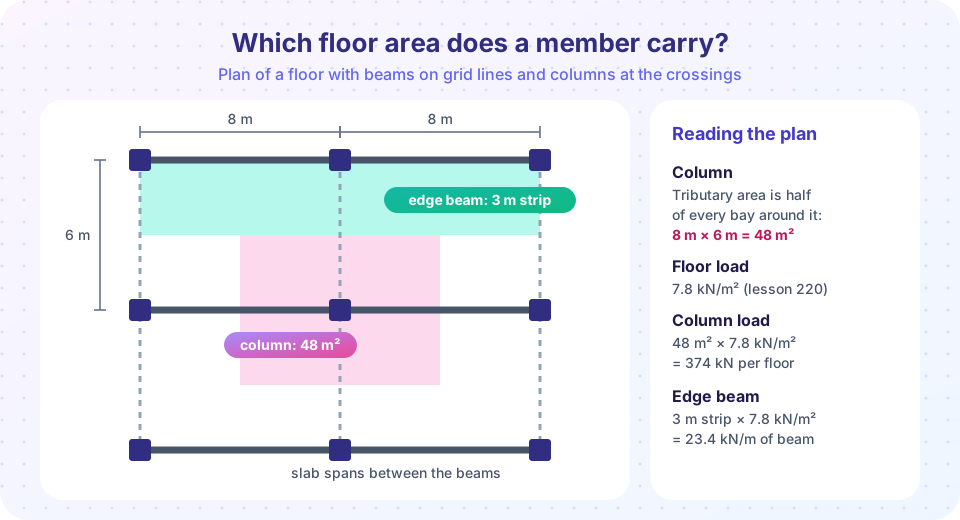
- An interior beam has a tributary width of half the span to the left plus half to the right: the beam spacing.
- An edge beam has only one side: half the spacing, plus any cladding or wall it carries.
- A column carries the tributary area around it: half the span in each direction of the beams that meet at it.
Worked example: beams and a column
A floor has beams on grid lines 6 m apart, each spanning 8 m between columns. The service floor load is 7.8 kN/m² (5.3 dead plus 2.5 live).
Interior beam. Tributary width 6 m, so w = 6 × 7.8 = 46.8 kN/m. Total load on the beam: 46.8 × 8 = 374.4 kN. Each end reaction is half: 187.2 kN.
Edge beam. Tributary width 3 m, so w = 3 × 7.8 = 23.4 kN/m (more if a heavy wall sits on it). End reaction: 23.4 × 8 / 2 = 93.6 kN.
Interior column. Two beams meet it, one from each side, so it receives 187.2 + 187.2 = 374.4 kN from this floor. Check with area: 8 m × 6 m = 48 m², and 48 × 7.8 = 374.4 kN ✓. Two independent routes to the same number is the check.
Notice that it does not matter whether you work through the beams or directly from the area, provided every part of the floor is counted once. The "area route" is faster for a rough hand check; the "member route" is needed to design the beams.
Press Run (or Ctrl + Enter) to see the result here.
Program input · what you'd type while the program runs
Type the answers before you press Run, one per line. Each time the program reads a line (with input()), it gets the next line from this box.
Main beams and secondary beams
In bigger floors the slab spans to secondary beams, which pass their reactions to girders (main beams) as point loads, and the girders pass theirs to columns. At each stage the load is a different shape. Suppose girders span 9 m and secondary beams at 1.5 m, 4.5 m and 7.5 m frame into them, each carrying a 3 m wide strip of an 8 m span. Each secondary beam delivers (3 × 7.8 × 8) / 2 = 93.6 kN to each of the two girders it connects, and an interior girder collects from beams on both sides, so each point load on it is 187.2 kN. Three points of 187.2 kN make 561.6 kN, which is 9 × 8 × 7.8, the girder's tributary area. Each girder end reaction is 280.8 kN.
One-way and two-way slabs
A rectangular slab supported on all four sides carries load in both directions, but the stiffer short direction attracts most of it. The ratio of long span to short span decides how to treat it:
- Long / short ≥ 2: nearly all load goes across the short span. Treat it as a one-way slab: a strip spanning between two parallel beams.
- Long / short < 2: treat it as a two-way slab. A common hand method draws 45° lines from the corners, which divide the slab into two triangles and two trapezoids. Each triangle loads a short beam; each trapezoid loads a long beam.
For a 4 m × 6 m slab with a 7.8 kN/m² load, each short edge beam sees a triangular load with peak w·a/2 = 7.8 × 4/2 = 15.6 kN/m, and each long edge beam sees a trapezoidal load with the same peak ordinate.
Press Run (or Ctrl + Enter) to see the result here.
Program input · what you'd type while the program runs
Type the answers before you press Run, one per line. Each time the program reads a line (with input()), it gets the next line from this box.
Accumulating column loads down a building
Gravity load builds up from the roof to the footing. At each level the column carries its own storey load plus everything above, so the lowest column carries the most. Live load reduction (previous lesson) lowers the live part as more area stacks up.
Press Run (or Ctrl + Enter) to see the result here.
Program input · what you'd type while the program runs
Type the answers before you press Run, one per line. Each time the program reads a line (with input()), it gets the next line from this box.
Common misconceptions
"The tributary area is the area closest to the member." It is the area that actually sends its load there, which depends on how the slab spans. A one-way slab sends no load to the beams parallel to its span.
"Beams carry the load they are tributary to, so beam depth does not matter." Load does not depend on depth, but stiffer members attract more load in indeterminate floors (Chapter 4).
"You only count live load once." Live load is counted on every tributary area, then reduced by the code rule if allowed.
Check your understanding
Quick check · 5 questions
of 5 answered You scored / 5 · perfect!
-
1. Beams are 5 m apart and the floor load is 6 kN/m². What line load does an interior beam carry?
Tributary width is the full spacing, 5 m, so w = 5 × 6 = 30 kN/m. -
2. An edge beam with beams 5 m apart carries (ignoring walls)
An edge beam only has a neighbor on one side, so half the spacing: 2.5 m. -
3. A slab is 3 m by 7 m. How should it be treated?
The ratio is 2.33, over 2, so load travels mostly across the short span. -
4. An interior column has a tributary area of 40 m² on each of 3 floors, and the service load is 8 kN/m² (no reduction). What axial load does the lowest column carry from these floors?
40 × 8 = 320 kN per floor, times 3 floors = 960 kN. -
5. Why can column load be found either by area or through the beams?
Both methods count the same floor area once, so they must agree, which makes a good check.
Summary
- Tributary areas convert floor pressure to line loads on beams and point loads on columns.
- Cut halfway between supports: interior members take the full spacing, edge members half.
- One-way action applies when the long span is at least twice the short span; otherwise use 45° two-way regions.
- Column loads accumulate down the building; live load reduction reduces the live part.
- Check by counting the same area two ways.
Next: Load combinations
Track your progress
Create a free account to tick off lessons and pick up where you left off on any device.
of Structural Engineering lessons completed