


















Lesson 40 of 47 · Seismic and Wind Design
Chapter 8 review: seismic and wind design
Review lateral load design: wind pressure, earthquake base shear, the load path, drift and ductility in one table and one picture, plus a ten-question quiz.
Lateral loads decide the shape of many buildings: where the walls go, which frames get braced, how deep the foundations are. You have now met the two main sources, the pressure of wind and the inertia of an earthquake, and the idea that links them, a continuous load path.
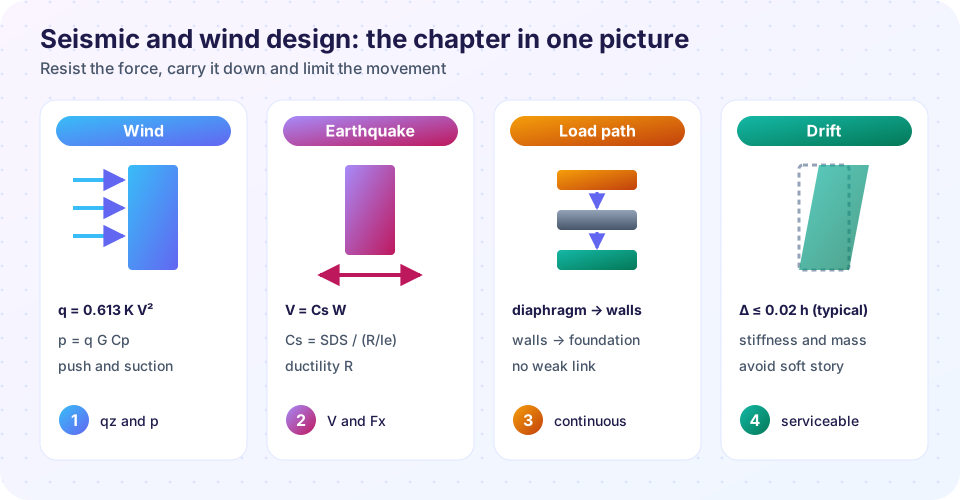
What you will learn
- The key wind and seismic formulas in one place.
- How the two loads differ in design philosophy.
- A checklist for a lateral design.
Recap table
| Topic | Key relation | Notes |
|---|---|---|
| Velocity pressure | qz = 0.613 Kz Kzt Kd Ke V² |
N/m², V in m/s |
| Surface pressure | p = q G Cp |
push (+) and suction (−) |
| Period | T = 2π√(m/k), Ta = Ct hn^x |
stiffer is shorter |
| Spectrum | plateau SDS, then SD1/T |
site dependent |
| Seismic coefficient | Cs = SDS/(R/Ie) |
with upper and lower limits |
| Base shear | V = Cs W |
W includes dead load |
| Story force | Fx = V wx hx^k / Σ wi hi^k |
k 1 to 2 |
| Drift | typically ≤ 0.02 h seismic, H/400 wind | stiffness |
The two design philosophies
Wind design keeps the structure elastic at the design wind. Earthquake design uses a reduced force and relies on ductile yielding. The price of that economy is that detailing matters: capacity design, strong columns and weak beams, confined concrete and compact steel.
Checklist
- Identify the loads: wind speed and exposure, or seismic parameters and the weight.
- Pick a lateral system and a regular layout.
- Compute base shear and story forces, and distribute to walls or frames by stiffness.
- Check drift, overturning and sliding; check the connections along the load path.
- Detail for ductility where earthquakes govern.
Try it
Press Run (or Ctrl + Enter) to see the result here.
Program input · what you'd type while the program runs
Type the answers before you press Run, one per line. Each time the program reads a line (with input()), it gets the next line from this box.
Check your understanding
Quick check · 10 questions
of 10 answered You scored / 10 · perfect!
-
1. What does the lateral load path do?
Diaphragm, vertical system and foundation form a continuous path. -
2. Wind pressure ratio for wind speeds 30 m/s and 60 m/s is
Pressure goes as V²: (60/30)² = 4. -
3. A building has SDS = 0.9 g, R = 6, Ie = 1.5. Short-period Cs is
0.9 / (6/1.5) = 0.225. -
4. The R factor in seismic design
A larger R lowers Cs, assuming ductile behavior. -
5. Which is the classical weakness that concentrates earthquake damage?
A story that is weaker or more flexible than the ones above takes all the drift. -
6. Which element collects floor forces and distributes them to walls?
The floor slab acts as a horizontal plate. -
7. Windward pressure coefficient is typically about
The windward wall is pushed, so Cp is positive. -
8. A tall slender tower is most concerned with
Sway, acceleration and vortex shedding matter for tall slender structures. -
9. In capacity design of a moment frame, yielding is intended to occur in
Strong column, weak beam. -
10. When does the k exponent in the vertical distribution equal 1?
For short periods the forces vary linearly with height.
Summary
- Wind:
q = 0.613 K V²,p = q G Cp. Earthquake:V = Cs W,Cs = SDS/(R/Ie). - Both need a continuous load path, a regular layout and drift control.
- Earthquake design depends on ductile detailing and capacity design.
Track your progress
Create a free account to tick off lessons and pick up where you left off on any device.
of Structural Engineering lessons completed