


















Lesson 36 of 47 · Foundations and Soils
Chapter 7 review: foundations and soils
Review foundation design: soil strength, bearing capacity, footing sizing, settlement and retaining wall checks in one table and one picture, plus a ten-question quiz.
Foundations connect a structure to the ground, and the ground is the one material nobody manufactures. In this chapter you met the soil model (three phases, effective stress), the bearing capacity equation, footings, settlement and retaining walls. This review pulls them together.
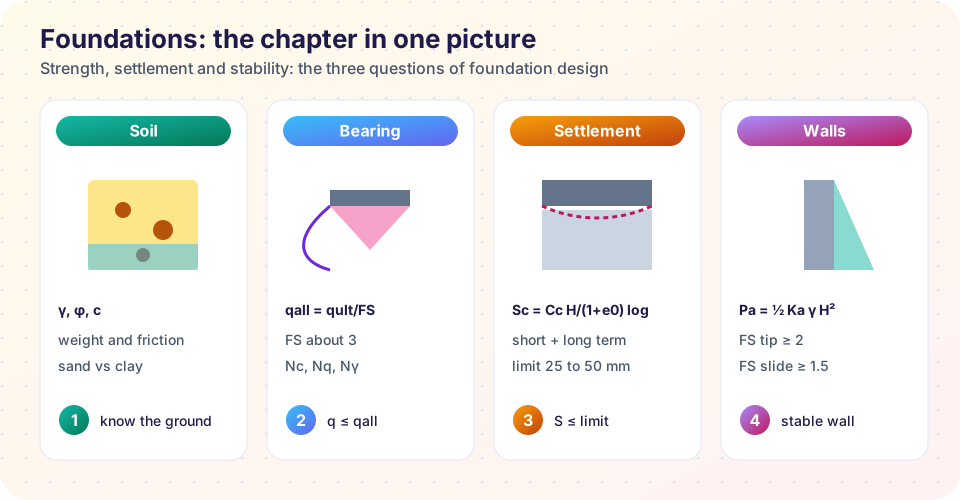
What you will learn
- The key foundation formulas in one place.
- How to run the three checks in the right order.
- Common mistakes to avoid.
Recap table
| Topic | Key relation | Notes |
|---|---|---|
| Soil unit weight | γ = (Gs + S e) γw / (1 + e) |
saturated: S = 1 |
| Effective stress | σ′ = σ − u |
controls strength and compression |
| Shear strength | τf = c′ + σ′ tan φ′ |
drained vs undrained |
| Bearing capacity | qult = c Nc + q Nq + ½ γ B Nγ |
FS ≈ 3 |
| Footing size | A = P / qall |
service loads |
| Eccentric footing | q = (P/A)(1 ± 6e/B) |
stay inside B/6 |
| Consolidation | Sc = Cc H/(1 + e0) log10((σ′0 + Δσ′)/σ′0) |
clays, slow |
| Active pressure | Ka = tan²(45° − φ/2), Pa = ½ Ka γ H² |
at H/3 |
| Wall checks | overturning ≥ 2, sliding ≥ 1.5 | plus bearing and drainage |
The order of checks
- Read the site investigation: layers, groundwater, soil parameters.
- Choose the foundation type from loads and soils.
- Size by bearing capacity with a factor of safety.
- Check settlement, total and differential, against what the structure tolerates.
- For walls: overturning, sliding, bearing and drainage.
- Design the concrete or steel of the foundation element itself.
Common mistakes
- Using total stress where effective stress is needed (or forgetting the water table).
- Checking bearing only, and finding the building sinks.
- Ignoring drainage behind a retaining wall.
- Treating a soil parameter from a table as if it were measured at your site.
Try it
Press Run (or Ctrl + Enter) to see the result here.
Program input · what you'd type while the program runs
Type the answers before you press Run, one per line. Each time the program reads a line (with input()), it gets the next line from this box.
Check your understanding
Quick check · 10 questions
of 10 answered You scored / 10 · perfect!
-
1. Effective stress is
Total stress minus pore pressure. -
2. Which soil type typically settles slowly because of consolidation?
Water must drain from clay pores before the soil compresses. -
3. In the bearing capacity equation, deeper footings gain strength through
q = γ Df adds resistance to heave. -
4. If qult = 900 kPa and FS = 3, qall is
900 / 3 = 300 kPa. -
5. The kern or middle third of a footing of width B extends
If the resultant stays within B/6 of the center, the base remains in compression. -
6. For a retaining wall with a level backfill and φ = 30°, Ka is
Ka = tan²(30°) = 1/3. -
7. Minimum accepted safety factor against sliding for a retaining wall is typically
Overturning needs about 2, sliding about 1.5. -
8. The resultant earth pressure on a wall acts at
A triangular pressure acts at H/3 from the base. -
9. A footing of width 2 m carries 450 kN under an allowable pressure of 150 kPa. Is it adequate if square?
150 × 4 = 600 kN, more than 450 kN. -
10. A water table rising to the footing base most affects
γ drops to the buoyant unit weight, lowering capacity.
Summary
- Soil is a frictional, stress-dependent material; use effective stress.
- Size by bearing capacity with
FS ≈ 3, then check settlement. - Retaining walls:
PaatH/3, overturning ≥ 2, sliding ≥ 1.5, resultant in the middle third, drainage. - Everything rests on a good site investigation.
Track your progress
Create a free account to tick off lessons and pick up where you left off on any device.
of Structural Engineering lessons completed