


















Lesson 6 of 47 · Loads and Structural Systems
Chapter 2 overview: loads and structural systems
A big-picture tour of structural loads (dead, live, snow, wind, seismic), how loads combine and travel to the ground, and the main structural systems.
A structure is only as good as the loads you imagined for it. Underestimate a snow load and a roof falls in; overestimate every load and the building costs twice what it should. This chapter is about deciding what pushes on a structure, how those pushes combine, how each one finds its way to the ground, and which structural systems are used to carry them.
What you will learn
- How loads are classified: permanent, variable, accidental; gravity or lateral.
- Why the design codes, not guesswork, supply load values, and where to look.
- How the lessons in this chapter fit together.
Key terms
Permanent load: acts for the whole life of the structure (weight of the structure itself). Variable load: comes and goes (people, snow, wind). Accidental load: rare and severe (impact, explosion). Gravity load: acts downward. Lateral load: acts sideways (wind, earthquake). Load path: the chain of members that carries a load to the ground.
The big picture
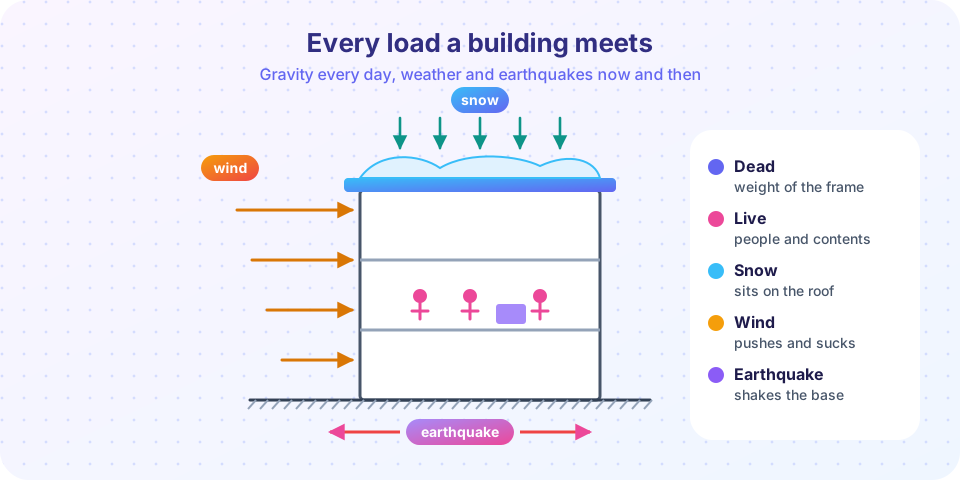
Loads come in families, and each family behaves differently.
| Family | Examples | Typical direction | How well can we predict it? |
|---|---|---|---|
| Permanent (dead) | Slab, beams, finishes, fixed equipment | Down | Very well, because you can weigh it |
| Variable (live) | People, furniture, stored goods, vehicles | Down | Poorly: depends on how the building is used |
| Environmental | Snow, wind, rain, temperature | Down or sideways | Statistically, from weather records |
| Seismic | Ground shaking | Sideways (and up and down) | With great uncertainty; derived from hazard maps |
| Accidental | Impact, explosion, fire | Any | Scenarios, not probabilities |
Design values are not invented by the engineer. They come from loading standards: in the United States ASCE/SEI 7 (Minimum Design Loads and Associated Criteria for Buildings and Other Structures), in Europe Eurocode 1 (EN 1991) with national annexes, and similar documents in other countries. The engineer's job is to pick the right clauses, check the site, and combine the loads correctly.
What pushes on a structure?
How loads are used
Structural systems
What each lesson covers
- Dead and live loads: unit weights, how to add up a floor, and why live loads are minimums set by codes.
- Tributary areas and load paths: how a floor load becomes a line load on a beam and a point load on a column.
- Load combinations: factored combinations in the US and European styles, and why different loads get different factors.
- Structural systems: beams, trusses, frames, arches, cables and shells, and what each is good at.
- Chapter 2 review: a recap and a ten-question quiz.
Why we separate gravity from lateral loads
Gravity loads are always there and always point down, so the gravity system (slabs, beams, columns) is the structure's backbone. Lateral loads come from wind and earthquakes. They are not always present, but when they arrive they can be far more dangerous, because buildings are naturally good at carrying weight and naturally poor at resisting a sideways shove. Tall buildings add a separate lateral force-resisting system: shear walls, braced frames or moment frames. Chapter 8 covers wind and seismic design.
Try it
Move the dead load slider: because the factor on dead load is lower than on live load, a heavy structure still grows the factored load, but not as fast as live load would.
Press Run (or Ctrl + Enter) to see the result here.
Program input · what you'd type while the program runs
Type the answers before you press Run, one per line. Each time the program reads a line (with input()), it gets the next line from this box.
Soil pressure is permanent yet lateral, a reminder that "permanent" and "gravity" are different questions.
Common misconceptions
"The structure only has to carry its own weight." Usually the dead load is only about half to two-thirds of the total. Variable loads and lateral loads often decide the design.
"Wind only pushes." Wind also suctions: on leeward walls and on roofs it pulls outward, and roof coverings are often torn away by suction first.
Check your understanding
Quick check · 4 questions
of 4 answered You scored / 4 · perfect!
-
1. Which load is permanent?
Dead load is permanent: it acts for the whole life of the structure. -
2. Why are lateral loads treated separately in tall buildings?
Structures are inherently good at carrying weight but poor at resisting sideways shove, so a lateral system is added. -
3. Who decides the minimum live loads for a building?
Minimum values come from codes such as ASCE 7 and Eurocode 1, applied to the building's use. -
4. Soil pressure on a basement wall is
It acts all the time and pushes sideways on the wall.
Summary
- Loads are permanent, variable or accidental, and act as gravity or lateral forces.
- Values come from loading standards; the engineer selects and combines them.
- This chapter covers dead and live loads, tributary areas, combinations and structural systems.
- Gravity and lateral systems are designed separately because structures resist them very differently.
Next: Dead and live loads
Track your progress
Create a free account to tick off lessons and pick up where you left off on any device.
of Structural Engineering lessons completed