


















Lesson 44 of 47 · Projects and Practice
Practice problem set with worked answers
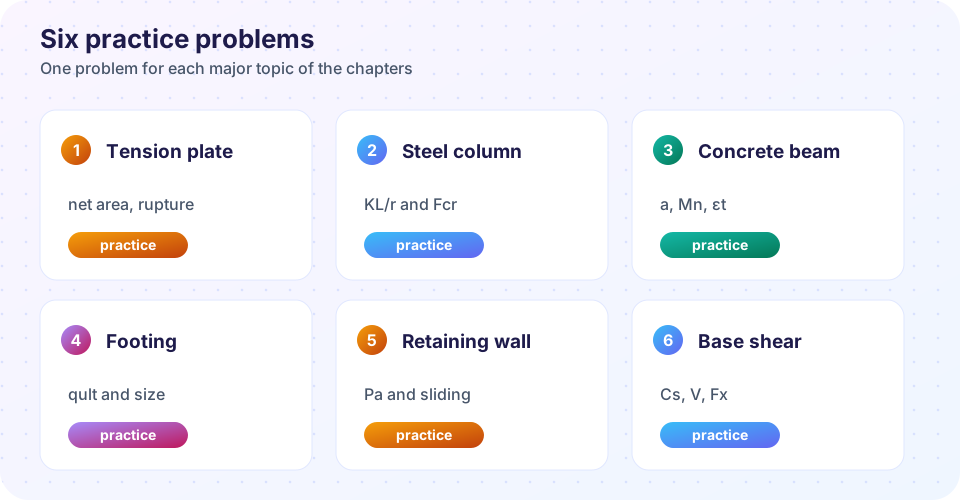
Six worked practice problems covering steel tension, columns, concrete beams, footings, retaining walls and base shear, with answers and a Python solver to check yours.
Reading about a method and using it are two different skills. This set gives you one problem for each major topic of chapters 5 to 8. Try each on paper first, with the formulas from the lessons. Then use the Python solver to compare your numbers, and read the worked answers below it.
What you will learn
- To apply the main equations of the course to concrete numbers.
- To check units and sanity of your answers.
- To use a script as a calculator and as a way to explore "what if" changes.
Key terms
Demand: the factored force or moment in the member.
Capacity: the design strength after applying the resistance factor.
Ratio: demand divided by capacity.
FS: factor of safety, resistance divided by action.
The problems
Use Fy = 345 MPa, Fu = 450 MPa, E = 200,000 MPa for steel; fy = 420 MPa for rebar.
Problem 1: tension plate. A 180 mm × 10 mm plate has two 24 mm effective holes in a line across its width. Find the design tension strength and the demand-capacity ratio for Pu = 400 kN.
Problem 2: steel column. A pinned-pinned column of length 5 m has A = 8,000 mm² and weak-axis r = 50 mm. Find φPn.
Problem 3: concrete beam. A beam has b = 250 mm, d = 450 mm, f′c = 25 MPa and three 20 mm bars (As ≈ 942 mm²). Find a, εt and φMn.
Problem 4: footing. A strip footing, B = 2.0 m, Df = 1.2 m, sits on sand with φ = 35°, γ = 17.5 kN/m³, c = 0. Find qult, qall with FS = 3, and the load per metre it can carry.
Problem 5: retaining wall. A 3 m wall retains a level backfill with φ = 32°, γ = 18 kN/m³. Find Ka, Pa and its overturning moment. The wall weighs 80 kN/m acting 1.0 m from the toe, and the base friction coefficient is 0.4. Find the factors of safety against overturning and sliding.
Problem 6: base shear. A four-story concrete moment frame, height 16 m, seismic weight 12,000 kN, SDS = 1.0 g, SD1 = 0.5 g, R = 6, Ie = 1.0. Use Ta = 0.0466 hn^0.9. Find Ta, Cs and V.
Worked answers
1. Ag = 1,800 mm²; An = (180 − 48) × 10 = 1,320 mm². Yield: 0.90 × 345 × 1,800 = 559 kN. Rupture: 0.75 × 450 × 1,320 = 445.5 kN. Rupture governs: φPn = 445.5 kN, ratio 400/445.5 = 0.90.
2. KL/r = 5,000/50 = 100. Fe = π² × 200,000/100² = 197.4 MPa. The limit is 4.71√(E/Fy) = 113, so the inelastic formula applies: Fcr = 0.658^(345/197.4) × 345 = 166 MPa. φPn = 0.90 × 166 × 8,000 = 1,195 kN.
3. a = 942 × 420/(0.85 × 25 × 250) = 74.5 mm. β1 = 0.85, c = 87.7 mm. εt = 0.003 × (450 − 87.7)/87.7 = 0.0124, tension-controlled, φ = 0.90. Mn = 942 × 420 × (450 − 37.3) = 163 kN·m, φMn = 147 kN·m.
4. Nq = 33.3, Nγ = 48.0 (Vesic). q = 17.5 × 1.2 = 21 kPa. qult = 21 × 33.3 + 0.5 × 17.5 × 2 × 48.0 = 699 + 841 = 1,540 kPa. qall = 513 kPa; capacity 513 × 2 = 1,026 kN/m. (This relies on a clean sand; settlement and a possible water table must still be checked.)
5. Ka = (1 − sin 32°)/(1 + sin 32°) = 0.307. Pa = 0.5 × 0.307 × 18 × 9 = 24.9 kN/m at 1.0 m, so Mo = 24.9 kN·m/m. Overturning: Mr = 80 × 1.0 = 80 kN·m, FS = 3.2 ≥ 2. Sliding: 0.4 × 80/24.9 = 1.29 < 1.5, so the wall slides: widen the base, add a key or add heel weight.
6. Ta = 0.0466 × 16^0.9 = 0.565 s. Cs = 1.0/6 = 0.167, upper limit 0.5/(0.565 × 6) = 0.1475, which governs. V = 0.1475 × 12,000 = 1,770 kN.
Common misconceptions
"If my answer differs by 1 percent I am wrong." Rounding of factors and bar areas makes small differences normal. Look for differences larger than a few percent.
"Passing is all that matters." Notice how many answers were near their limits. A ratio of 0.98 means there is little reserve for errors in the loads.
"One failed check means starting over." Usually a small change (a bigger base, a thicker plate) fixes it.
Try it
Press Run (or Ctrl + Enter) to see the result here.
Program input · what you'd type while the program runs
Type the answers before you press Run, one per line. Each time the program reads a line (with input()), it gets the next line from this box.
Check your understanding
Quick check · 4 questions
of 4 answered You scored / 4 · perfect!
-
1. In Problem 1, which limit state governs?
0.75 Fu An = 445.5 kN is smaller than 0.90 Fy Ag = 559 kN. -
2. Problem 5 shows the wall passes overturning but fails sliding. A good fix is
More vertical load or a key raises the sliding resistance. -
3. Why is the upper limit on Cs used in Problem 6?
At T = 0.565 s, SD1/(T R/Ie) is below SDS/(R/Ie), so it governs. -
4. Problem 3 has εt = 0.0124. What does that tell you?
εt ≥ 0.005 means tension-controlled.
Summary
- Each problem used one core formula; a clean sketch and consistent units prevent most errors.
- Compare answers to within a few percent; read ratios, not only pass/fail.
- A failed check suggests its own fix: widen, thicken, add steel or stiffen.
Next: Glossary
Track your progress
Create a free account to tick off lessons and pick up where you left off on any device.
of Structural Engineering lessons completed