


















Lesson 46 of 47 · Projects and Practice
Cheat sheet: structural engineering formulas
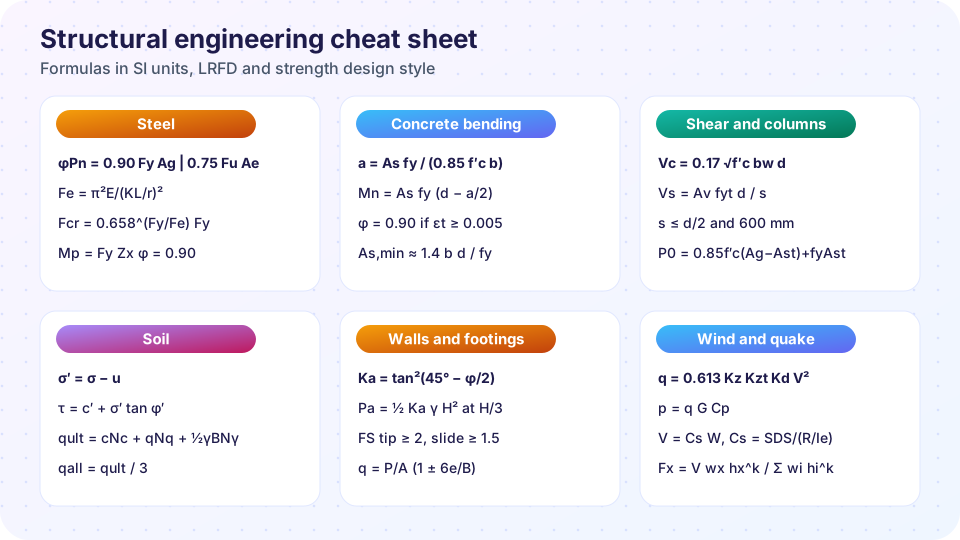
A one-page structural engineering cheat sheet: steel, reinforced concrete, soil, foundations, wind and seismic formulas with resistance factors and limits, plus a calculator.
When you are in the middle of a calculation you do not want a chapter, you want the formula. This page collects the key relations of chapters 5 to 8 in one picture and a set of tables. Use it to jog your memory, then go back to the lessons if a formula does not feel familiar. Remember that formulas come with conditions: a cheat sheet reminds you, it does not replace the code.
What you will learn
- Where to find every key formula at a glance.
- The resistance factors and limits that go with each formula.
- A fast way to compute the main checks with a small calculator.
Key terms
φ: resistance factor applied to nominal strength.
FS: factor of safety for soil and wall stability.
Ie, R: importance factor and response modification coefficient for seismic design.
G, Cp: gust effect factor and pressure coefficient for wind.
Steel (LRFD)
| Check | Formula | φ |
|---|---|---|
| Tension yield | Pn = Fy Ag |
0.90 |
| Tension rupture | Pn = Fu Ae, Ae = U An |
0.75 |
Column, inelastic (KL/r ≤ 4.71√(E/Fy)) |
Fcr = 0.658^(Fy/Fe) Fy |
0.90 |
| Column, elastic | Fcr = 0.877 Fe, Fe = π²E/(KL/r)² |
0.90 |
| Beam, compact, braced | Mn = Mp = Fy Zx |
0.90 |
| Beam shear | Vn = 0.6 Fy Aw |
1.00 |
| Bolt shear | Rn = Fnv Ab per plane |
0.75 |
| Fillet weld | Rn = 0.6 FEXX × 0.707 a per length |
0.75 |
Reinforced concrete (strength design)
| Check | Formula | Notes |
|---|---|---|
| Stress block | a = As fy/(0.85 f′c b), β1 = 0.85 for f′c ≤ 28 |
c = a/β1 |
| Moment | Mn = As fy (d − a/2) |
φ = 0.90 if εt ≥ 0.005 |
| Minimum steel | max(0.25√f′c/fy, 1.4/fy) b d |
|
| Shear | Vc = 0.17√f′c bw d, Vs = Av fyt d/s |
φ = 0.75, s ≤ d/2, 600 mm |
| Short column | P0 = 0.85f′c(Ag − Ast) + fy Ast |
tied 0.80, spiral 0.85; φ = 0.65 / 0.75 |
| One-way slab thickness | L/20, L/24, L/28, L/10 |
simply, one end, both ends, cantilever |
| Development length | ld ≈ fy/(1.7√f′c) db for db ≥ 22 mm |
simplified |
Soil and foundations
| Topic | Formula | Notes |
|---|---|---|
| Effective stress | σ′ = σ − u |
|
| Shear strength | τ = c′ + σ′ tan φ′ |
|
| Bearing capacity | qult = c Nc + q Nq + ½γB Nγ |
FS ≈ 3 |
| Factors | Nq = e^(π tan φ) tan²(45° + φ/2), Nc = (Nq − 1)cot φ, Nγ = 2(Nq + 1)tan φ |
|
| Footing pressure | q = (P/A)(1 ± 6e/B) |
e ≤ B/6 |
| Consolidation | Sc = Cc H/(1 + e0) log10((σ′0 + Δσ′)/σ′0) |
|
| Active pressure | Ka = tan²(45° − φ/2), Pa = ½ Ka γ H² |
at H/3 |
| Wall stability | overturning ≥ 2, sliding ≥ 1.5 | resultant in middle third |
Wind and earthquake
| Topic | Formula | Notes |
|---|---|---|
| Velocity pressure | q = 0.613 Kz Kzt Kd Ke V² |
N/m², V in m/s |
| Design pressure | p = q G Cp |
Cp about +0.8 / −0.5 |
| Period | Ta = Ct hn^x |
steel moment frame 0.0724, 0.8 |
| Seismic coefficient | Cs = SDS/(R/Ie) |
≤ SD1/(T R/Ie), ≥ 0.044 SDS Ie |
| Base shear | V = Cs W |
|
| Story force | Fx = V wx hx^k/Σ wi hi^k |
k = 1 to 2 |
Try it
Press Run (or Ctrl + Enter) to see the result here.
Program input · what you'd type while the program runs
Type the answers before you press Run, one per line. Each time the program reads a line (with input()), it gets the next line from this box.
Check your understanding
Quick check · 4 questions
of 4 answered You scored / 4 · perfect!
-
1. Which resistance factor goes with net-section rupture of a tension member?
Rupture is a brittle limit state and uses 0.75. -
2. The balance of the concrete stress block is described by
From C = T. -
3. At what height above the base does the active earth pressure resultant act on a wall?
A triangular pressure acts at one third of the height. -
4. V = Cs W with Cs = SDS/(R/Ie). If R is doubled, V
Cs is inversely proportional to R.
Summary
- Steel: yield, rupture,
Fcr,Mp, bolts and welds; concrete: stress block, shear, columns, slabs. - Soil: effective stress, bearing capacity, footing pressure, settlement, walls; lateral:
q,p,Cs,V,Fx. - Check conditions and units before trusting a formula, and always follow the governing code.
Next: Further study
Track your progress
Create a free account to tick off lessons and pick up where you left off on any device.
of Structural Engineering lessons completed