


















Lesson 28 of 47 · Reinforced Concrete
Chapter 6 overview: reinforced concrete
A map of reinforced concrete design: why steel bars and concrete work together, how beams crack, and what the strength design method checks in beams and columns.
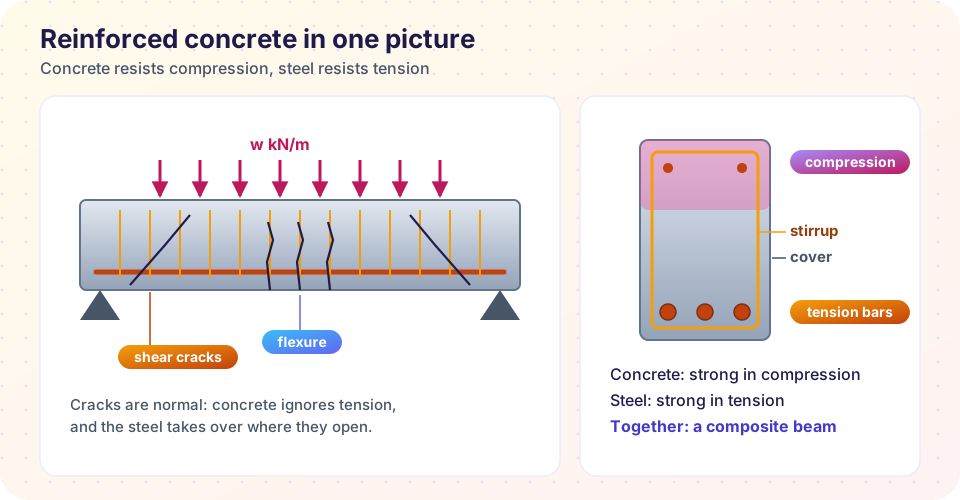
Concrete is the most widely used construction material on Earth. It is cheap, fireproof, moldable and made from local ingredients. Its weakness is simple: concrete is about ten times stronger in compression than in tension, and when it is stretched it cracks. Reinforced concrete solves this by placing steel bars exactly where tension will occur, and letting concrete do what it does well, carry compression and protect the steel.
What you will learn
- Why concrete and steel cooperate so well.
- The key material numbers:
f′c,Ec, the modulus of rupture and the steel grade. - Where beams crack in flexure and in shear, and what each kind of reinforcement does.
- What the strength design method checks, and what the next four lessons cover.
Key terms
f′c: the specified compressive strength of concrete, measured on cylinders at 28 days (in MPa).
Reinforcement: steel bars (rebar) or mesh embedded in concrete.
Cover: the concrete between the surface and the nearest bar, protecting steel from fire and corrosion.
Stirrup: a closed loop of small bar around the longitudinal bars, resisting shear.
Bond: the grip between concrete and the bar surface that transfers force.
Why the partnership works
Three physical facts make reinforced concrete work:
- Bond. Ribbed bars are gripped by the hardened concrete, so strain in the bar and in the surrounding concrete stay equal until slip occurs.
- Similar thermal expansion. Concrete and steel both expand by about
10 × 10⁻⁶per degree Celsius, so temperature changes do not tear them apart. - Protection. Fresh concrete is alkaline (pH around 13), which forms a protective film on steel. Cover keeps carbon dioxide and chlorides away so the steel does not rust.
The materials in numbers
Normal concrete has f′c between 20 and 40 MPa (higher grades up to 100 MPa and above are used in towers). Its tensile strength is only about 10 percent of that. The modulus of elasticity in the common design formula is
Ec ≈ 4700 √f′c (MPa)
so f′c = 30 MPa gives Ec ≈ 25,700 MPa, about an eighth of the steel's Es = 200,000 MPa. The stress at which tension cracks form is roughly the modulus of rupture fr = 0.62 √f′c, about 3.4 MPa for 30 MPa concrete. Reinforcing bars come in grades with yield strengths such as fy = 420 MPa (Grade 420, about 60 ksi) or 500 MPa, and standard sizes with diameters 10, 12, 16, 20, 25, 32 mm and so on.
Concrete has two more habits to respect. Creep is the slow increase of deformation under sustained load, and shrinkage is the shortening as water leaves. Both are one reason cracks appear even when the loads are modest and why deflections of beams grow over the years.
How a beam behaves
Under load, a simply supported beam bends and the bottom stretches. Where the tensile stress exceeds the concrete's tensile strength, vertical flexural cracks open at midspan, and the tension bars take over. Near the supports, the shear force is high and inclined cracks appear at about 45 degrees. A well designed beam shows many fine cracks rather than a few large ones, which means bars are well distributed.
The strength design method (called ultimate strength design in older books) assumes the section is cracked and treats concrete in tension as having no strength. It sets the factored load effect against a reduced strength, as steel design does:
Mu ≤ φMn Vu ≤ φVn Pu ≤ φPn
The next lessons build these checks in turn: flexure, shear and detailing, then columns and slabs.
How reinforced concrete works
Each material does what it does best
Where reinforcement goes
Try it
Press Run (or Ctrl + Enter) to see the result here.
Program input · what you'd type while the program runs
Type the answers before you press Run, one per line. Each time the program reads a line (with input()), it gets the next line from this box.
Press Run (or Ctrl + Enter) to see the result here.
Program input · what you'd type while the program runs
Type the answers before you press Run, one per line. Each time the program reads a line (with input()), it gets the next line from this box.
Check your understanding
Quick check · 4 questions
of 4 answered You scored / 4 · perfect!
-
1. Why is concrete reinforced with steel?
Concrete carries compression well but cracks in tension, so bars carry the tension. -
2. Which property of concrete and steel lets them move together as temperature changes?
Both expand about 10 × 10⁻⁶ per °C, so there is little thermal mismatch. -
3. Using Ec = 4700 √f′c, the modulus for f′c = 25 MPa is
4700 × 5 = 23,500 MPa. -
4. What does cover do?
Concrete cover keeps the steel safe and developed.
Summary
- Concrete takes compression, steel takes tension, bond and cover make the team work.
Ec ≈ 4700√f′c,fr ≈ 0.62√f′c,Es = 200 GPa,fy = 420or500 MPa.- Beams crack in flexure at midspan and in shear near supports; bars and stirrups cross the cracks.
- Strength design:
Mu ≤ φMn,Vu ≤ φVn,Pu ≤ φPn.
Next: Beam flexure
Track your progress
Create a free account to tick off lessons and pick up where you left off on any device.
of Structural Engineering lessons completed