


















Lesson 2 of 47 · Getting Started
What structural engineers do
Meet the structural engineering design cycle, the idea of limit states and safety margins, the role of building codes, and a code example of iterating a beam size.
A structural engineer answers one question over and over: will this thing carry what we ask of it, for as long as we ask, without costing more than it should? The answer is never a single calculation. It is a loop of choices, estimates and checks that starts with a sketch and ends with drawings a builder can follow.
This lesson shows you the loop, the vocabulary of safety (limit states, factors, codes) and the people you work with. You will also run a tiny design loop yourself.
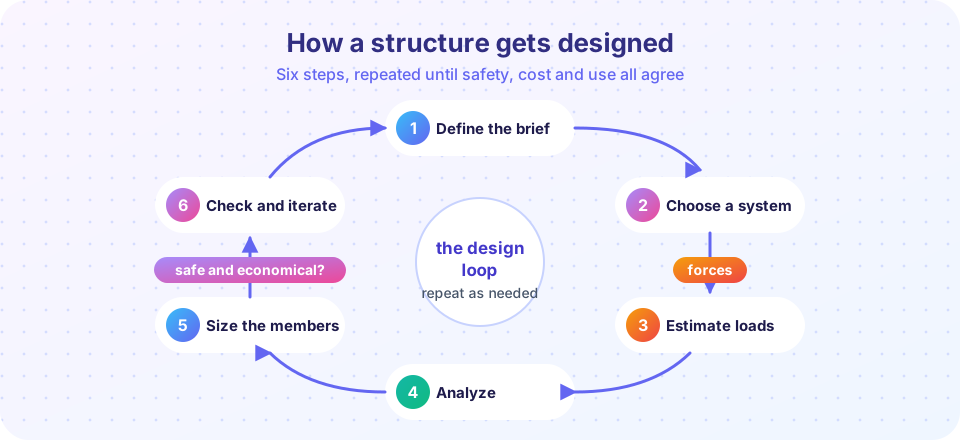
What you will learn
- The six steps of a structural design and why they repeat.
- What a limit state is, and the difference between strength and serviceability.
- Why designs carry safety margins and how codes supply them.
- Who else is on a project and what the structural engineer owns.
Key terms
Limit state: a condition beyond which a structure no longer does its job. Ultimate limit state: collapse or loss of stability. Serviceability limit state: too much deflection, vibration or cracking, though nothing breaks. Demand: the force or moment the structure must resist. Capacity: what the member can resist. Code: the legally adopted rulebook of loads, materials and checks.
The six steps
1. Define the brief. What is the building for, how big is it, where is it, what budget and schedule? A school gym and a warehouse can have the same floor area and need very different structures. The site matters: soil, wind, snow and seismic risk all vary by place.
2. Choose a structural system. Beams and columns? A truss roof? Concrete walls? A cable-stayed deck? The engineer works with the architect to sketch a system that carries load by an efficient, buildable path. Chapter 2 surveys the options.
3. Estimate the loads. Weight of the structure (dead load), people and contents (live load), wind, snow, earthquake and temperature. Standards give minimum values, but the engineer decides which apply and how they combine.
4. Analyze. Compute reactions, internal forces and deflections. For simple structures this is statics; for complex ones it is matrix methods or finite-element software. Chapters 3 and 4 cover the methods.
5. Size the members. Choose a steel section, a concrete depth and bar layout, a footing width. Chapters 5 to 7 are about this step.
6. Check and iterate. Test every member against every limit state. Few designs pass on the first try. A beam that is strong enough may sag too much, so you deepen it, and since a heavier beam adds load, you reanalyze. The loop closes.
At the end, the engineer produces drawings and calculations that are checked by a colleague and reviewed by an authority. In most countries the responsible engineer must be professionally licensed, and signs the work.
Limit states: what "fails" means
Failure is more than collapse. Engineers split it into two families.
| Family | Question | Example |
|---|---|---|
| Ultimate limit state (strength, stability) | Could it collapse or become unstable? | A beam yields, a column buckles, a footing slides |
| Serviceability limit state | Does it stay usable and comfortable? | A floor feels bouncy, a window cracks, a ceiling sags |
The second family is not cosmetic. A floor that does not break but vibrates every time someone walks across it makes a building unusable. Long-span floors and slender footbridges are often governed by serviceability, not strength.
Why we need safety margins
Nothing about a real structure is known exactly. The steel might be a little weaker than the specification. The concrete might be poured on a cold day. The actual crowd on a stadium might be larger than the model assumed. The builder might place a bar 10 mm off. Safety margins cover these unknowns.
Modern codes apply the margin in two places at once. They increase the loads (load factors, for example "1.2 times the dead load") and reduce the resistance (resistance factors, for example "0.9 times the nominal capacity"). This approach is called load and resistance factor design in North America and limit state design in Europe, where the Eurocodes are the standard. An older method, allowable stress design, instead divides the strength by a single factor of safety. You will meet both, and Chapter 2 introduces the load side.
A margin is not an insult to the engineer; it is an admission of uncertainty. A bridge designed with zero margin would be unbuildable, because no construction process is perfect.
Who you work with
- Architect: shapes the building. Often the structural engineer's earliest partner.
- Geotechnical engineer: investigates the soil and recommends foundation types and bearing capacity (Chapter 7).
- Mechanical, electrical and plumbing engineers: need holes through beams and space above ceilings, which the structure must allow for.
- Contractor and fabricator: turn drawings into steel and concrete and tell you what is buildable.
- Building authority: checks the design against the code.
Good structural engineering is half calculation and half communication. A perfect design that cannot be built, or that blocks the ventilation ducts, is not perfect.
Lessons from failures
Engineering is a learning profession. Several famous failures changed the rules. The Tacoma Narrows suspension bridge in the US twisted itself apart in a moderate wind in 1940 and taught designers about aerodynamic flutter. The 1981 Hyatt Regency walkway collapse in Kansas City followed a change to a hanger connection detail that doubled the load on a critical connection, a lesson in how a small design change must be rechecked. The 1968 Ronan Point partial collapse in London led to rules about progressive collapse (one failed element should not bring down a whole corner). You do not need the details now. The point is that most failures come from errors of judgment, communication or detail, not from a wrong formula.
A tiny design loop
Here is a complete design cycle in miniature. We pick a timber beam, 100 mm wide, spanning 4 m under a 5 kN/m uniform load (including its own weight). We try deeper sections until two checks pass: bending stress below 10 MPa and deflection below span/300.
Press Run (or Ctrl + Enter) to see the result here.
Program input · what you'd type while the program runs
Type the answers before you press Run, one per line. Each time the program reads a line (with input()), it gets the next line from this box.
Notice that the strength check already passes at about 250 mm, yet the beam is not acceptable until it is slightly deeper because deflection governs. That is the design loop in action: a quick estimate (step 4) led to a check (step 6) that sent you back to resize (step 5).
Press Run (or Ctrl + Enter) to see the result here.
Program input · what you'd type while the program runs
Type the answers before you press Run, one per line. Each time the program reads a line (with input()), it gets the next line from this box.
A ratio below 1 passes; above 1 fails. Engineers report the largest ratio of each member to see which check controls.
Common misconceptions
"Structural engineering is just applying formulas." Formulas are the last step. Most of the skill is choosing the load path, spotting what could go wrong and communicating with the team.
"A factor of safety means the structure will carry twice the load." Not exactly. Margins cover uncertainty in loads and materials, and different codes apply them differently. A design that just meets the code is expected to survive normal use and rare events, not an arbitrary overload.
Check your understanding
Quick check · 5 questions
of 5 answered You scored / 5 · perfect!
-
1. Which is a serviceability limit state?
Serviceability concerns usability and comfort. Buckling and sliding are ultimate limit states. -
2. Load factors in modern codes are used to
Factored loads are larger than service loads, giving a margin against loads exceeding the estimate. -
3. In the beam example, why did the depth have to increase beyond what strength alone needed?
Deflection decreases with the cube of depth, and the limit was only met at a larger depth than the stress check needed. -
4. What does a utilization ratio of 0.8 mean?
Utilization is demand divided by capacity; 0.8 means 80 percent of capacity is used for that check. -
5. Who recommends the bearing capacity of the soil?
Soil investigation is the geotechnical engineer's responsibility.
Summary
- Design is a loop: brief, system, loads, analysis, sizing, checking, then back again.
- Limit states split failure into strength and stability on one side and serviceability on the other.
- Codes supply load factors, resistance factors and minimum loads to cover uncertainty.
- Structural engineers work in a team and sign responsibility for the safety of the structure.
- Many failures come from detail changes and poor communication, which is why checking and review matter.
Next: Forces and equilibrium
Track your progress
Create a free account to tick off lessons and pick up where you left off on any device.
of Structural Engineering lessons completed