


















Lesson 13 of 47 · Analysis of Statically Determinate Structures
Trusses: method of joints and method of sections
Solve a truss step by step: assumptions, tension and compression, the method of joints, zero-force members, the method of sections, with a worked example and a runnable solver.
A truss is a structure built from straight bars joined at their ends so that every bar is either pulled or pushed along its length and never bent. That single property makes trusses light and efficient, and it makes them wonderfully easy to analyze: each member has exactly one unknown, its axial force. This lesson shows two ways to find those forces and checks them against a computer solution.
What you will learn
- The assumptions that make truss analysis possible.
- How to find member forces with the method of joints.
- How to spot zero-force members.
- When and how to use the method of sections.
Key terms
Tension (T): the member is being stretched; it pulls on its joints. Compression (C): the member is being squashed; it pushes on its joints. Joint (node): where members meet. Zero-force member: a member that carries no load under the current loading. Method of sections: cut through a truss and balance one part, usually using a moment equation.
The assumptions
Truss theory works under four assumptions:
- Members are straight and joined at frictionless pins (real bolted or welded joints are stiffer, but the forces come out close).
- Loads and reactions act only at joints.
- The weight of members is negligible, or has been lumped at the joints.
- The truss is a stable, determinate arrangement of triangles (m + r = 2j).
Under these assumptions each member is a two-force member: it has force at only two points, so the two forces must be equal, opposite and along the line joining them. That is why every member carries a pure axial force. Whenever you apply a load in the middle of a member the assumption breaks, and the member must be treated as a beam.
Sign convention
Call a force positive when the member is in tension and negative when in compression. Always draw an unknown member force as pulling away from the joint (tension). If the answer comes out negative, the member is in compression. This avoids guessing and keeps the arithmetic consistent.
Method of joints
Take each joint as a free body. A pin-jointed joint is a point, so moments are automatically balanced and you only have ΣFx = 0 and ΣFy = 0. Start at a joint with at most two unknown member forces, and move along the truss.
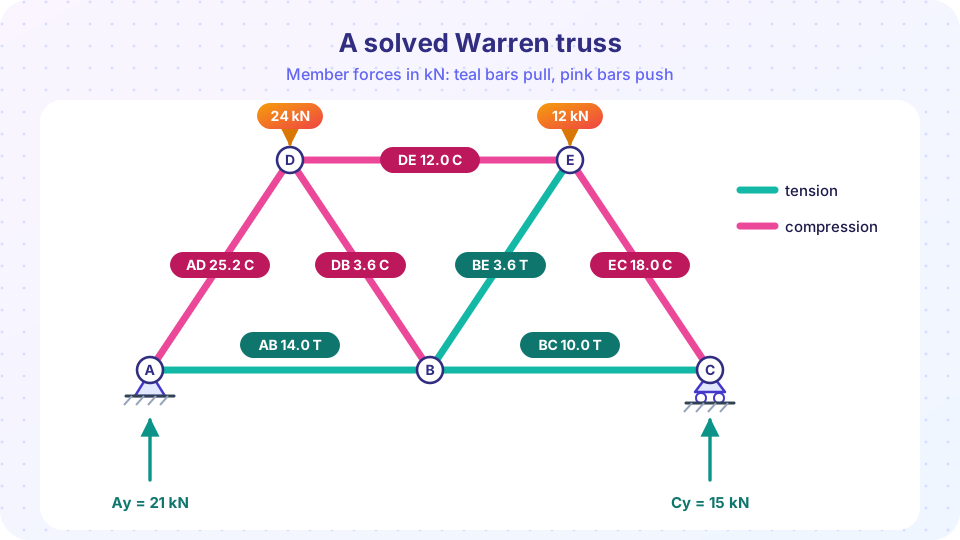
Step 0: reactions. For the truss in the figure, with 24 kN at D and 12 kN at E, take moments about A: Cy × 8 = 24 × 2 + 12 × 6 = 120, so Cy = 15 kN, and Ay = 36 − 15 = 21 kN. There is no horizontal load, so Ax = 0.
Member AD runs from A (0, 0) to D (2, 3): length √13 = 3.606 m, sine = 3/3.606 = 0.832, cosine = 2/3.606 = 0.555.
Joint A (unknowns AB and AD):
- ΣFy: 21 + 0.832 F_AD = 0, so F_AD = −25.24 kN (compression).
- ΣFx: F_AB + 0.555 × (−25.24) = 0, so F_AB = +14.0 kN (tension).
Joint D (unknowns DB and DE; AD is now known):
- The compression in AD pushes on D with a vertical component of 21 kN upward and a horizontal component of 14 kN to the right.
- ΣFy: 21 − 0.832 F_DB − 24 = 0, so F_DB = −3.61 kN (compression).
- ΣFx: 14 + 0.555 × (−3.61) + F_DE = 0, so F_DE = −12.0 kN (compression).
Joint C (unknowns BC and EC): ΣFy gives F_EC = −Cy / 0.832 = −18.03 kN (compression), and ΣFx gives F_BC = 0.555 × 18.03 = +10.0 kN (tension).
Joint B is the check: its remaining unknown F_BE follows from ΣFy: 0.832 (F_BE + F_DB) = 0, so F_BE = +3.61 kN (tension). ΣFx at B must close to zero: −14 + 10 − 0.555 × (−3.61) + 0.555 × 3.61 = −14 + 10 + 4 = 0 ✓. The leftover joint equation is the check on all the arithmetic.
Press Run (or Ctrl + Enter) to see the result here.
Program input · what you'd type while the program runs
Type the answers before you press Run, one per line. Each time the program reads a line (with input()), it gets the next line from this box.
The solver sets up all 2j joint equations at once and solves them together; the method of joints is the same thing done one joint at a time. Change a load or a node position and re-run. If you remove a member and the matrix becomes singular, the truss is a mechanism.
Zero-force members
Some members carry nothing under a particular load, and spotting them saves work. Two rules for an unloaded joint with no support:
- If only two non-collinear members meet at the joint, both are zero-force members.
- If three members meet and two are collinear, the third (non-collinear) member is a zero-force member.
Zero-force members are not useless: they brace compression members against buckling and carry load if the loading changes.
Method of sections
If you need the force in just one or two members in the middle of a large truss, solving joint by joint wastes effort. Cut the truss with an imaginary line through at most three members whose forces you do not know, draw the free-body diagram of one side, and apply the three equilibrium equations. The smart choice is to take moments about the point where two of the cut members meet, so that only one unknown remains.
Example. Cut through DE, DB and AB, and keep the left part (A and D). Take moments about B, where DB and AB meet. Counter-clockwise positive, with DE acting horizontally at D (3 m above B and 2 m to its left):
Ay (4 m, clockwise) :   −21 × 4 = −84
Load at D (2 m, ccw):   +24 × 2 = +48
DE at height 3 m:       −3 × F_DE
−84 + 48 − 3 F_DE = 0   →   F_DE = −12.0 kN   (compression)
That matches the method of joints with one equation.
Press Run (or Ctrl + Enter) to see the result here.
Program input · what you'd type while the program runs
Type the answers before you press Run, one per line. Each time the program reads a line (with input()), it gets the next line from this box.
Live truss: change the loads
Try loads of 24 and 12 to reproduce the lesson, then set the load at D to zero. Member DB flips between compression and tension depending on which load is larger, and when the two loads are equal it carries nothing.
Common misconceptions
"Tension members are always thinner than compression members." Tension members can be slender because they do not buckle. Compression members must be stocky or braced, which is why top chords are usually heavier.
"A zero-force member can be removed." Only if the loading never changes and nothing else depends on it. Zero-force members often provide stability and bracing.
"Forces in a truss depend on member size." In a determinate truss they do not; they depend only on geometry and loads. Size matters for deflection and for the stress.
Check your understanding
Quick check · 5 questions
of 5 answered You scored / 5 · perfect!
-
1. In a pin-jointed truss each member carries
Pins cannot transmit moment and loads act at joints, so members are two-force members in pure tension or compression. -
2. At a joint, you assume an unknown member force pulls away from the joint. A result of −15 kN means
Positive means tension in this convention; a negative result means the member pushes on the joint, which is compression. -
3. How many equilibrium equations does each joint of a plane truss provide?
A joint is a point, so ΣFx = 0 and ΣFy = 0 are the only independent equations. -
4. When is the method of sections the better choice?
A section lets you reach a single member with one moment equation, without solving the joints before it. -
5. In the worked truss, which member is in tension, apart from the bottom chord?
BE carries +3.61 kN (tension). AD, DB, DE and EC are in compression.
Summary
- Trusses carry load by axial force in straight two-force members; loads act at joints.
- Method of joints: ΣFx = 0 and ΣFy = 0 at each joint, starting where only two unknowns remain; assume tension, and a negative answer means compression.
- The last joint equations give a check on the arithmetic.
- Zero-force members can be spotted from joint geometry.
- Method of sections: cut through up to three unknown members and take moments about where two of them meet.
Track your progress
Create a free account to tick off lessons and pick up where you left off on any device.
of Structural Engineering lessons completed