


















Lesson 35 of 47 · Foundations and Soils
Footings, settlement and retaining walls
Size spread footings, check eccentricity and the kern, estimate immediate and consolidation settlement, and check retaining walls against overturning, sliding and bearing.
Bearing capacity tells you the soil will not collapse. It does not tell you how far the building will sink, or whether a wall holding back a bank will slide away. This lesson turns to the everyday work of foundation design: sizing footings so the soil pressure is acceptable, estimating settlement and checking a retaining wall for the three ways it can fail.
What you will learn
- How to size a footing from a service load and an allowable pressure.
- Eccentricity, the middle third and the pressure formula.
- How to estimate immediate and consolidation settlement.
- The overturning, sliding and bearing checks for a retaining wall.
Key terms
Allowable bearing pressure qall: the pressure that gives acceptable safety and settlement.
Kern (middle third): the central part of a footing within which the load resultant keeps the whole base in compression.
Consolidation: slow compression of saturated clay as pore water drains.
Rankine coefficient Ka: ratio of horizontal to vertical effective stress in the active state.
Differential settlement: unequal settlement between neighboring footings.
Sizing a spread footing
For a first size, use service (unfactored) loads and the allowable pressure:
A_required = P / qall (square footing: B = √A)
For P = 800 kN and qall = 200 kPa: A = 4 m², so B = 2.0 m. The footing's own weight and the soil above it are often included in the load or deducted from qall as a net pressure. After deciding on plan size, the thickness and reinforcement are designed as a reinforced concrete member using factored loads (the earlier chapter): it bends like a cantilever projecting from the column face, and it must resist one-way shear at d from the column and punching shear at d/2 around the column.
Eccentric loads
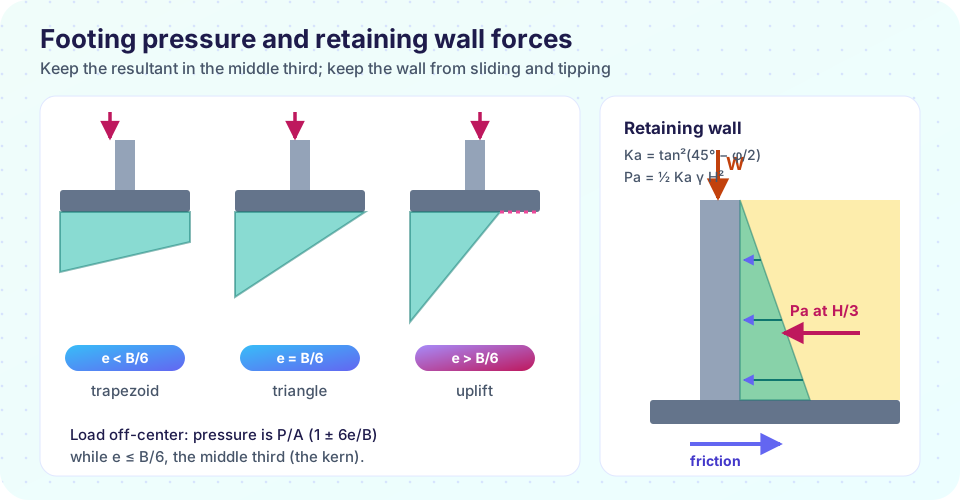
If a column also carries a moment M, the resultant is off-center by e = M/P. For a rectangular footing of length B in the direction of eccentricity, the soil pressure at the two edges is
q = (P / A) (1 ± 6e / B)
When e ≤ B/6 the load lies in the middle third and the base is wholly in compression, shaped as a trapezoid (the left and center of the picture). At e = B/6 the pressure at one edge reaches zero. Beyond B/6 the footing would lift off, and the contact area is reduced so that the pressure triangle is 3(B/2 − e) long and its peak is 2P / (3 (B/2 − e) × width). Engineers avoid this, and resist wind and earthquake overturning with wider footings or tie beams.
Settlement
Immediate settlement
On sands and in the first moments of loading on clays, the soil compresses elastically:
Si = q B (1 − ν²) Iw / Es
where q is the net pressure, B the width, ν Poisson's ratio, Es the soil modulus and Iw an influence factor depending on shape and rigidity (about 0.82 for a rigid square footing). With q = 200 kPa, B = 2 m, Es = 20 MPa, ν = 0.3: Si = 200 × 2 × 0.91 × 0.82 / 20,000 = 0.015 m = 15 mm.
Consolidation settlement
For a saturated clay layer of thickness H, the final settlement from drainage of pore water is
Sc = Cc H / (1 + e0) × log10( (σ′0 + Δσ′) / σ′0 )
where Cc is the compression index from an oedometer test, e0 the initial void ratio, σ′0 the initial effective stress at mid-layer and Δσ′ the added stress from the building (spread out with depth, about the 2:1 rule). For Cc = 0.30, H = 3 m, e0 = 0.90, σ′0 = 60 kPa, Δσ′ = 40 kPa:
Sc = 0.30 × 3 / 1.9 × log10(100/60) = 0.105 m ≈ 105 mm
Terzaghi's one-dimensional theory also predicts the time: it depends on the drainage path (the layer thickness squared) and on the coefficient of consolidation cv, so a thick clay layer can keep settling for years.
How much is too much?
Tolerable settlement depends on the structure. Total settlement of 25 mm is a common limit for isolated footings on sand and 50 mm for rafts. More important is the angular distortion between neighbors, the differential settlement divided by the distance: cracking in panel walls begins near 1/300, and structural damage near 1/150 (Skempton and MacDonald's observations in 1956).
Retaining walls
A retaining wall holds back soil. The soil pushes the wall with an earth pressure that grows with depth. In the active state (the wall moves slightly away from the soil) the Rankine coefficient for a level, cohesionless backfill is
Ka = tan²(45° − φ/2) = (1 − sin φ)/(1 + sin φ)
For φ = 30°: Ka = 1/3. The pressure at depth z is σh = Ka γ z, a triangle, and the resultant over a height H is
Pa = ½ Ka γ H² acting at H/3 above the base
For a 4 m wall with γ = 18 kN/m³: Pa = 0.5 × (1/3) × 18 × 16 = 48 kN/m, acting 1.33 m above the base, giving an overturning moment of 64 kN·m per metre of wall.
The checks
- Overturning:
FS = ΣM resisting / ΣM overturning ≥ 2, about the toe. - Sliding:
FS = μ ΣV / Pa ≥ 1.5, withμ = tan δof the base (abouttan(2φ/3)for concrete on soil). - Bearing: the resultant should lie in the middle third of the base, and the toe pressure
qmax = (ΣV/B)(1 + 6e/B)must not exceedqall. - Drainage: water behind a wall can double the load. Provide a drain, weep holes and free-draining backfill.
Example
A gravity wall (4 m high) weighs 150 kN/m acting 1.5 m from the toe. Overturning: Mr = 150 × 1.5 = 225 kN·m against Mo = 64: FS = 3.5. Sliding with μ = tan 20° = 0.364: 0.364 × 150 / 48 = 1.14 < 1.5. The wall tips safely but slides. Remedies: a wider base with soil over the heel (adding vertical load), a shear key into the soil, or a sloping base. Adding a 60 kN/m heel soil weight at a 2.0 m arm gives ΣV = 210 kN/m, FS(sliding) = 1.59, and the resultant lies within the middle third.
Common misconceptions
"If bearing is fine, settlement is fine." A clay can have a high safety factor against failure and still settle 100 mm over ten years.
"Active pressure is the maximum possible." Active pressure is the minimum, reached after a small movement. A stiff wall that cannot move feels the at-rest pressure, K0 ≈ 1 − sin φ, which is larger.
"Water behind the wall is a detail." Poor drainage is the leading cause of retaining wall failures.
Try it
Press Run (or Ctrl + Enter) to see the result here.
Program input · what you'd type while the program runs
Type the answers before you press Run, one per line. Each time the program reads a line (with input()), it gets the next line from this box.
Press Run (or Ctrl + Enter) to see the result here.
Program input · what you'd type while the program runs
Type the answers before you press Run, one per line. Each time the program reads a line (with input()), it gets the next line from this box.
Check your understanding
Quick check · 5 questions
of 5 answered You scored / 5 · perfect!
-
1. A footing carries P = 600 kN at qall = 150 kPa. What square width is needed?
A = 600/150 = 4 m², B = 2 m. -
2. The middle third rule says the load resultant should lie within
For e ≤ B/6 the whole base is in compression. -
3. Active earth pressure for φ = 30° gives Ka of
Ka = (1 − sin 30°)/(1 + sin 30°) = 0.5/1.5 = 1/3. -
4. Where does the Rankine resultant Pa act on a wall of height H?
The triangular pressure has its centroid at one third of the height. -
5. Which settlement is slow and happens in saturated clay as water drains?
Consolidation needs pore water to leave the clay.
Summary
- Size footings with
A = P/qall, then design the concrete for flexure, one-way shear and punching shear. - Keep load in the middle third; pressure is
(P/A)(1 ± 6e/B). - Settlement has an immediate part and a consolidation part; differential settlement matters most.
- Retaining walls:
Ka,Pa = ½ Ka γ H²atH/3; check overturning (≥ 2), sliding (≥ 1.5), bearing and drainage.
Next: Chapter 7 review
Track your progress
Create a free account to tick off lessons and pick up where you left off on any device.
of Structural Engineering lessons completed