


















Lesson 5 of 47 · Getting Started
Chapter 1 review: getting started
Review the foundations of structural engineering: the design loop, equilibrium, moments, supports and reactions, with a recap table, practice code and a ten-question quiz.
You now have the foundation that every later chapter stands on: what structural engineers do, how to isolate a body and write its equilibrium equations, and how supports turn a real structure into a solvable model. This review ties the four lessons together, gives you two practice tools and ends with a quiz that mixes everything.
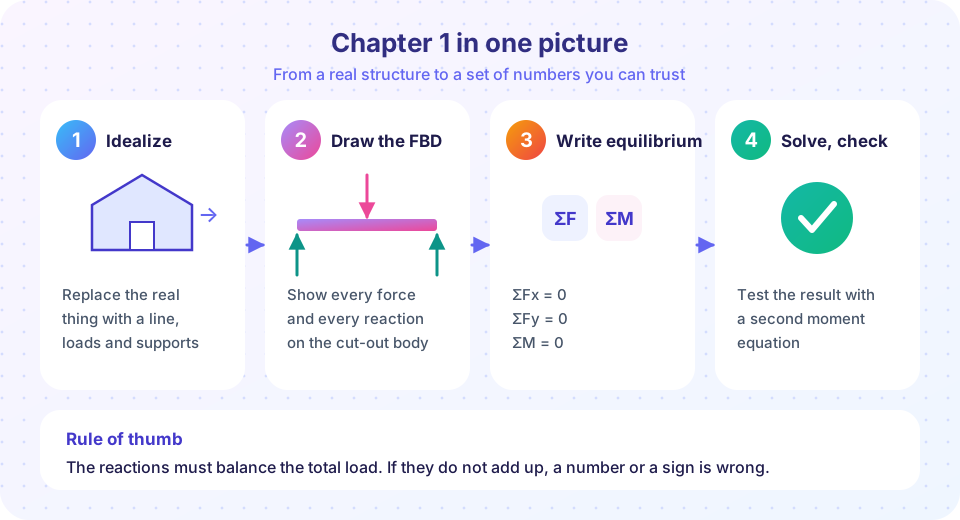
What you will learn
- A single checklist that works for any statically determinate reaction problem.
- Which mistakes cost the most marks and the most safety, and how to catch them.
- Whether you are ready for Chapter 2.
Chapter in one table
| Lesson | Big idea | Key formula or rule |
|---|---|---|
| What structural engineers do | Design is a loop; failure means strength or serviceability | Utilization = demand / capacity, must be ≤ 1 |
| Forces, moments and equilibrium | A body at rest balances forces and moments | ΣFx = 0, ΣFy = 0, ΣM = 0; M = F × d |
| Supports, reactions and idealization | Supports supply a reaction for each blocked motion | Roller 1, pin 2, fixed 3; r = 3 is determinate |
| Course map | Loads travel down to the soil | Strength, stiffness, stability |
The reaction checklist
- Sketch the structure and idealize supports and loads.
- Replace distributed loads with resultants (area and centroid).
- Draw the free-body diagram with unknown reactions.
- Count the unknowns. More than three in a plane means you need Chapter 4.
- Take moments about a support to remove unknowns.
- Apply ΣFx and ΣFy.
- Check with a moment equation about a different point.
- Sanity check: reactions near a heavy load are bigger; the total vertical reaction equals the total vertical load.
Try it
Press Run (or Ctrl + Enter) to see the result here.
Program input · what you'd type while the program runs
Type the answers before you press Run, one per line. Each time the program reads a line (with input()), it gets the next line from this box.
Change the loads and see how the reactions move. If the check is not zero, the problem is in your set-up, not the arithmetic.
Press Run (or Ctrl + Enter) to see the result here.
Program input · what you'd type while the program runs
Type the answers before you press Run, one per line. Each time the program reads a line (with input()), it gets the next line from this box.
Convert to a consistent set (N and mm, or kN and m) at the start and write the units on every line.
Common misconceptions
"If my equations are solved, the answer is right." Only if the model is right: the free-body diagram, the support types and the sign of each term. Always run the independent check.
"Statics works for all structures." Only when the unknowns are no more than the equations. Chapter 4 deals with the rest.
Check your understanding
Quick check · 10 questions
of 10 answered You scored / 10 · perfect!
-
1. A free-body diagram should show
The FBD cuts the body free and shows all external forces, including support reactions. -
2. Which limit state is a floor that bounces uncomfortably?
The floor has not failed but is unfit for comfortable use, a serviceability issue. -
3. A 100 N force acts 0.3 m from a pivot, perpendicular to the lever. What is the moment?
M = F × d = 100 × 0.3 = 30 N·m. -
4. A beam with a pin and a roller has loads totalling 90 kN. What must Ay + By equal?
ΣFy = 0 requires the vertical reactions to equal the total vertical load. -
5. A cantilever has what reactions at its fixed end?
A fixed support prevents translation and rotation, so it supplies two forces and a moment. -
6. The number of reactions on a stable structure is 5, in a plane. What is the degree of indeterminacy?
r − 3 = 2. -
7. Why can a pin at one end and a roller at the other let a bridge expand freely?
The roller gives way to length changes, so temperature does not create large axial forces. -
8. A distributed triangular load of peak 6 kN/m over 4 m has a resultant of
R = ½ × 6 × 4 = 12 kN, at one third of the length from the peak end. -
9. What is the best use of a second moment equation about the other support?
Any independent equation not used in the solution is an excellent check on the result. -
10. Which step comes first in a reaction problem?
Everything else depends on the diagram, so draw it first.
Summary
- Design is a loop of brief, system, loads, analysis, sizing and checking, judged against strength and serviceability limit states.
- Equilibrium gives three equations in two dimensions; moments about a support remove unknowns.
- Supports supply a reaction for each blocked motion; r compared with 3 classifies the structure.
- Always check with a second equation and keep units consistent.
Track your progress
Create a free account to tick off lessons and pick up where you left off on any device.
of Structural Engineering lessons completed