


















Lesson 26 of 47 · Steel Design
Connections: bolts, welds and how they fail
Learn how bolted and welded steel connections are designed: bolt shear and bearing, slip-critical joints, fillet weld throat and strength, with worked examples.
A structure is only as good as its connections. Many famous failures began at a joint, not at a member, because joints concentrate force in a small place, and they are often built in the field under imperfect conditions. This lesson covers the two connection methods used in nearly every steel building: bolts and welds.
What you will learn
- The three limit states of a bolt in a bearing connection.
- When a joint must be slip-critical rather than bearing type.
- How a fillet weld carries load and how to compute its strength per unit length.
- Basic detailing rules: spacing, edge distance and weld length.
Key terms
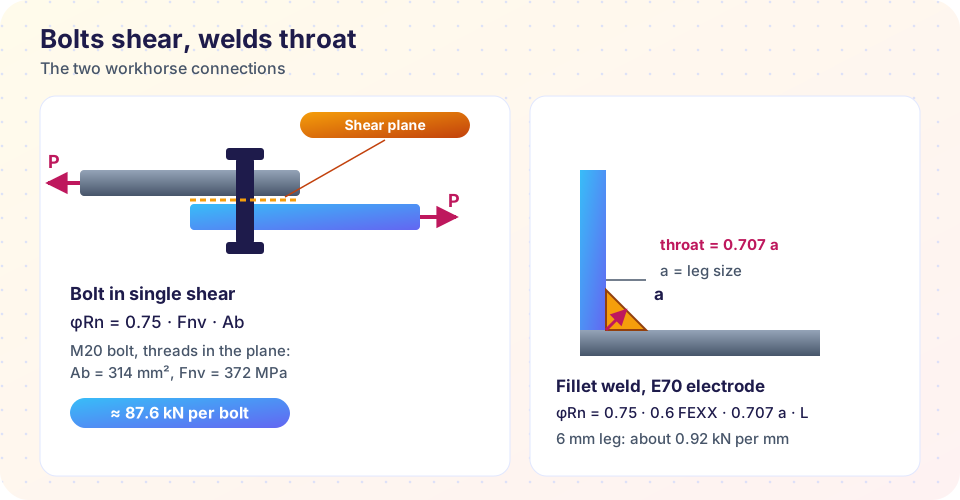
Shear plane: the interface between plates where a bolt is cut in shear.
Bearing: the bolt pushing on the wall of its hole in the plate.
Slip-critical joint: a joint with pretensioned bolts that resist load by friction, so the plates never slip.
Fillet weld: a triangular weld deposited in the corner between two surfaces.
Throat: the shortest distance from the weld root to its face; 0.707 × leg for an equal-leg weld.
Bolted connections
Structural bolts are high-strength: the two common grades are ASTM A325 (similar to ISO class 8.8) and A490 (similar to 10.9). They are used with hardened washers and nuts. There are two ways to use them.
Bearing-type joints let the plates slip slightly into bearing against the bolts. The force is carried by shear in the bolt and bearing on the plate. The bolts need only be snug-tight in many cases.
Slip-critical joints use bolts tightened to a specified pretension, so the clamping force gives a friction force that keeps the plates from sliding. These are used where slip would be harmful: vibration, load reversal or large holes.
Bolt shear
The nominal shear strength is Rn = Fnv × Ab per shear plane. For A325 bolts with the threads in the shear plane, Fnv = 372 MPa; with threads excluded from the plane it is 469 MPa. The resistance factor is φ = 0.75. For an M20 bolt (Ab = 314 mm²) in single shear, threads included:
φRn = 0.75 × 372 × 314 = 87,600 N ≈ 87.6 kN
A double-shear bolt (plate on each side of a central plate) has two shear planes and twice the strength.
Bearing and tear-out
The plate can fail where the bolt pushes on the hole wall. When deformation around the hole is a concern the strength is
φRn = 0.75 × 2.4 × d × t × Fu
for each bolt, with an upper limit set by the edge distance (tear-out). For a 12 mm plate, Fu = 450 MPa and a 20 mm bolt: 0.75 × 2.4 × 20 × 12 × 450 = 194 kN, well above the 87.6 kN bolt-shear value, so shear governs here. With thin plates the bearing check becomes critical.
Worked example
A tension splice must carry Pu = 300 kN, and each bolt provides 87.6 kN. The number of bolts needed is 300 / 87.6 = 3.4, so use 4. Then check each plate for tension yield and rupture at the bolt line (previous lesson), block shear, and bearing.
Spacing and edge distance
Bolts need room. Typical rules: center-to-center spacing at least 2⅔ d (3d preferred), and an edge distance of roughly 1.25 to 1.75 d depending on how the edge was cut. Bolts too close together tear out the steel between them, and bolts too close to an edge push out the end of the plate. Codes also set maximum values to prevent corrosion and plate separation.
Welded connections
Welding fuses the parts together with deposited metal, giving a continuous, compact joint with no holes to weaken the member. It requires skilled labor, controlled conditions and inspection, so many shops weld while the field bolts.
Fillet welds
The fillet weld is the workhorse. It looks like a small triangle in the corner of two plates. Experiments show that the weld usually fails by shear along the plane through its throat, where the metal is thinnest:
throat = 0.707 × a        (equal legs of size a)
Rn per unit length = 0.6 × FEXX × 0.707 × a
φ = 0.75
FEXX is the strength classification of the electrode, 482 MPa for an E70 electrode (70 ksi). For a 6 mm leg:
φRn = 0.75 × 0.6 × 482 × 0.707 × 6 = 920 N per mm of weld
So a load of 150 kN needs about 150,000 / 920 = 163 mm of weld, say two lines of 90 mm. Compare this with the strength of the plate being joined: the weld should not be able to carry more than the base metal, so the leg size is usually limited to the plate thickness (or slightly less) and a minimum size depends on the thickness of the thicker part to avoid brittle cooling cracks.
Groove welds
Where the weld has to be as strong as the plate, a complete-joint-penetration groove weld fills a prepared joint, and its strength is the strength of the base metal. They are more expensive and are used at critical locations, such as column splices and beam-to-column moment connections.
Detailing welds
Welds loaded off-center, or combining end and side welds, need an eccentricity check. End returns at corners prevent stress concentrations. Avoid mixing bolts and welds on the same line of force unless the design says how they share the load (welds are much stiffer than bolts in bearing).
Common misconceptions
"Bigger welds are always better." Weld volume grows with the square of the leg, and heat builds up. Oversize welds can distort or crack the plates and are wasteful.
"A fillet weld fails along its leg." The critical plane is the throat, which is 70 percent of the leg.
"A snug-tight bolt is the same as a pretensioned bolt." Only the pretensioned bolt of a slip-critical joint gives friction resistance; a snug bolt is for bearing joints.
Try it
Press Run (or Ctrl + Enter) to see the result here.
Program input · what you'd type while the program runs
Type the answers before you press Run, one per line. Each time the program reads a line (with input()), it gets the next line from this box.
Check your understanding
Quick check · 4 questions
of 4 answered You scored / 4 · perfect!
-
1. In a bearing-type bolted joint, force is carried by
The plates slip into bearing, so the bolt shears and the plate presses on the bolt. -
2. What is the throat of an equal-leg fillet weld with a 10 mm leg?
0.707 × 10 = 7.07 mm. -
3. Why are slip-critical joints used?
Pretension gives friction, so the plates do not slide. -
4. The number of bolts to carry 250 kN with bolts of 87.6 kN each is
250 / 87.6 = 2.85, so use 3 bolts (then check the plates).
Summary
- Bolt shear
φRn = 0.75 Fnv Abper shear plane; check bearing and tear-out of the plate too. - Slip-critical joints use pretensioned bolts and friction; bearing joints allow small slip.
- Fillet weld strength comes from the throat:
0.75 × 0.6 FEXX × 0.707 aper unit length. - Respect spacing, edge distances, minimum and maximum weld sizes.
Next: Chapter 5 review
Track your progress
Create a free account to tick off lessons and pick up where you left off on any device.
of Structural Engineering lessons completed