


















Lesson 10 of 47 · Loads and Structural Systems
Structural systems: beams, trusses, frames, arches and cables
Compare the main structural systems, how each carries load through bending, tension or compression, the lateral systems for wind and earthquakes, and when to use which.
All structures do the same job, moving load to the ground, but they do it in different ways. Some push material into bending, which is easy to build but wasteful. Others turn the load into pure tension or compression, which is efficient but needs special geometry and anchors. Choosing a structural system is the most important design decision, because it fixes how efficient the structure can possibly be.
What you will learn
- How bending, axial force and membrane action differ, and why axial action is more efficient.
- The characteristics of beam, truss, frame, arch, cable and shell systems.
- The main lateral systems: shear walls, braced frames and moment frames.
- How to compare systems with simple formulas.
Key terms
Bending: a member curves under load, with compression on one face and tension on the other. Axial force: force along the member's axis (tension pulls, compression pushes). Thrust: the horizontal reaction of an arch or cable. Redundancy: extra load paths, so that losing one member does not cause collapse. Lateral force-resisting system: the part of a structure that carries wind and earthquake loads.
Why axial action beats bending
When a beam bends, only the extreme fibres at its top and bottom work hard. The material near the middle (the neutral axis) carries almost no stress. A bar in pure tension or compression, by contrast, uses all of its cross-section equally. That is why a tension cable can carry a very large load in a very thin line, and why trusses, arches and cables span farther than beams of the same weight. The price is geometry: the force must travel along the member, so the shape has to match the load.
The systems
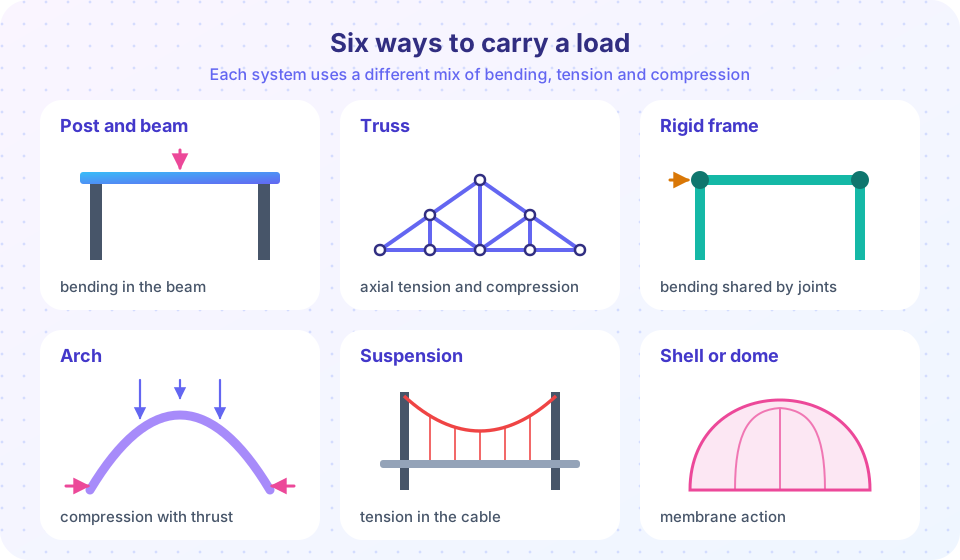
Post and beam. Horizontal beams on vertical columns. The simplest system: easy to build in timber, steel or concrete, easy to analyze. It works in bending, so beams get deep as spans grow. Typical floor spans are a few metres to perhaps ten.
Truss. Straight members joined at their ends to form triangles, so every member carries only tension or compression (if loads are applied at the joints). The triangle is the key: it cannot change shape without a member changing length. Trusses span roofs, bridges and floors efficiently, up to tens of metres, and the open web leaves room for services. Chapter 3 analyzes them.
Rigid frame. Beams and columns connected by stiff joints that transfer moment. The joints share bending between members, which lowers the beam's mid-span moment and also gives lateral stiffness. Portal frames in warehouses and moment frames in buildings are examples. Frames are usually statically indeterminate (Chapter 4).
Arch. A curved member that carries load mainly in compression. The arch pushes outward at its feet, so the supports must resist a horizontal thrust (or be tied together by a tie-rod). A parabolic arch carrying a uniform load has only compression and no bending. Masonry builders used arches for millennia precisely because stone resists compression but not tension.
Cable and suspension. The mirror image of an arch: a flexible cable in pure tension. A suspension bridge hangs a deck from cables draped over towers and anchored in the ground, and the anchors resist the pull. Cables cannot resist bending or compression, so they must be stabilized against wind and moving loads.
Shell and plate. Thin curved surfaces (domes, vaults, hyperbolic paraboloids) that carry load by membrane forces in the surface. Folded plates and concrete shells use very little material for large spans. Their design is advanced and sensitive to buckling.
A quick comparison
For a simply supported span L under a uniform load w:
- Beam: maximum moment M = wL²/8, which grows with the square of the span.
- Cable or arch of rise f: horizontal thrust H = wL²/(8f), and the axial force at the support is √(H² + (wL/2)²). There is no bending.
Press Run (or Ctrl + Enter) to see the result here.
Program input · what you'd type while the program runs
Type the answers before you press Run, one per line. Each time the program reads a line (with input()), it gets the next line from this box.
The beam needs a deep section to resist 2,000 kN·m of bending. The cable carries 447 kN of pure tension with a sag of 5 m. The flatter the cable, the larger the force, and a perfectly flat cable would need infinite tension, which is why every cable or arch needs a rise.
Lateral systems in buildings
Wind and earthquakes push buildings sideways, so a building needs at least one of these:
- Shear walls: stiff reinforced-concrete or masonry walls that act like vertical cantilevers. Lifts and stair cores often serve as shear walls.
- Braced frames: diagonal braces turn a rectangular frame into trusses. Efficient in steel, but the braces can get in the way of windows and doors.
- Moment frames: rigid beam-column joints resist sideways load by bending. Architecturally open, but flexible and heavier.
- Tube and outrigger systems for very tall buildings: the whole building acts as a hollow tube cantilevering from the ground.
Chapter 8 covers how to design them. For now, remember the rule: every building needs a complete, continuous path for sideways load as well as for gravity.
Redundancy and robustness
A good system has more than one path for the load. If one member is lost to a vehicle impact or corrosion, the neighbours pick up the load and the structure stays up. Systems without redundancy (a single-bolt connection, a lone tension rod) are called fracture critical, and codes require extra inspection and conservatism for them.
Common misconceptions
"Arches and cables are old-fashioned." They are among the most efficient systems and are in constant modern use in bridges, stadium roofs and canopies.
"Trusses are always better than beams." Over short spans a solid beam is simpler and cheaper to build; labour often costs more than steel.
"Bracing is only for tall buildings." Even a two-storey frame needs a lateral system.
Check your understanding
Quick check · 5 questions
of 5 answered You scored / 5 · perfect!
-
1. Why is axial force usually more efficient than bending?
In bending only the outer fibres are highly stressed; in axial action all fibres share the load. -
2. What do the supports of an arch have to resist besides vertical load?
An arch pushes outward at its feet; the supports or a tie must resist that horizontal force. -
3. A cable of 40 m span carries 10 kN/m and sags 5 m. The horizontal thrust is
H = wL²/(8f) = 10 × 1600 / (8 × 5) = 400 kN. (447 kN is the maximum tension at the supports.) -
4. Which lateral system turns a frame into a truss?
Diagonal braces form triangles, so the frame cannot rack. -
5. What is a fracture-critical member?
Without redundancy, one failure leads to collapse, so such members get special care.
Summary
- Axial systems (trusses, arches, cables) use material more efficiently than bending systems (beams).
- Arches and cables need a horizontal thrust path; flatter shapes mean larger forces.
- Frames share bending through stiff joints; shells carry load in their surface.
- Buildings need a lateral system: shear walls, braced frames or moment frames.
- Redundancy gives alternative load paths and makes a design robust.
Next: Chapter 2 review
Track your progress
Create a free account to tick off lessons and pick up where you left off on any device.
of Structural Engineering lessons completed