


















Lesson 16 of 47 · Analysis of Statically Determinate Structures
Chapter 3 review: statically determinate structures
Review truss analysis, shear and moment diagrams and beam deflection with a recap table, a one-page checklist, practice code and a ten-question quiz.
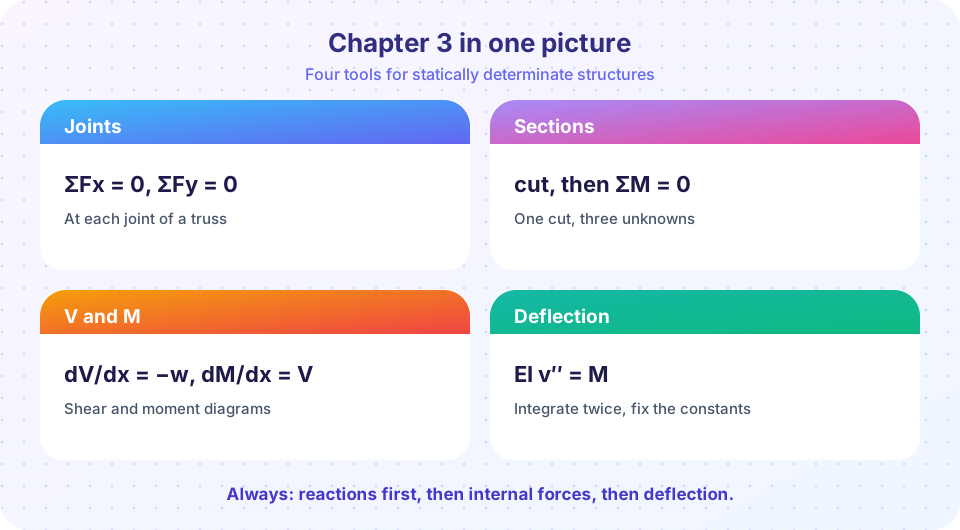
You can now take a determinate structure and answer all three analysis questions: what are the reactions, what are the internal forces and how far does it move? This review collects the formulas, links the methods together and finishes with a quiz.
What you will learn
- A single summary of every method in the chapter.
- How the Mmax of a beam depends on its supports and load pattern.
- What to practise before moving on to indeterminate structures.
Chapter in one table
| Lesson | Tool | Key results |
|---|---|---|
| Chapter overview | Count: m + r = 2j; r = 3 for a beam | Determinate, unstable or indeterminate |
| Trusses | Joints: ΣFx = ΣFy = 0. Sections: cut and take moments | Tension positive; negative means compression |
| Shear and moment diagrams | dV/dx = −w, dM/dx = V | Mmax where V = 0; wL²/8, PL/4, wL²/2, PL |
| Beam deflection | EI v″ = M; superposition | 5wL⁴/(384EI), PL³/(48EI), PL³/(3EI), wL⁴/(8EI) |
A one-page checklist
- Sketch the structure and idealize supports and loads.
- Count: is it determinate and stable?
- Reactions by equilibrium of the whole body; check with a second moment equation.
- Trusses: method of joints for everything, method of sections for one or two members.
- Beams: cut, write V and M on each segment, find zeros of V, draw both diagrams.
- Peak values size the member; deflection from tables or integration is checked against a limit.
- Verify: the sum of member or reaction forces closes, the diagrams close at the free ends, areas under V match changes of M.
Try it
Press Run (or Ctrl + Enter) to see the result here.
Program input · what you'd type while the program runs
Type the answers before you press Run, one per line. Each time the program reads a line (with input()), it gets the next line from this box.
Spreading the load and supporting the beam at both ends gives the smallest moment. A cantilever with a tip load needs eight times the moment capacity of a simple beam with a uniform load of the same total.
Press Run (or Ctrl + Enter) to see the result here.
Program input · what you'd type while the program runs
Type the answers before you press Run, one per line. Each time the program reads a line (with input()), it gets the next line from this box.
Notice that the 8 m beam fails the deflection check with the same load per metre as the 6 m beam that passed. That is the fourth-power effect of the span.
Common misconceptions
"The method of joints always starts at a support." It starts at any joint with two unknowns, which is often but not always a support.
"A zero in the moment diagram means no load there." M = 0 at a pin or roller end is just a boundary condition. Zero moment can also occur at a point of contraflexure in the middle of a loaded beam.
Check your understanding
Quick check · 10 questions
of 10 answered You scored / 10 · perfect!
-
1. A plane truss has 9 members, 6 joints and 3 reactions. Which is true?
m + r = 12 and 2j = 12, so the count matches. -
2. In the method of joints, a negative result for a member force assumed in tension means
You assumed tension; a negative result means the member is actually in compression. -
3. A simply supported 4 m beam carries 12 kN/m. Mmax is
wL²/8 = 12 × 16 / 8 = 24 kN·m. -
4. Where is the maximum moment on a beam?
Since dM/dx = V, extremes occur at V = 0. -
5. The shear diagram of a cantilever with a tip load P is
Without any other load, V is constant, equal to P, between the fixed end and the tip. -
6. A 5 kN/m load acts over a 6 m simple span. The end shear is
Total load 30 kN, shared equally, gives 15 kN at each support. -
7. The deflection of a uniformly loaded simple beam becomes how many times larger when the span grows by 50%?
1.5⁴ = 5.0625. -
8. A pin-jointed square with one diagonal and three reactions has m + r = 8 and 2j = 8. It is
The count matches and the diagonal makes the square rigid. -
9. For an 'applied couple' at a point on a beam, what happens to the diagrams?
A pure couple changes M abruptly by its value and does not change V. -
10. Which is the best way to reduce the deflection of a rectangular beam?
I grows with the cube of depth, so depth is the most effective change.
Summary
- Determinate analysis is reactions, then internal forces, then deflection, always in that order.
- Trusses: assume tension, solve joint by joint, cut sections for single members.
- Beams: V and M from cuts, linked by dV/dx = −w and dM/dx = V; Mmax at V = 0.
- Deflection follows from EI v″ = M or from tables, and is checked against a span fraction.
- Support type and load pattern change moments dramatically.
Track your progress
Create a free account to tick off lessons and pick up where you left off on any device.
of Structural Engineering lessons completed