


















Lesson 34 of 47 · Foundations and Soils
Soil strength and bearing capacity
Learn soil shear strength (Mohr-Coulomb), the bearing capacity equation for footings, the factors Nc, Nq and Ngamma, water table effects and allowable pressure.
If you stand on a sandy beach with a thin pole it sinks, but with wide shoes it does not. A footing works the same way: it gives the load a wide enough area to spread over. The question is how wide, and the answer comes from the strength of the soil, which is a different kind of strength from that of steel or concrete: it is a friction strength.
What you will learn
- The Mohr-Coulomb law for soil shear strength.
- The bearing capacity equation and what each term means.
- How to compute
Nc,NqandNγand a worked bearing capacity. - The effects of water table, footing shape and the factor of safety.
Key terms
Friction angle φ: the angle expressing how strength grows with pressure on the failure plane.
Cohesion c: the part of strength that does not depend on normal stress, from bonding between fine particles.
Surcharge q: the effective pressure of soil above the footing base, q = γ Df.
Ultimate bearing capacity qult: the pressure at which the soil fails in shear.
Factor of safety FS: qult / qall, typically about 3.
Soil shear strength
Sliding failure in soil happens along a surface. Charles Augustin de Coulomb (1776) proposed, and Christian Otto Mohr extended, that the shear strength on a plane depends on the effective normal stress on it:
τf = c′ + σ′ tan φ′
The more you squeeze the soil, the stronger it is, like pressing two rough surfaces together. For clean sand c′ ≈ 0 and φ′ is about 30° to 40°. For a clay loaded quickly (undrained) the strength is a constant su with φ = 0. Choosing the right case (drained versus undrained) is a key professional decision.
The bearing capacity equation
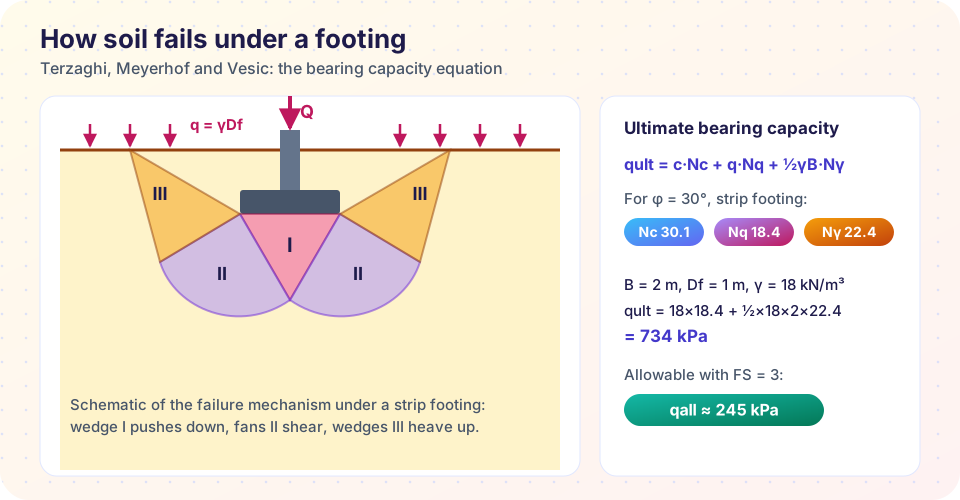
In 1943 Karl Terzaghi analyzed the failure of a strip footing. He identified three zones (see the picture): a triangular wedge directly under the footing that moves down with it, a fan of radial shear around it, and passive wedges on each side that must be pushed up against the weight of the soil above. Summing the three contributions gives:
qult = c Nc + q Nq + ½ γ B Nγ
c Nc: the contribution of cohesion.q Nq: the surcharge. Soil beside the footing and above its base acts as a weight that resists heave, so deeper footings are stronger.½ γ B Nγ: the soil weight in the failure wedge. Wider footings get more of it.
The bearing capacity factors depend only on φ. Common closed-form expressions are
Nq = e^(π tan φ) tan²(45° + φ/2)
Nc = (Nq − 1) cot φ           (Nc = 5.14 when φ = 0)
Nγ = 2 (Nq + 1) tan φ         (Vesic)
For φ = 30°: Nq = 18.4, Nc = 30.1, Nγ = 22.4. The numbers grow quickly with φ: at 40° Nq is about 64.2 and Nγ about 109. So a few degrees of friction matter enormously.
Worked example
A strip footing 2 m wide sits 1 m deep in dry sand with γ = 18 kN/m³, φ = 30°, c = 0.
- Surcharge
q = 18 × 1 = 18 kPa. qult = 18 × 18.4 + 0.5 × 18 × 2 × 22.4 = 331 + 403 = 734 kPa.- With
FS = 3:qall = 734/3 = 245 kPa. - The 2 m strip can therefore carry about
245 × 2 = 490 kNper metre of length. Check settlement separately.
Real-life corrections
- Shape. A square or round footing has a stronger 3D failure mechanism than a long strip, so shape factors raise
qult(and rectangular footings lie between). - Depth and inclination. Codes include depth factors and reduce capacity for inclined or eccentric loads (use the effective width
B′ = B − 2e). - Water table. Below the water table the soil weight is reduced to the buoyant unit weight
γ′ = γsat − γw. A water table at the footing base roughly halves theNγterm. Check it for the wettest season. - Net versus gross pressures. Some methods subtract the overburden
γ Dfalready present before the building is built.
Bearing capacity of clays
For a saturated clay under quick loading, φ = 0, Nc = 5.14, Nq = 1 and Nγ = 0, so qult = 5.14 su + q. A clay with su = 50 kPa gives qult = 5.14 × 50 + q ≈ 257 kPa plus surcharge, but clays settle, so settlement often governs.
Factor of safety
An overall FS = 3 is typical for static loads. It covers uncertainty in soil properties (variability is big), the simplifications of the theory and the fact that soil failure is catastrophic. Limit-state codes apply a partial factor to resistance instead.
Common misconceptions
"Wider is always better." For sand, qult grows with B; for clay, it hardly changes with B, but the settlement grows with width. In a clay, bearing capacity may be fine while the footing sinks too much.
"Use the highest φ from the table." Use the value from your own geotechnical report; a few degrees too high can double the computed capacity.
"Bearing capacity is the only check." Settlement and stability must be checked too, and often govern.
Try it
Press Run (or Ctrl + Enter) to see the result here.
Program input · what you'd type while the program runs
Type the answers before you press Run, one per line. Each time the program reads a line (with input()), it gets the next line from this box.
Check your understanding
Quick check · 5 questions
of 5 answered You scored / 5 · perfect!
-
1. In τf = c′ + σ′ tan φ′, what does tan φ′ represent?
It is the friction coefficient: strength grows with normal stress. -
2. In qult = c Nc + q Nq + ½ γ B Nγ, which term benefits from a deeper footing?
The surcharge q = γ Df grows with depth. -
3. For φ = 0 (undrained clay), Nc equals
Nc = π + 2 ≈ 5.14 for φ = 0. -
4. A water table at the footing base mainly reduces
γ is replaced by γ′ = γsat − γw below the water table. -
5. If qult = 600 kPa and FS = 3, then qall is
600 / 3 = 200 kPa.
Summary
- Soil strength is frictional:
τf = c′ + σ′ tan φ′. qult = c Nc + q Nq + ½ γ B Nγ; factors depend on φ and rise steeply.- Depth adds surcharge, width adds weight, the water table subtracts; shape and eccentricity need corrections.
- Divide by a factor of safety, about 3, and always check settlement as well.
Track your progress
Create a free account to tick off lessons and pick up where you left off on any device.
of Structural Engineering lessons completed