


















Lesson 18 of 51 · Present Tense Verbs
Ser and Estar: Two Verbs for "To Be"
Master ser and estar, the two Spanish verbs for to be: conjugations, the rules for identity, origin, location and states, tricky adjectives and a clear memory aid.
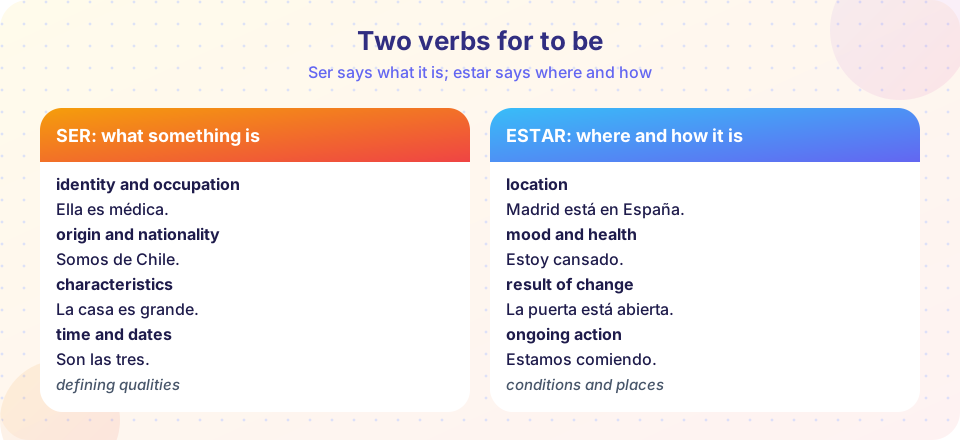
English has one verb for "to be". Spanish has two, ser and estar, and choosing between them is the first big puzzle of the language. Beginners often panic about it, but the idea behind the split is simple. Ser says what something is: its identity, nature and defining qualities. Estar says how or where something is: its location and its current condition.
Think of ser as the verb of "what" and estar as the verb of "where and how". With about twenty minutes of focused practice, you will get the right verb in most sentences, and with a few weeks of reading and listening the choice will start to feel natural. This lesson gives you the forms, the uses, a memory aid, and the tricky cases where the verb changes the meaning of an adjective.
What you will learn
- The present-tense forms of ser and estar.
- The main uses of each verb and a memory aid for each.
- Adjectives whose meaning changes with ser or estar.
- How estar differs from hay (there is, there are).
Key terms
Copula: a linking verb that joins a subject to a description (to be).
Predicate adjective: an adjective after the verb: La casa es grande.
State: a condition that can change (tired, happy, open).
Characteristic: a quality seen as defining (tall, kind, Spanish).
The forms
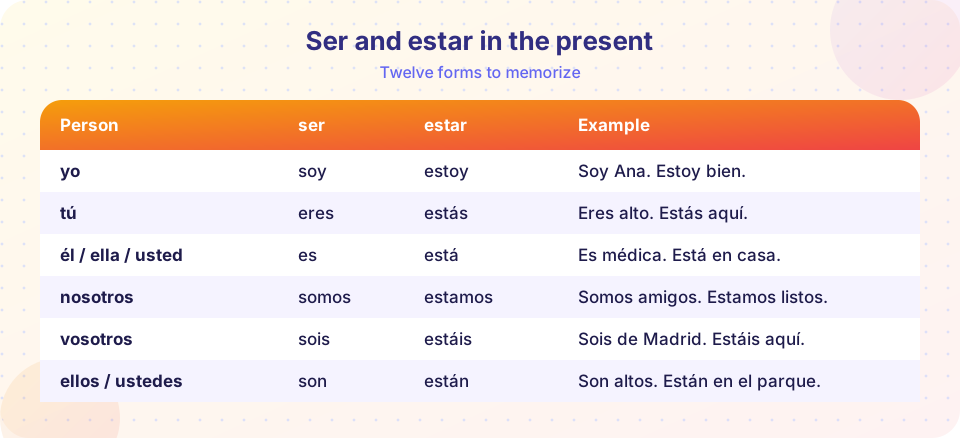
Both verbs are irregular, so you must memorize them. The six forms follow the six persons from the overview.
| Person | ser (to be: identity) | estar (to be: place, state) |
|---|---|---|
| yo | soy | estoy |
| tú | eres | estás |
| él / ella / usted | es | está |
| nosotros / nosotras | somos | estamos |
| vosotros / vosotras | sois | estáis |
| ellos / ellas / ustedes | son | están |
Notice that most forms of estar are regular -ar endings with an accent in two places (estás, está, están), and yo estoy ends in -oy like voy, doy and soy. The accents matter: esta without an accent means "this" (feminine), while está is "is".
Uses of ser
A classic memory aid for ser is DOCTOR: Description, Occupation, Characteristic, Time, Origin, Relationship.
- Identity and description. Soy Ana. (I am Ana.) Esto es un libro. (This is a book.)
- Occupation. Mi madre es médica. (My mother is a doctor.) No una is needed.
- Characteristics. La casa es grande. Mis amigos son simpáticos. (My friends are nice.)
- Time and date. Hoy es martes. Son las cinco. (It is five o'clock.) Es la una. (It is one o'clock.)
- Origin and nationality. Somos de Chile. Ella es francesa.
- Relationship, possession, material. Él es mi hermano. El libro es de Ana. (The book is Ana's.) La mesa es de madera. (The table is made of wood.)
- Events. La fiesta es en mi casa. (The party is at my house.) Here ser means "to take place".
Uses of estar
A helpful memory aid for estar is PLACE: Position, Location, Action, Condition, Emotion.
- Location. Madrid está en España. ¿Dónde está el baño? (Where is the bathroom?) Use estar for the location of people and things, even permanent ones.
- Mood, health, emotion. Estoy cansado. (I am tired.) Está enferma. (She is sick.) Estamos contentos. (We are happy.)
- Result of a change. La puerta está abierta. (The door is open.) El café está frío. (The coffee is cold.)
- Ongoing action. Estamos comiendo. (We are eating.) You will learn this form, the present progressive, later; for now recognize the pattern estar + -ando / -iendo.
Contrasts that teach
Sometimes the same adjective works with both verbs, and the meaning changes. This is the best demonstration of the ser / estar idea.
| Adjective | With ser | With estar |
|---|---|---|
| aburrido | Es aburrido. He is boring. | Está aburrido. He is bored. |
| listo | Es listo. He is clever. | Está listo. He is ready. |
| malo | Es malo. He is bad (evil). | Está malo. He is sick. |
| bueno | Es bueno. He is good (a good person). | Está bueno. It tastes good (food). |
| verde | Es verde. It is green. | Está verde. It is unripe. |
| abierto | Es abierto. He is open-minded. | Está abierto. It is open (a shop). |
In each pair ser names a quality, and estar names a condition at the moment. Estar is also the verb of change and surprise: ¡Qué alta estás! (How tall you have got!) points to a visible change.
Estar or hay?
To say a thing exists somewhere, use hay (there is, there are): Hay un parque cerca. (There is a park nearby.) To say where a specific known thing is, use estar: El parque está cerca. (The park is nearby.) Compare Hay una farmacia en la calle (There is a pharmacy on the street) with La farmacia está en la calle Mayor (The pharmacy is on Main Street). Hay has no plural form and no article: Hay dos libros, not Hay los libros.
Two short dialogues
Seeing both verbs in one conversation helps the difference to settle. Read each exchange aloud and name the reason for every ser and estar.
| Spanish | English |
|---|---|
| ¿Dónde estás? | Where are you? (location: estar) |
| Estoy en la biblioteca. | I am at the library. |
| ¿Cómo es la biblioteca? | What is the library like? (characteristic: ser) |
| Es grande y muy tranquila, pero hoy está llena. | It is big and very quiet, but today it is full. (ser for qualities, estar for today's state) |
| ¿Qué hora es? | What time is it? (time: ser) |
| Son las cuatro. Estoy un poco cansado. | It is four. I am a little tired. (time: ser, state: estar) |
Other useful fixed expressions are worth learning as chunks. With ser: Es tarde (It is late), Es temprano (It is early), Es importante (It is important). With estar: Estoy de acuerdo (I agree), Estoy de vacaciones (I am on vacation), Estoy de pie (I am standing), Estoy a dieta (I am on a diet).
When in doubt, ask yourself two questions. First: am I describing what the thing is, as a defining quality? Use ser. Second: am I saying where it is, or how it is right now, or what has happened to it? Use estar. After a few weeks of reading Spanish, the choice will feel less like a rule and more like a sound that fits.
Common misconceptions
"Ser is permanent, estar is temporary." Useful as a first approximation but not exact. Madrid está en España is permanent but uses estar (location), and La fiesta es a las ocho is temporary but uses ser (event). Think "identity and defining qualities" versus "location and current state".
"Use ser for feelings." Feelings and moods use estar: Estoy contento, Estoy nervioso.
"Estoy aburrido means I am boring." It means I am bored. Soy aburrido means I am boring.
"The accent on está is optional." Está (is) and esta (this) are different words.
Try it
First a Python helper that prints the conjugations and applies the rules above by category. It is a lookup table for the categories we listed, not an automatic classifier. Then a drill and flashcards.
Press Run (or Ctrl + Enter) to see the result here.
Program input · what you'd type while the program runs
Type the answers before you press Run, one per line. Each time the program reads a line (with input()), it gets the next line from this box.
Check your understanding
Quick check · 5 questions
of 5 answered You scored / 5 · perfect!
-
1. Which verb states where something is located?
Location uses estar, even for permanent places: Madrid está en España. -
2. How do you say 'I am tired'?
A state or condition uses estar. -
3. What does 'Es listo' mean?
Ser listo means clever; estar listo means ready. -
4. Which sentence is correct?
Time uses ser: Son las cinco. -
5. Which is correct for 'There are two books on the table'?
Hay introduces something that exists somewhere.
Summary
- Ser: identity, occupation, origin, characteristics, time, possession (DOCTOR).
- Estar: location, mood, health, results of change, ongoing actions (PLACE).
- Forms: soy, eres, es, somos, sois, son; estoy, estás, está, estamos, estáis, están.
- Some adjectives change meaning: aburrido, listo, malo, bueno, verde, abierto.
- Use hay to say something exists; use estar for the location of a known thing.
Track your progress
Create a free account to tick off lessons and pick up where you left off on any device.
of Spanish for Beginners lessons completed