


















Lesson 51 of 51 · Projects and Practice
Further study: what to learn next in Spanish
Plan your next steps in Spanish: levels, grammar topics to study next, reading and listening habits, exams, a study planner and related language courses.
Congratulations: if you worked through the earlier chapters, you can ask questions, talk about daily life, tell stories in the past, make plans and handle common situations. That is a real foundation. This last lesson helps you decide what to do next, how to keep learning efficiently and where this site can take you from here.
What you will learn
- Understand where you stand on the common European framework (CEFR).
- Choose the next grammar topics and the best habits.
- Plan your time and use spaced repetition.
- Find related courses on this site.
Key terms
CEFR: Common European Framework of Reference for Languages, with levels A1 to C2. Input: Spanish you read and listen to. Output: Spanish you speak and write. Immersion: living or studying in an environment where the language is used. DELE / SIELE: well-known Spanish proficiency exams.
Where you are
Language levels are often described with the CEFR: A1 (beginner), A2 (elementary), B1 (intermediate), B2 (upper intermediate), C1 (advanced) and C2 (proficiency). A beginner course like this one aims at roughly A1 to A2, with a first look at some B1 topics such as the subjunctive. Levels are guidelines, not exact measurements, and everyone's profile is uneven: you may speak at A2 and read at B1. Official exams such as the DELE (Diplomas de Español como Lengua Extranjera, from the Instituto Cervantes) and the SIELE certify your level, and they are useful if you need proof for studies or work. You do not need an exam to enjoy Spanish.
Grammar topics to study next
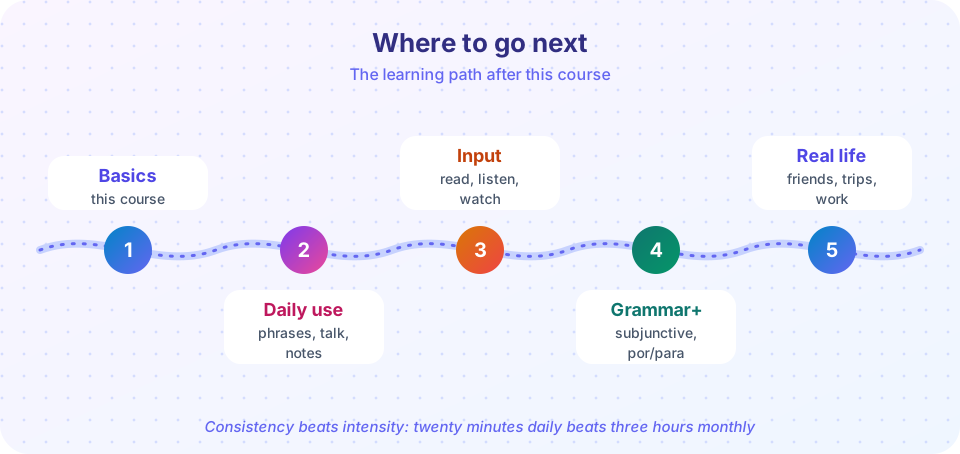
Your next grammar steps should follow the things you most often wish you could say. Typical next topics are:
- Imperfect subjunctive and "if" sentences. Si tuviera dinero, viajaría. (If I had money, I would travel.)
- The other perfect tenses. Había comido (I had eaten), habré terminado (I will have finished), haya llegado (has arrived, subjunctive).
- Por and para, and ser and estar in depth, with their many uses.
- Object pronouns in combination, leísmo and the order of pronouns.
- The passive and impersonal se: Se habla español. (Spanish is spoken.)
- Relative pronouns: que, quien, el cual, cuyo.
- Reported speech. Dijo que vendría. (He said he would come.)
- Connectors for writing: sin embargo, por lo tanto, además, aunque.
Take one topic per month. First read an explanation, then collect ten real examples from texts or songs, then write ten sentences about your life, and finally use them in a conversation.
Habits that work
Four daily habits
Twenty minutes every day
Input that fits you
Keep going
- Input. Listen and read a lot, at a level where you understand most of the content. Start with graded readers, slow podcasts for learners and children's books; move to series with Spanish subtitles and then to news and novels. Variety of accents is helpful: Spanish, Mexican, Argentine, Colombian.
- Output. Speak and write every week: with a language partner, a tutor, in an online class, or to yourself (describe your day aloud). A short written diary entry in Spanish each day, even three sentences, builds fluency.
- Review. Use spaced repetition for words and phrases (see the scheduler below).
- Chunks. Learn expressions as units: Me da igual (I don't mind), Hace tiempo que..., Tengo ganas de... (I feel like...).
- Vocabulary. The most frequent one or two thousand words cover a large share of everyday speech, so frequency lists and your own phrasebook are efficient starting points.
- Mistakes. Treat them as data. Keep an error log and review it weekly.
A website or a course cannot replace talking with people. If you can, find a conversation partner this week, even for ten minutes, and use the dialogues in chapter 8 as your script.
A sample weekly routine
Here is a realistic plan for about three and a half hours a week, split into small sessions. Monday: twenty minutes of review with your phrasebook and spaced repetition. Tuesday: twenty minutes of listening (a podcast or video) and writing down five new words. Wednesday: thirty minutes of a new grammar topic with exercises. Thursday: twenty minutes of reading a short text aloud. Friday: thirty minutes of conversation or self-interview recording. Saturday: one hour of something you enjoy in Spanish: a film, a song, a cooking video. Sunday: rest, or ten minutes to write a diary entry. Adjust the schedule to your life; what matters is that you return often. When you miss a day, simply continue the next day without guilt.
Plan your time
Estimates of the time needed to reach a comfortable conversational level vary widely with the learner, the method and the learner's other languages, but they are generally counted in hundreds of hours. Small, regular steps are more reliable than rare marathons. Try the planner below to see what your own schedule adds up to; it only multiplies your numbers.
Spaced repetition schedule
When you learn a phrase on a given day, review it after 1, 3, 7, 14 and 30 days. This Python program prints the dates for a start day of your choice. Change the start date to today's date and copy the schedule into your calendar.
Press Run (or Ctrl + Enter) to see the result here.
Program input · what you'd type while the program runs
Type the answers before you press Run, one per line. Each time the program reads a line (with input()), it gets the next line from this box.
Related courses on this site
If you enjoy languages, you may like the other beginner courses: French for Beginners, German for Beginners, Italian for Beginners and Portuguese for Beginners. Spanish shares a great deal of vocabulary and grammar with Portuguese, Italian and French, so each new Romance language gets easier. For methods, see Language Learning Methods, and to understand how languages work, try Linguistics and English Grammar, which helps you see English structures more clearly when you compare them with Spanish.
Common misconceptions
- "I need a perfect accent before I speak." Communication matters more than a native accent; people value effort.
- "Fluency means no mistakes." Fluent speakers make mistakes and repair them quickly.
- "I will learn the subjunctive later; it is too hard." Start now with common triggers, then widen.
- "Listening to Spanish in the background is enough." Active listening, with attention and repetition, is much more effective.
Check your understanding
Quick check · 5 questions
of 5 answered You scored / 5 · perfect!
-
1. What does CEFR stand for?
The CEFR describes language levels from A1 to C2. -
2. Which habit is most helpful for retaining vocabulary?
Spaced repetition strengthens memory. -
3. Which of these is a natural next grammar topic?
After the present subjunctive, conditionals with si are a natural step. -
4. What is "input"?
Input is what you hear and read; output is what you speak and write. -
5. What is the best way to treat mistakes?
Mistakes show exactly what to study next.
Summary
- This course takes you to a solid beginner level; the CEFR helps you describe progress.
- Choose the next grammar topics based on what you want to say.
- Combine input, output, review and chunks; practice a little every day.
- Use spaced repetition and a study plan; look for real conversations.
- Explore the related language and linguistics courses on this site.
Next: Back to the course page
Track your progress
Create a free account to tick off lessons and pick up where you left off on any device.
of Spanish for Beginners lessons completed