


















Lesson 15 of 51 · Nouns, Articles and Adjectives
Adjectives and Agreement
Learn how Spanish adjectives agree in gender and number, where they go in the sentence, nationality words, buen and gran, plus this, that and possessive adjectives.
Adjectives describe nouns: a red car, a small house, the new students. In English they never change. In Spanish they change to match the noun, in gender and in number, and they usually come after it. These two differences, the matching and the position, are the whole story of Spanish adjectives. Learn them well and your descriptions will sound natural.
This lesson also covers the adjectives you use constantly without noticing: this and that (demonstratives), my and your (possessives), and a few short forms like buen and gran that change meaning with position.
What you will learn
- How adjectives agree in gender and number, including the patterns for nationalities.
- Where adjectives go and why position can change the meaning.
- The short forms buen, mal and gran.
- The demonstratives (este, ese, aquel) and the possessives (mi, tu, su, nuestro).
Key terms
Adjective: a word that describes or limits a noun.
Descriptive adjective: tells what something is like (alto, rojo, interesante).
Demonstrative: points out a noun: este libro (this book).
Possessive: shows ownership: mi casa (my house).
Apocope: dropping the final sound of a word in a certain position (bueno → buen).
Agreement in four forms
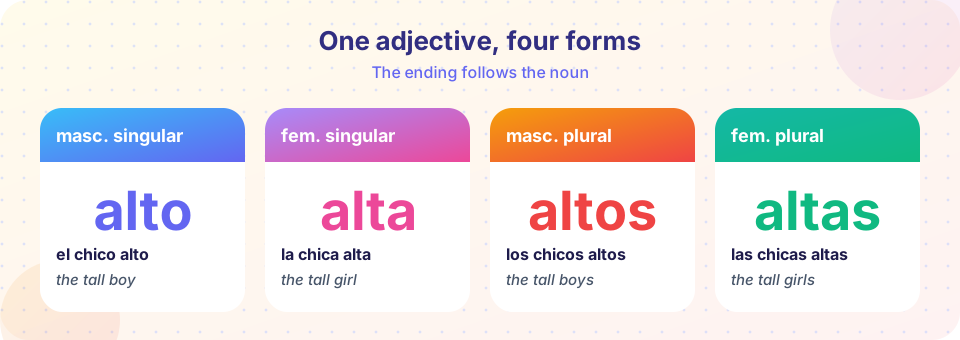
An adjective that ends in -o has four forms:
| Singular | Plural | |
|---|---|---|
| Masculine | el chico alto | los chicos altos |
| Feminine | la chica alta | las chicas altas |
The ending of the adjective copies the gender and number of the noun, not of the speaker. If you describe the table (la mesa) as new, you say la mesa nueva whether you are a man or a woman.
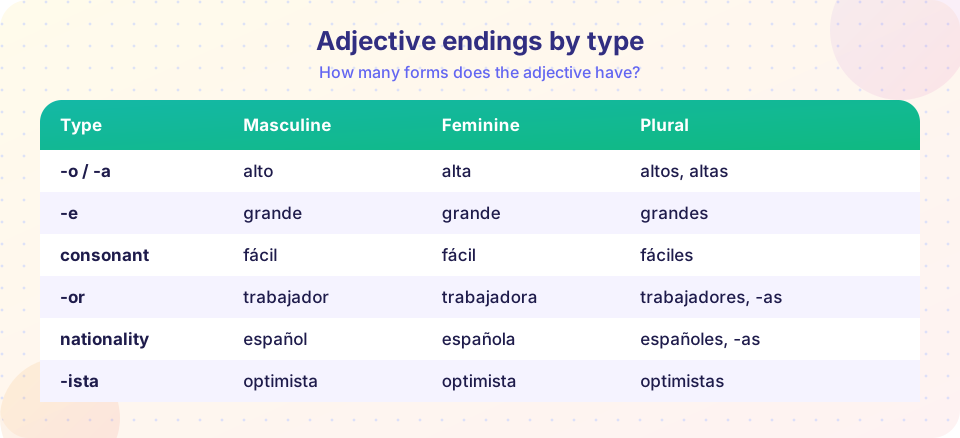
Adjectives that do not end in -o have only two forms, singular and plural, with the same word for masculine and feminine:
| Type | Masculine | Feminine | Plural |
|---|---|---|---|
| ends in -e | grande | grande | grandes |
| ends in a consonant | fácil | fácil | fáciles |
| ends in -ista | optimista | optimista | optimistas |
| ends in -or | trabajador | trabajadora | trabajadores, trabajadoras |
| nationality in a consonant | español | española | españoles, españolas |
Add -es to a consonant: fácil → fáciles, azul → azules, feliz → felices (z changes to c, as with nouns).
Nationalities
Nationalities are adjectives and agree like any other, but they are not capitalized in Spanish: un chico español, una chica española, los profesores mexicanos. Common patterns:
- -o / -a: mexicano / mexicana, colombiano / colombiana, italiano / italiana, chino / china.
- consonant, add -a for feminine: español / española, inglés / inglesa (the accent disappears), alemán / alemana, francés / francesa.
- no change: canadiense, estadounidense, costarricense, nicaragüense.
To say where you are from, use ser de plus a country, or the adjective: Soy de Canadá or Soy canadiense; Ella es de España or Ella es española.
Where adjectives go
Descriptive adjectives usually follow the noun: un coche rojo, una casa grande, los libros interesantes. In English the adjective comes first, so this will feel backwards. It helps to think of the noun as the main idea and the adjective as an extra detail you add after it.
Adjectives of quantity and number go before the noun: muchos amigos (many friends), pocos libros (few books), dos coches (two cars), algunas ideas (some ideas), todos los días (every day).
Some adjectives can go before the noun for emphasis or a poetic effect, and a handful change meaning:
| Before the noun | After the noun |
|---|---|
| un gran hombre (a great man) | un hombre grande (a big man) |
| un viejo amigo (a long-time friend) | un amigo viejo (an old, aged friend) |
| un pobre hombre (an unfortunate man) | un hombre pobre (a man without money) |
| mi antiguo trabajo (my former job) | un edificio antiguo (an ancient building) |
| el mismo día (the same day) | el día mismo (that very day) |
Short forms before nouns
Three common adjectives lose their ending before a singular noun: bueno and malo before a masculine one, grande before either gender:
- bueno → buen: un buen libro, un buen día, but una buena idea (feminine keeps the full form).
- malo → mal: un mal día, un mal momento.
- grande → gran: un gran hombre, una gran ciudad (gran works before both genders and means great, not big).
The same holds for primero and tercero: el primer día, el tercer piso. Alguno and ninguno shorten too: algún día, ningún problema.
Demonstratives: this, that
Demonstratives point to nouns and agree with them. There are three levels of distance:
| Distance | Masculine | Feminine | Plural |
|---|---|---|---|
| this (near me) | este libro | esta casa | estos libros, estas casas |
| that (near you) | ese libro | esa casa | esos libros, esas casas |
| that (far from both) | aquel libro | aquella casa | aquellos libros, aquellas casas |
Esta mesa es nueva (This table is new). Ese chico es mi hermano (That boy is my brother). Aquellas montañas son muy altas (Those mountains over there are very tall).
Possessives: my, your, their
Short possessives go before the noun and agree with the thing owned, not the owner:
| Owner | Singular noun | Plural noun |
|---|---|---|
| my | mi casa, mi libro | mis casas, mis libros |
| your (informal) | tu casa | tus casas |
| his, her, your (formal), their | su casa | sus casas |
| our | nuestra casa / nuestro libro | nuestras casas / nuestros libros |
| your (plural, Spain) | vuestra casa / vuestro libro | vuestras casas / vuestros libros |
Only nuestro and vuestro change for gender; mi, tu, su change only for number. Su casa can mean his, her, your or their house, so context decides; to be clear, say la casa de ella (her house).
A worked tour: building a description
The fastest way to master agreement is to build a phrase one step at a time and change one thing at each step. Start with the noun la casa, which is feminine singular. Add the adjective blanco. Because the noun is feminine singular, the adjective must be too, so we get la casa blanca. Now make it plural: the article becomes las, the noun becomes casas, and the adjective becomes blancas. Three words, three changes, one phrase: las casas blancas.
Swap the noun for el coche (masculine singular) and every ending moves with it: el coche blanco, los coches blancos. Try an adjective that ends in -e: la casa grande, el coche grande, las casas grandes, los coches grandes. Notice that only the plural ending changes, since grande is the same for both genders.
You can stack adjectives. Each one agrees with the noun and they are joined by y (and) before the last: una casa grande y blanca, unos zapatos negros y cómodos (black and comfortable shoes). When one adjective describes two nouns of different genders, use the masculine plural: El libro y la revista son interesantes (the book and the magazine are interesting) and Ana y Pedro son altos (Ana and Pedro are tall).
Now describe a person: Mi hermana es alta, morena y muy simpática. (My sister is tall, dark-haired and very nice.) Beware that simpático means nice or likeable, not "sympathetic". To say you feel sympathy, use compasivo or comprensivo. Describing a friend of yours who is a boy, you say Mi amigo es alto, inteligente y divertido; only alto and divertido change for gender, since inteligente has one form.
Read your own descriptions aloud and listen for the repeated -a and -o sounds: when they match across the phrase, the agreement is right. This sound pattern is why native speakers rarely need to think about it.
Common misconceptions
"The adjective should match the speaker." It matches the noun: Soy alta (a woman says this) because she describes herself, a feminine person. But la silla es alta, whoever speaks.
"Mi needs an s for a plural owner." It does not. Mis libros means my books (plural things), not our books.
"Adjectives go before nouns like in English." For descriptive adjectives, usually after: una casa grande, not una grande casa, unless you mean great.
"Nationalities are capitalized." Not in Spanish: español, mexicana. Country names are capitalized (España, México).
Try it
First an agreement helper in Python: give the masculine singular form and see all four forms. It is a rule engine for the patterns in this lesson, so unusual adjectives may be wrong. Then a drill and flashcards.
Press Run (or Ctrl + Enter) to see the result here.
Program input · what you'd type while the program runs
Type the answers before you press Run, one per line. Each time the program reads a line (with input()), it gets the next line from this box.
Check your understanding
Quick check · 6 questions
of 6 answered You scored / 6 · perfect!
-
1. Which is correct?
Casa is feminine: una casa blanca. -
2. How do you say 'the tall girls'?
Feminine plural for article, noun and adjective, with the adjective after the noun. -
3. What is the feminine of 'español'?
Add -a to a nationality ending in a consonant: española. -
4. Which form is correct before a masculine singular noun?
Bueno shortens to buen before masculine singular nouns. -
5. What does 'un hombre grande' mean?
Grande after the noun means big; gran before the noun means great. -
6. Which possessive agrees with 'casas'?
Mis casas: possessives agree in number with the thing owned.
Summary
- Adjectives agree with the noun in gender and number; -o adjectives have four forms.
- Adjectives in -e or a consonant have one form for both genders; add -s or -es for plural.
- Descriptive adjectives usually follow the noun; quantity adjectives go before.
- Bueno, malo and grande shorten before masculine singular nouns (buen, mal, gran).
- Demonstratives (este, ese, aquel) and possessives (mi, tu, su, nuestro) agree with the noun.
Next: Chapter 3 Review
Track your progress
Create a free account to tick off lessons and pick up where you left off on any device.
of Spanish for Beginners lessons completed