


















Lesson 34 of 51 · Past Tenses
Chapter 6 review: Past tenses
Review the Spanish preterite, imperfect and present perfect with a summary table, common-mistake fixes, mixed practice and a ten-question chapter quiz.
You now have three past tenses and a method for choosing among them. This review gathers the forms, the decision rules and the most common mistakes. Work through the table, practise with the drills and finish with the mixed quiz.
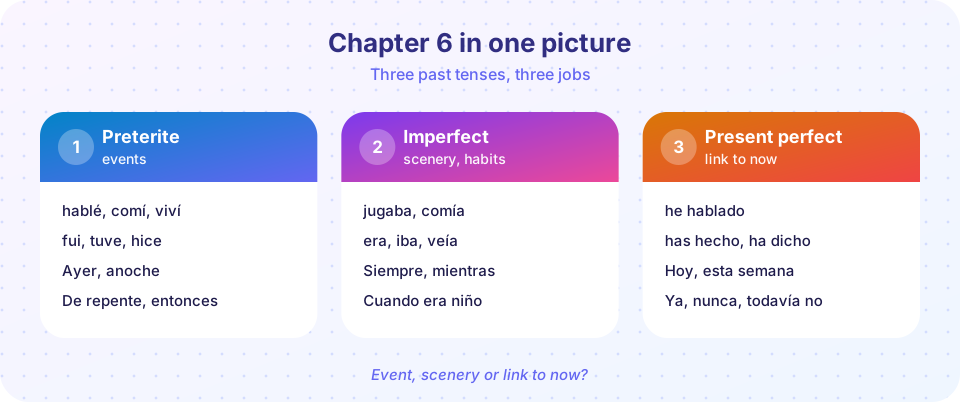
Recap table
| Lesson | Key ideas | Example |
|---|---|---|
| Preterite: regular | -é, -aste, -ó, -amos, -asteis, -aron / -í, -iste, -ió, -imos, -isteis, -ieron; spelling in yo; -ir stem changes in third person | Busqué las llaves. |
| Preterite: irregular | fui (ser/ir); special stems; hizo, dijeron; di, vi | Hicieron la cena. |
| The imperfect | -aba / -ía; ser, ir, ver irregular; habits, description, age, time | Era tarde y llovía. |
| Preterite or imperfect | film vs photograph; interrupted actions; meaning changes | Leía cuando sonó el teléfono. |
| Present perfect | haber + participle; irregular participles; unfinished periods | Hoy he trabajado mucho. |
Choosing a past tense in ten seconds
- Does the sentence mention today, this week, ever, never or already with a connection to now? Consider the present perfect (or the preterite in Latin America).
- Is it a finished event or a sequence with a clear time or outcome? Use the preterite.
- Is it a habit, a description, weather, age, time or an action in progress? Use the imperfect.
- If both appear in one sentence, the ongoing background takes the imperfect and the interruption takes the preterite.
Fix the mistakes
| Sentence | Correction | Why |
|---|---|---|
| Ayer yo llegé tarde. | Ayer llegué tarde. | -gar verbs spell -gué in the yo preterite. |
| Ellos dijieron la verdad. | Ellos dijeron la verdad. | j-stems drop the i. |
| Cuando era niño, jugué en el parque. | Cuando era niño, jugaba en el parque. | A habit in the past is imperfect. |
| Yo he no comido. | Yo no he comido. | No goes before haber. |
| Ella ha escribido una carta. | Ella ha escrito una carta. | Irregular participle. |
| Ayer he visto a Ana. | Ayer vi a Ana. | Ayer is a finished period: preterite. |
| Había frío. | Hacía frío. | Weather uses hacer, not haber. |
A story to analyze
Read the paragraph, then name the tense of every verb.
Ayer fue un día extraño. Cuando me desperté, todavía era de noche y hacía mucho frío. Me levanté, preparé un café y miré por la ventana: nevaba y no había nadie en la calle. Llamé a mi hermana, pero no contestó. Esta semana hemos hablado poco, y por eso me preocupé. Finalmente, ella me escribió un mensaje: estaba bien, solo dormía.
Yesterday was a strange day. When I woke up, it was still night and it was very cold. I got up, made a coffee and looked out of the window: it was snowing and nobody was in the street. I called my sister, but she did not answer. This week we have spoken little, and that is why I worried. Finally, she wrote me a message: she was fine, she was just sleeping.
The analysis: fue is the preterite of ser (an evaluation of the finished day); me desperté, me levanté, preparé, miré, llamé, contestó, me preocupé, escribió are events in the preterite; era, hacía, nevaba, había, estaba, dormía are scenery and states in the imperfect; hemos hablado is the present perfect, because esta semana has not ended. Could you write a similar paragraph about your own week? Try it with three events and three descriptions.
Mixed practice
Type the verb forms that fit the context.
Chapter review quiz
Quick check · 10 questions
of 10 answered You scored / 10 · perfect!
-
1. What is the yo preterite of "empezar"?
The z becomes c before é: empecé. -
2. What is the preterite of "ir" for tú?
Ser and ir share fui, fuiste, fue... -
3. What is the imperfect of "ver" for yo?
Ver is irregular in the imperfect: veía. -
4. Which sentence is correct?
Decir has the stem dij- and the ending -eron. -
5. Which tense for "It was raining when I arrived"?
Ongoing weather (imperfect) interrupted by an event (preterite). -
6. What does "No pude abrirla" mean?
Poder in the preterite negative means a failed attempt. -
7. What is the participle of "volver"?
Volver has an irregular participle: vuelto. -
8. Which is the best use of the present perfect?
Esta semana is unfinished; ayer and en 2019 are finished periods. -
9. Which verb form is a habit in the past?
Comía, with todos los días or siempre, is a habit. -
10. "Quise llamarte" means…
Querer in the preterite means to try on one occasion.
Summary
- Preterite: completed events; spelling and stem rules; many common irregular verbs.
- Imperfect: habits, scenery, age, time and actions in progress; only ser, ir, ver are irregular.
- Present perfect: haber plus participle; experiences, recent news and unfinished periods.
- When tenses meet, the imperfect sets the scene and the preterite moves the story.
Track your progress
Create a free account to tick off lessons and pick up where you left off on any device.
of Spanish for Beginners lessons completed