


















Lesson 4 of 51 · Getting Started
Study Habits That Work
Build a Spanish study routine that sticks: short daily sessions, spaced repetition, active recall, listening and speaking, with a forgetting-curve plot and a review scheduler.
Most people who give up on a language do not fail because the language is too hard. They fail because their routine does not survive a busy week. A good routine is small, repeatable and built on what memory research shows works. This lesson gives you such a routine, explains the science behind it in plain terms, and lets you play with a model of forgetting so you can see why reviewing on a schedule pays off.
You will also meet a short list of classroom phrases. They are the first Spanish you should be able to say, because they let you ask for help in Spanish instead of switching to English.
What you will learn
- Why short daily study beats long weekly cramming.
- How spaced repetition and active recall work, and how to use them with flashcards.
- How to balance input (listening, reading) with output (speaking, writing).
- Six classroom phrases for asking for help in Spanish.
Key terms
Active recall: trying to remember an answer before looking it up. Retrieval itself strengthens memory.
Forgetting curve: the pattern that memory of new material drops quickly at first, then more slowly. Hermann Ebbinghaus described it in 1885 using lists of nonsense syllables.
Shadowing: listening to a speaker and repeating right behind them, imitating rhythm and melody.
Comprehensible input: Spanish you can mostly understand while still meeting some new words.
Little and often
Memory is built by repeated use. Thirty focused minutes a day, five days a week, give you 2.5 hours; cramming the same time on one Sunday gives far weaker results. The reason is the forgetting curve: after you learn something, most of the loss happens in the first day or two. A review at the right moment resets the curve and makes the next drop slower. Each successful review lengthens the time you can wait before the next one.
You can see the effect with a model. In the plot below, memory strength decays as R = exp(-t / S), where t is days since the last review and S is a stability value. Every review increases S. These are illustrative numbers, not measurements of a real person, but the shape matches what Ebbinghaus found and what later studies confirmed in many settings.
A session you can repeat
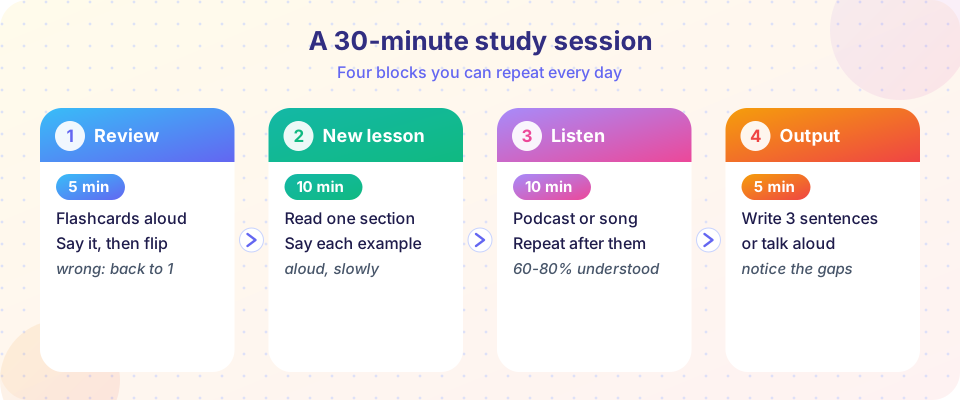
The picture above shows a 30-minute template. Adjust the times to your life, but keep the four blocks.
- Review (5 minutes). Go through flashcards or yesterday's vocabulary. Look at the Spanish side or the English side first, try to say the answer out loud, then flip. Cards you get right wait longer next time; cards you miss come back tomorrow.
- New material (10 minutes). Read one lesson section or one part of a lesson. Say every example aloud.
- Listening and shadowing (10 minutes). Use a podcast, a children's show, a song with lyrics, or a graded reader with audio. Choose material where you understand about 60 to 80 percent. If you understand almost nothing, it is too hard; if everything, too easy.
- Output (5 minutes). Write three sentences with the new words, or say them to your phone or to a mirror. Output reveals gaps that passive reading hides: you notice that you do not know how to say "because" until you need it.
If you only have ten minutes, do the review block. A streak of small sessions beats a perfect plan you abandon.
Spaced repetition in practice
A simple way to use spaced repetition without any software is the Leitner box system. You have boxes numbered 1 to 5. New cards start in box 1. When you answer correctly a card moves up one box; when you answer wrongly it goes back to box 1. Box 1 is reviewed every day, box 2 every 2 days, box 3 every 4 days, box 4 every week, box 5 every two weeks. Apps automate this, but paper cards work, and writing a word by hand has its own memory benefit.
Two rules keep the cards useful. Write phrases not isolated words: Tengo hambre (I am hungry) teaches more than hambre. And write the card yourself, in your own words, with an example sentence you find memorable.
Input and output
Beginners often over-invest in one side. Reading and listening (input) feed your ear and your vocabulary; speaking and writing (output) turn knowledge into skill. Spend about two thirds of your time on input and a third on output at the start, and shift towards output as you improve. If you can, schedule one conversation per week, with a tutor, a language exchange partner or a patient friend. Ten awkward minutes in Spanish are worth an hour of silent study.
A few rules for conversation: speak slowly, accept mistakes, ask for repetition, and write down new words after the call. Nobody expects a beginner to be perfect, and most Spanish speakers are delighted when you try.
Making it stick
Attach your study block to a habit you already have: after breakfast, on the commute, before dinner. Put your flashcards on your phone's first screen. Tell a friend your weekly goal. Small cues like these remove the daily decision of whether to study, which is the real enemy of a language routine.
Common misconceptions
"I will learn passively, just by listening." Listening is essential, but speaking and recalling words actively are what make them available when you need them.
"Mistakes will become habits." Mistakes are information. Fixing them in conversation, with feedback, is part of learning.
"I have no time." Ten minutes in the bus queue count. Use a flashcard app or the review block of this course.
"Learning styles: I am a visual learner so I only need pictures." Studies have not found that matching teaching to a claimed style improves results. Use pictures, sounds and speech all together.
Classroom phrases
These six phrases help you stay in Spanish when you get lost. Say them aloud until they become automatic.
| Spanish | English |
|---|---|
| No entiendo. | I do not understand. |
| ¿Puede repetir, por favor? | Can you repeat, please? |
| Más despacio, por favor. | Slower, please. |
| ¿Cómo se dice "book" en español? | How do you say "book" in Spanish? |
| ¿Qué significa "gracias"? | What does "gracias" mean? |
| Hablo un poco de español. | I speak a little Spanish. |
Try it
First the forgetting-curve plot, a model that applies the formula above with made-up stability values. Then a review scheduler that uses simple Leitner intervals, and finally flashcards for the classroom phrases.
Press Run (or Ctrl + Enter) to see the result here.
Program input · what you'd type while the program runs
Type the answers before you press Run, one per line. Each time the program reads a line (with input()), it gets the next line from this box.
Press Run (or Ctrl + Enter) to see the result here.
Program input · what you'd type while the program runs
Type the answers before you press Run, one per line. Each time the program reads a line (with input()), it gets the next line from this box.
Check your understanding
Quick check · 5 questions
of 5 answered You scored / 5 · perfect!
-
1. What does the forgetting curve say?
Most forgetting happens soon after learning; well-timed reviews slow it. -
2. In the Leitner system, what happens to a card you answer wrongly?
A wrong answer sends the card back to box 1 so you see it again soon. -
3. Which is better for flashcards?
Phrases such as Tengo hambre teach grammar and meaning together. -
4. How do you say 'Slower, please' in Spanish?
Más despacio, por favor means slower, please. -
5. What is the best advice about mistakes in conversation?
Speaking with errors and getting feedback is how output skills grow.
Summary
- Short, regular sessions beat long, rare ones because of the forgetting curve.
- Use active recall and spaced repetition; cards should hold phrases, not just words.
- A balanced session has review, new material, listening and output.
- Plan for at least one real conversation each week.
- Learn six classroom phrases so you can ask for help in Spanish.
Next: Chapter 1 Review
Track your progress
Create a free account to tick off lessons and pick up where you left off on any device.
of Spanish for Beginners lessons completed