


















Lesson 16 of 51 · Nouns, Articles and Adjectives
Chapter 3 Review: Nouns, Articles and Adjectives
Review Spanish noun gender, plurals, articles, contractions, adjective agreement and position with a recap table, a phrase builder and a ten-question quiz.
In this chapter you met the structure that makes Spanish noun phrases work: every noun has a gender and a number, and the article and adjectives around it agree. You learned the endings that predict gender, the plural rules, the eight articles and two contractions, the four-form adjectives, and the short forms buen, mal and gran.
Use this review to consolidate. Work through the recap table, read the model paragraph out loud, try the phrase builder, and take the ten-question quiz. If you score below eight, reread the lesson named in the explanation before moving on to verbs in Chapter 4.
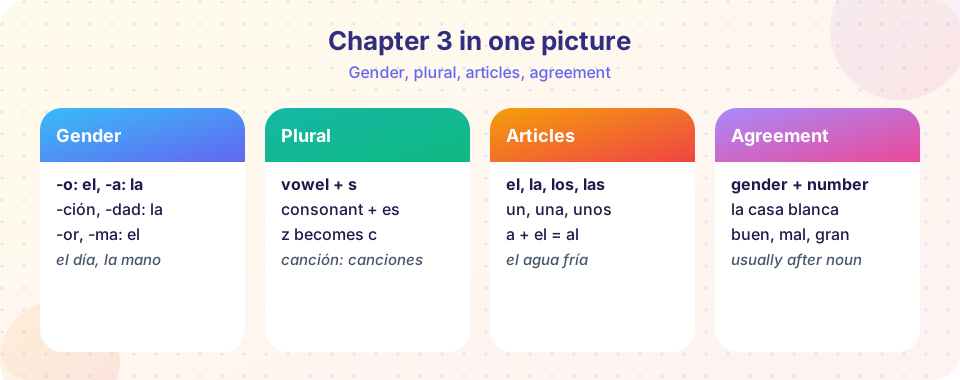
Recap table
| Topic | Key rule | Example |
|---|---|---|
| Gender | -o usually masculine, -a usually feminine | el libro, la casa |
| Reliable suffixes | -ción, -dad, -tad, -tud feminine; -or, -aje, -ma masculine | la canción, el amor, el problema |
| Exceptions | el día, el mapa; la mano, la foto | memorize them |
| People | -o to -a; add -a; same word; different word | el niño / la niña, el estudiante / la estudiante |
| Plurals | vowel + s; consonant + es; z to c; -ción loses its accent | casas, ciudades, lápices, canciones |
| Articles | el, la, los, las; un, una, unos, unas | el libro, unas flores |
| Contractions | a + el = al; de + el = del | al banco, del parque |
| el agua | stressed a- feminine noun takes el | el agua fría, las aguas |
| Adjectives | agree in gender and number; usually after the noun | la casa blanca |
| Short forms | buen, mal, gran before nouns | un buen día |
| Demonstratives | este, ese, aquel with four forms each | estos libros |
| Possessives | mi, tu, su agree in number; nuestro in gender too | mis amigos, nuestra casa |
A model paragraph
Read this aloud, then say it again while covering the English.
Mi casa es pequeña, pero tiene un jardín bonito. En la cocina hay una mesa grande y cuatro sillas blancas. Los libros interesantes están en el salón. Las ventanas son altas y la luz de la tarde es preciosa.
My house is small, but it has a pretty garden. In the kitchen there is a big table and four white chairs. The interesting books are in the living room. The windows are tall and the afternoon light is beautiful.
Look for the agreement chains: una mesa grande, cuatro sillas blancas, los libros interesantes, las ventanas son altas. Notice also that un jardín bonito keeps bonito masculine because jardín is masculine, and that grande and interesantes do not change for gender. Hay means "there is" and tiene "it has"; they come from verbs you will study in Chapter 4.
Self-check list
Tick each statement honestly. Revisit the lesson in brackets for any you cannot do.
- I can predict the gender of a new noun from its ending and I know five exceptions (Gender and Plural).
- I can form the plural of casa, ciudad, lápiz, canción and lunes (Gender and Plural).
- I can choose between el, la, los, las, un, una, unos, unas and use al and del (Articles).
- I know why it is el agua fría and where Spanish drops a (Articles).
- I can make an adjective agree and place it correctly, and I know buen, mal and gran (Adjectives).
Common trouble spots
Learners most often slip on the same few points, so check yourself against this list:
- Forgetting that adjectives agree. Say la casa blanca, not la casa blanco.
- Placing the adjective before the noun. Descriptive adjectives normally follow: un coche rojo.
- Using la with agua. The article is el: el agua.
- Plurals of nouns ending in a consonant. Add -es: ciudades, lápices, canciones.
- Dropping articles in general statements. Say Me gusta el café, not Me gusta café.
- Wrong contractions. A el and de el never appear: write al and del.
If two or more of these look familiar, spend a few minutes writing ten example phrases correcting each one, then read them aloud.
Try it
The phrase builder below combines an article, a noun and an adjective with all agreement rules. It uses a small lexicon and simple rules, so it is a study tool, not a general translator. Then a mixed drill with a few questions from each lesson.
Press Run (or Ctrl + Enter) to see the result here.
Program input · what you'd type while the program runs
Type the answers before you press Run, one per line. Each time the program reads a line (with input()), it gets the next line from this box.
Check your understanding
Quick check · 10 questions
of 10 answered You scored / 10 · perfect!
-
1. What is the gender of 'canción'?
Nouns ending in -ción are feminine: la canción. -
2. What is the plural of 'canción'?
The accent is dropped: canciones. -
3. Which sentence agrees correctly?
Interesante has one form for both genders; plural adds -s. -
4. Which is the correct article for 'día'?
El día: it ends in -a but is masculine. -
5. How do you say 'a great city'?
Gran before the noun means great. Una ciudad grande means a big city. -
6. Which possessive agrees with 'casa' for 'our'?
Nuestra casa: feminine singular. -
7. What does 'unos amigos' mean?
Unos is the plural of un: some. -
8. Which is the feminine of 'inglés'?
The accent drops: inglesa. -
9. Which phrase is correct?
Aquella agrees with feminine singular casa. -
10. Where does a descriptive adjective usually go?
Una casa grande, not una grande casa.
Summary
- Gender is a grammar label; endings predict it, and exceptions must be memorized.
- Plurals follow a few rules: -s, -es, z to c, and accent changes.
- Articles agree with the noun; a + el = al, de + el = del; el agua is a sound rule.
- Adjectives agree in gender and number, usually after the noun; some shorten before it.
- Chapter 4 adds verbs: the heart of every sentence.
Track your progress
Create a free account to tick off lessons and pick up where you left off on any device.
of Spanish for Beginners lessons completed