


















Lesson 11 of 51 · Sounds, Greetings and Basics
Chapter 2 Review: Sounds, Greetings and Basics
Review Spanish vowels, consonant rules, stress, accent marks, greetings and introductions with a recap table, a mixed drill and a ten-question quiz.
This chapter gave you the sound system of Spanish and your first real conversation. You learned that Spanish vowels are pure and constant, that a dozen consonant rules explain nearly every spelling, that stress follows three simple rules, and that accents appear exactly when the rules are broken. Then you used all of it to greet people, introduce yourself and say goodbye.
Use this review to find any weak spots. Read the one-page summary, scan the recap table, run the drills, and take the quiz. If you score below eight out of ten, reread the lesson named in the explanation before starting Chapter 3.
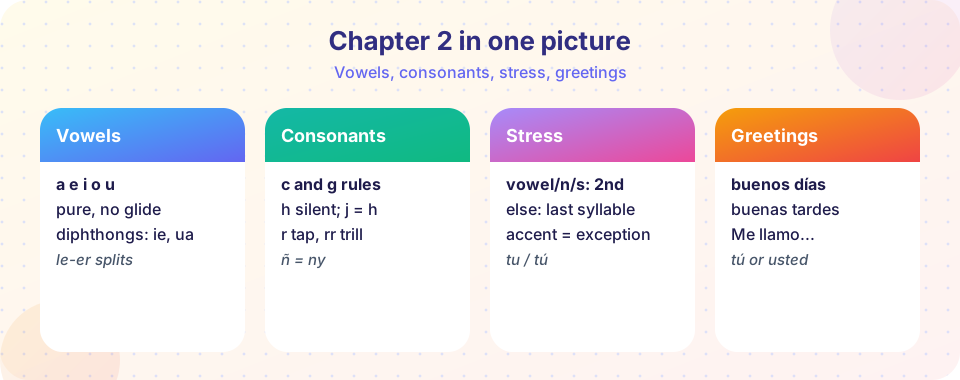
Recap table
| Topic | Key rule | Example |
|---|---|---|
| Alphabet | 27 letters; ñ is a letter; ch and ll are digraphs | eñe, hache |
| Vowels | Five pure sounds, no glide: a e i o u | casa, mesa, libro, sol, luz |
| Diphthongs | Weak (i, u) plus any vowel share one syllable; two strong vowels split | bue-no, le-er |
| c and g | Hard before a, o, u; soft before e, i | casa, cena; gato, gente |
| silent letters | h is silent; u in que, qui, gue, gui is silent | hola, queso, guerra |
| r and rr | Tap inside a word, trill for rr or an initial r | pero, perro |
| b and v | Same sound | vaca = baca |
| Stress | Vowel, n or s: second-to-last; other consonant: last | CA-sa, ho-TEL |
| Accent marks | Mark stress that breaks the rules; esdrújulas always | café, árbol, teléfono |
| Tilde diacrítica | Separates short words | tu / tú, el / él, si / sí |
| Greetings | By time of day | buenos días, buenas tardes, buenas noches |
| Introductions | Me llamo...; Soy de...; Mucho gusto | Me llamo Ana. Soy de México. |
Phrases from this chapter
| Spanish | English |
|---|---|
| ¿Cómo se escribe? | How is it written? |
| ¿Cómo estás? / ¿Cómo está usted? | How are you? (informal / formal) |
| Bien, gracias. ¿Y tú? | Fine, thank you. And you? |
| ¿Cómo te llamas? / ¿Cómo se llama usted? | What is your name? (informal / formal) |
| Me llamo... / Soy... | My name is... / I am... |
| ¿De dónde eres? | Where are you from? |
| Soy de Canadá. | I am from Canada. |
| Mucho gusto. / Encantado/a. | Nice to meet you. |
| Hasta luego. / Nos vemos. | See you later. |
| Por favor. / Gracias. / De nada. | Please. / Thank you. / You are welcome. |
A self-test conversation
Cover the English column of the dialogue in the Greetings lesson and play both parts out loud, then change the names and countries. Record yourself on your phone and listen once: you will hear the rhythm and notice vowels that slide. Repeat the same dialogue three days in a row; by the third day it should feel automatic.
Then try these three tasks, each in less than a minute: spell your first name and surname with Spanish letter names; say five words that contain an rr or an initial r (such as perro, carro, rojo, rápido, Roma) and decide whether each r is trilled; and pick four words from the Stress lesson and say them, stressing the right syllable.
Common trouble spots, one more time
Most pronunciation errors by English speakers come from the same short list. Check each against your own speech:
- Gliding vowels. Hola should be a steady OH-lah, with no w sliding in at the end of the o. Keep the lips still.
- Aspirated consonants. Pero, tiempo and casa have no puff of air after p, t or k.
- Wrong r. English r does not exist in Spanish. Use a tap for single r and a trill for rr.
- The j and g sounds. Jugo and gente start with a strong breathy h, not an English j.
- Silent letters. The h in hola and the u in queso and guerra are silent.
- Misplaced stress. Read the three stress rules in your head until they run automatically.
- Missing accents. Remember tú, él, sí, qué and cómo.
A short reading to try aloud
Here is a short text using only what you learned in this chapter, with the sound of each line in capital letters for the stressed syllable. Read it three times: slowly, normally, and from memory.
| Spanish | Say it like | English |
|---|---|---|
| Hola, me llamo Marta. | OH-la, me YA-mo MAR-ta | Hello, my name is Marta. |
| Soy de México. | soy de ME-hi-ko | I am from Mexico. |
| ¿Cómo te llamas? | KO-mo te YA-mas | What is your name? |
| Mucho gusto. | MU-cho GUS-to | Nice to meet you. |
| Hasta luego. | AS-ta LUE-go | See you later. |
The respelling shows a Latin American pronunciation of ll (like English y) and of x in México (like a strong h). In Spain, Marta and the other words sound very similar, since only c and z before e or i differ. Check your pronunciation against a native recording when you can.
Try it
A mixed drill covers the whole chapter. The second exercise is a flashcard deck of useful phrases. Both use fixed lists, not adaptive tests.
Check your understanding
Quick check · 10 questions
of 10 answered You scored / 10 · perfect!
-
1. Which vowel sound is Spanish 'e'?
Spanish e is /e/, a clean eh sound. -
2. Which word needs a written accent?
Lápiz is stressed on the second-to-last syllable but ends in z, so it needs an accent: lápiz. -
3. How is 'queso' pronounced?
Que is /ke/ with a silent u. -
4. How is 'jirafa' pronounced at the start?
J is /x/, a breathy h: hee-RAH-fa. -
5. Where does the stress fall in 'ciudad'?
It ends in d, so the last syllable is stressed. -
6. Which pair differs only by an accent?
Tu (your) and tú (you). -
7. What is the best reply to '¿Cómo te llamas?'
You give your name. -
8. At 3 p.m. you say...
Afternoon greeting. -
9. How many syllables does 'país' have?
The accent on í separates it from the a: pa-ís. -
10. Which is the correct way to write a question?
Spanish uses both ¿ and ?, and dónde carries an accent in questions.
Summary
- Spanish vowels are pure; consonant rules are few and regular.
- Stress follows the ending of the word; accent marks show exceptions.
- Accents also separate short words such as tu and tú.
- Greet by time of day; introduce with Me llamo..., Soy de... and Mucho gusto.
- Use usted when in doubt and tú once invited.
Track your progress
Create a free account to tick off lessons and pick up where you left off on any device.
of Spanish for Beginners lessons completed