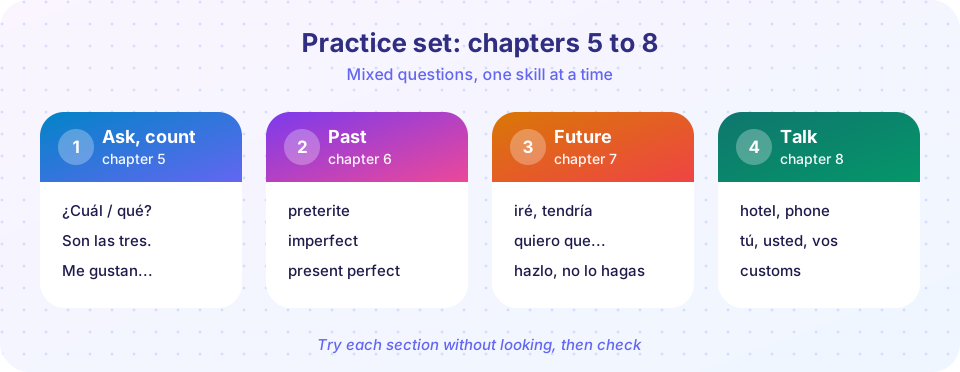
Practice everything from chapters 5 to 8 with mixed gap fills, tense choices, matching, a speaking challenge and a self-assessment checklist.
You have learned a lot: questions, numbers, food, routines, three past tenses, the future, commands, the subjunctive and real conversations. This practice set mixes everything. Mixing is deliberate: in real life, nobody tells you which tense to use or which pronoun to choose. Do each section without looking at the lessons; then check the ones that you missed.
Retrieval practice: recalling information without looking, which strengthens memory.
Interleaving: mixing topics in one session, which builds flexible skills.
Self-assessment: checking your own level honestly.
Error log: a notebook of your mistakes and their corrections.
Work in three rounds. In round 1, do each exercise without help and note your score. In round 2, read the explanations of every wrong answer and write the correct sentence in your own words. In round 3, one day later, repeat the exercises you missed. This pattern (test, correct, retest) is more effective than re-reading. Keep an error log: write each mistake, the correction and a rule in one line. For instance, "Yo llegé" → "llegué": -gar verbs add u before é. After a week you will see patterns in your errors, and the patterns tell you what to study next.
<style>*{box-sizing:border-box}body{margin:0;padding:14px;font-family:system-ui,-apple-system,'Segoe UI',sans-serif;background:linear-gradient(135deg,#faf5ff,#eff6ff);color:#1e1b4b}.card{background:#fff;border-radius:18px;box-shadow:0 8px 22px rgba(67,56,202,.16);padding:16px;max-width:560px;margin:0 auto}button{font:inherit;font-weight:600;border:0;border-radius:999px;padding:8px 16px;margin:4px 4px 0 0;color:#fff;background:linear-gradient(135deg,#6366f1,#ec4899);cursor:pointer}button.alt{background:#eef2ff;color:#3730a3}input{font:inherit;padding:6px 10px;border:2px solid #c7d2fe;border-radius:10px;width:150px}.small{font-size:.85rem;color:#475569}</style><style>.row{margin:0 0 12px;padding:10px 12px;border-radius:12px;background:#f8fafc}.ok{background:#dcfce7}.no{background:#fee2e2}.near{background:#fef9c3}.en{font-size:.85rem;color:#475569;font-style:italic}</style><divclass="card"><divid="list"></div><buttonid="chk">Check answers</button><buttonid="rst"class="alt">Clear</button><pid="score"class="small"></p></div><script>var items=[{"s":"¿___ es tu número de teléfono?","a":["cuál"],"en":"What is your phone number?"},{"s":"Son las ocho y ___. (8:30)","a":["media"],"en":"It is half past eight."},{"s":"300 = ___","a":["trescientos"],"en":"three hundred"},{"s":"Me ___ las manzanas.","a":["gustan"],"en":"I like apples."},{"s":"Yo me ___ (levantarse) a las siete.","a":["levanto"],"en":"I get up at seven."},{"s":"¿Cuánto ___ las naranjas?","a":["cuestan"],"en":"How much are the oranges?"}];functionstrip(t){return t.normalize('NFD').replace(/[\u0300-\u036f]/g,'');}var list=document.getElementById('list');
items.forEach(function(it,k){var d=document.createElement('div');d.className='row';var p=it.s.split('___');d.appendChild(document.createTextNode(p[0]));var inp=document.createElement('input');inp.id='f'+k;inp.setAttribute('aria-label','answer '+(k+1));d.appendChild(inp);d.appendChild(document.createTextNode(p[1]||''));var e=document.createElement('div');e.className='en';e.textContent=it.en;d.appendChild(e);var m=document.createElement('div');m.className='small';m.id='m'+k;d.appendChild(m);d.id='r'+k;list.appendChild(d);});
document.getElementById('chk').onclick=function(){var good=0;items.forEach(function(it,k){var v=document.getElementById('f'+k).value.trim().toLowerCase();var r=document.getElementById('r'+k),m=document.getElementById('m'+k);var ex=it.a.indexOf(v)>=0;var near=!ex&&it.a.some(function(a){returnstrip(a)===strip(v)&&v!=='';});if(ex){good++;r.className='row ok';m.textContent='Correct';}elseif(near){r.className='row near';m.textContent='Almost: check the accent. Answer: '+it.a[0];}else{r.className='row no';m.textContent=v?'Not quite. Answer: '+it.a[0]:'Answer: '+it.a[0];}});document.getElementById('score').textContent='Score: '+good+' / '+items.length;};
document.getElementById('rst').onclick=function(){items.forEach(function(it,k){document.getElementById('f'+k).value='';document.getElementById('r'+k).className='row';document.getElementById('m'+k).textContent='';});document.getElementById('score').textContent='';};</script>
<style>*{box-sizing:border-box}body{margin:0;padding:14px;font-family:system-ui,-apple-system,'Segoe UI',sans-serif;background:linear-gradient(135deg,#faf5ff,#eff6ff);color:#1e1b4b}.card{background:#fff;border-radius:18px;box-shadow:0 8px 22px rgba(67,56,202,.16);padding:16px;max-width:560px;margin:0 auto}button{font:inherit;font-weight:600;border:0;border-radius:999px;padding:8px 16px;margin:4px 4px 0 0;color:#fff;background:linear-gradient(135deg,#6366f1,#ec4899);cursor:pointer}button.alt{background:#eef2ff;color:#3730a3}input{font:inherit;padding:6px 10px;border:2px solid #c7d2fe;border-radius:10px;width:150px}.small{font-size:.85rem;color:#475569}</style><style>.q{margin:0 0 14px;padding:10px 12px;border-radius:12px;background:#f8fafc}.q .s{font-weight:700;margin-bottom:6px}.q .e{font-size:.85rem;color:#475569;font-style:italic}.q button{background:#eef2ff;color:#3730a3}.q button.right{background:#16a34a;color:#fff}.q button.wrong{background:#dc2626;color:#fff}.fb{font-size:.9rem;margin-top:6px}</style><divclass="card"><divid="box"></div><pid="score"class="small"></p></div><script>var items=[{"s":"Ayer ___ al cine con mis amigos.","o":["fui","iba"],"a":0,"x":"A single completed event with ayer: preterite.","en":"Yesterday I went to the cinema with my friends."},{"s":"Cuando era niña, ___ en el campo.","o":["viví","vivía"],"a":1,"x":"A background situation in childhood: imperfect.","en":"When I was a girl, I lived in the countryside."},{"s":"Esta semana ___ mucho. (perfect)","o":["he trabajado","trabajaba"],"a":0,"x":"An unfinished time period calls for the present perfect.","en":"This week I have worked a lot."},{"s":"Mientras yo ___, ella cantaba.","o":["cociné","cocinaba"],"a":1,"x":"Two ongoing actions: imperfect.","en":"While I was cooking, she was singing."},{"s":"De repente ___ un ruido.","o":["se oyó","se oía"],"a":0,"x":"A sudden event: preterite.","en":"Suddenly a noise was heard."},{"s":"No ___ abrir la puerta. (I failed)","o":["pude","podía"],"a":0,"x":"Poder in the preterite negative means a failed attempt.","en":"I could not open the door (and did not)."}];var good=0,done=0;var box=document.getElementById('box');
items.forEach(function(it,k){var d=document.createElement('div');d.className='q';var s=document.createElement('div');s.className='s';s.textContent=it.s;d.appendChild(s);var e=document.createElement('div');e.className='e';e.textContent=it.en;d.appendChild(e);var fb=document.createElement('div');fb.className='fb';
it.o.forEach(function(o,j){var b=document.createElement('button');b.textContent=o;b.onclick=function(){if(d.dataset.done)return;d.dataset.done='1';done++;if(j===it.a){good++;b.className='right';fb.textContent='Correct. '+it.x;}else{b.className='wrong';fb.textContent='Not quite. '+it.x;}document.getElementById('score').textContent='Score: '+good+' / '+done;};d.appendChild(b);});
d.appendChild(fb);box.appendChild(d);});</script>
<style>*{box-sizing:border-box}body{margin:0;padding:14px;font-family:system-ui,-apple-system,'Segoe UI',sans-serif;background:linear-gradient(135deg,#faf5ff,#eff6ff);color:#1e1b4b}.card{background:#fff;border-radius:18px;box-shadow:0 8px 22px rgba(67,56,202,.16);padding:16px;max-width:560px;margin:0 auto}button{font:inherit;font-weight:600;border:0;border-radius:999px;padding:8px 16px;margin:4px 4px 0 0;color:#fff;background:linear-gradient(135deg,#6366f1,#ec4899);cursor:pointer}button.alt{background:#eef2ff;color:#3730a3}input{font:inherit;padding:6px 10px;border:2px solid #c7d2fe;border-radius:10px;width:150px}.small{font-size:.85rem;color:#475569}</style><style>.row{margin:0 0 12px;padding:10px 12px;border-radius:12px;background:#f8fafc}.ok{background:#dcfce7}.no{background:#fee2e2}.near{background:#fef9c3}.en{font-size:.85rem;color:#475569;font-style:italic}</style><divclass="card"><divid="list"></div><buttonid="chk">Check answers</button><buttonid="rst"class="alt">Clear</button><pid="score"class="small"></p></div><script>var items=[{"s":"Mañana ___ (yo, tener) tiempo.","a":["tendré"],"en":"Tomorrow I will have time."},{"s":"Me ___ (gustar) viajar a Chile.","a":["gustaría"],"en":"I would like to travel to Chile."},{"s":"Quiero que tú ___ (venir) conmigo.","a":["vengas"],"en":"I want you to come with me."},{"s":"Ojalá ___ (llover) mañana.","a":["llueva"],"en":"I hope it rains tomorrow."},{"s":"___ (hacer, tú) la tarea.","a":["haz"],"en":"Do your homework."},{"s":"No ___ (decir, tú) nada.","a":["digas"],"en":"Do not say anything."}];functionstrip(t){return t.normalize('NFD').replace(/[\u0300-\u036f]/g,'');}var list=document.getElementById('list');
items.forEach(function(it,k){var d=document.createElement('div');d.className='row';var p=it.s.split('___');d.appendChild(document.createTextNode(p[0]));var inp=document.createElement('input');inp.id='f'+k;inp.setAttribute('aria-label','answer '+(k+1));d.appendChild(inp);d.appendChild(document.createTextNode(p[1]||''));var e=document.createElement('div');e.className='en';e.textContent=it.en;d.appendChild(e);var m=document.createElement('div');m.className='small';m.id='m'+k;d.appendChild(m);d.id='r'+k;list.appendChild(d);});
document.getElementById('chk').onclick=function(){var good=0;items.forEach(function(it,k){var v=document.getElementById('f'+k).value.trim().toLowerCase();var r=document.getElementById('r'+k),m=document.getElementById('m'+k);var ex=it.a.indexOf(v)>=0;var near=!ex&&it.a.some(function(a){returnstrip(a)===strip(v)&&v!=='';});if(ex){good++;r.className='row ok';m.textContent='Correct';}elseif(near){r.className='row near';m.textContent='Almost: check the accent. Answer: '+it.a[0];}else{r.className='row no';m.textContent=v?'Not quite. Answer: '+it.a[0]:'Answer: '+it.a[0];}});document.getElementById('score').textContent='Score: '+good+' / '+items.length;};
document.getElementById('rst').onclick=function(){items.forEach(function(it,k){document.getElementById('f'+k).value='';document.getElementById('r'+k).className='row';document.getElementById('m'+k).textContent='';});document.getElementById('score').textContent='';};</script>
<style>*{box-sizing:border-box}body{margin:0;padding:14px;font-family:system-ui,-apple-system,'Segoe UI',sans-serif;background:linear-gradient(135deg,#faf5ff,#eff6ff);color:#1e1b4b}.card{background:#fff;border-radius:18px;box-shadow:0 8px 22px rgba(67,56,202,.16);padding:16px;max-width:560px;margin:0 auto}button{font:inherit;font-weight:600;border:0;border-radius:999px;padding:8px 16px;margin:4px 4px 0 0;color:#fff;background:linear-gradient(135deg,#6366f1,#ec4899);cursor:pointer}button.alt{background:#eef2ff;color:#3730a3}input{font:inherit;padding:6px 10px;border:2px solid #c7d2fe;border-radius:10px;width:150px}.small{font-size:.85rem;color:#475569}</style><style>.cols{display:flex;gap:12px}.col{flex:1;display:flex;flex-direction:column;gap:8px}.t{padding:10px;border-radius:12px;background:#eef2ff;cursor:pointer;text-align:center;font-weight:600;border:2px solid transparent}.t.sel{border-color:#6366f1;background:#e0e7ff}.t.done{background:#dcfce7;cursor:default}.t.bad{background:#fee2e2}</style><divclass="card"><pclass="small">Click a Spanish word, then its English meaning.</p><divclass="cols"><divclass="col"id="L"></div><divclass="col"id="R"></div></div><pid="msg"class="small"></p><buttonid="again"class="alt">New round</button></div><script>var pairs=[["¿De parte de quién?","Phone: who is calling?"],["Un billete de ida y vuelta","Train: round trip"],["Me duele la cabeza","Health: headache"],["¡Buen provecho!","Before eating"],["vos tenés","Argentine informal you"],["coche / carro / auto","Regional words for car"]];var sel=null,done=0;functionshuffle(a){return a.map(function(x){return[Math.random(),x];}).sort(function(p,q){return p[0]-q[0];}).map(function(p){return p[1];});}functionbuild(){done=0;sel=null;document.getElementById('msg').textContent='';varL=document.getElementById('L'),R=document.getElementById('R');L.innerHTML='';R.innerHTML='';shuffle(pairs.map(function(p,i){return[p[0],i];})).forEach(function(p){var d=document.createElement('div');d.className='t';d.textContent=p[0];d.dataset.i=p[1];d.onclick=function(){if(d.classList.contains('done'))return;Array.prototype.forEach.call(L.children,function(c){c.classList.remove('sel');});d.classList.add('sel');sel=d;};L.appendChild(d);});shuffle(pairs.map(function(p,i){return[p[1],i];})).forEach(function(p){var d=document.createElement('div');d.className='t';d.textContent=p[0];d.dataset.i=p[1];d.onclick=function(){if(!sel||d.classList.contains('done'))return;if(sel.dataset.i===d.dataset.i){sel.className='t done';d.className='t done';sel=null;done++;if(done===pairs.length)document.getElementById('msg').textContent='All matched. Well done!';}else{d.classList.add('bad');setTimeout(function(){d.classList.remove('bad');},500);}};R.appendChild(d);});}
document.getElementById('again').onclick=build;build();</script>
Section A.¿Cuál es tu número de teléfono? uses cuál because you choose one number out of many possibilities. Son las ocho y media is the standard form for 8:30. 300 is trescientos (one word). Me gustan las manzanas needs the plural gustan because the apples are plural. Me levanto is the first-person form of the reflexive verb levantarse. Cuestan agrees with las naranjas.
Section B.Ayer fui is a completed event; vivía describes a background in a childhood memory; he trabajado fits esta semana because the period is unfinished; cocinaba is an action in progress together with cantaba; se oyó reports a sudden event; pude in the negative means that you tried and failed.
Section C.Tendré is the future with the irregular stem tendr-. Me gustaría is the conditional. Vengas and llueva are present subjunctive forms (wish and ojalá). Haz is the irregular tú command; no digas is the negative command built from the subjunctive.
Section D.¿De parte de quién? is asked on the phone; ida y vuelta means round trip; me duele la cabeza describes a headache; buen provecho is said before a meal; vos tenés is the Argentine informal form; coche, carro and auto are regional words for car.
If you missed more than two items in a section, go back to the corresponding lesson and read the section on the form you missed, then redo the exercise the next day.
Speaking challenge: a three-minute self-interview#
Record yourself (or say it aloud) answering these questions in order, without writing:
¿Cómo te llamas, de dónde eres y a qué te dedicas?
¿A qué hora te levantas y qué desayunas?
¿Qué hiciste ayer? (use the preterite)
¿Cómo era tu casa cuando eras niño/a? (use the imperfect)
¿Qué vas a hacer este fin de semana? (use ir a or the future)
¿Qué te gustaría hacer algún día? (use the conditional)
Dame un consejo para aprender español. (use a command)
Listen to the recording and mark: pauses, wrong tenses, missing accents in your written version, words you did not know. Then repeat the interview a week later and compare.