


















Lesson 28 of 51 · Past Tenses
Chapter 6 overview: Past tenses
Preview the Spanish past tenses: preterite, imperfect and present perfect, how they differ, and the roadmap of lessons with practice and quizzes.
So far you have talked about the present and about habits. Now you will learn how to tell what happened yesterday, last year or when you were a child. This is the chapter where Spanish asks for a new kind of thinking. English has one simple past (I ate), but Spanish has two main past tenses that you must choose between, plus a perfect tense that connects the past to now.
The big picture
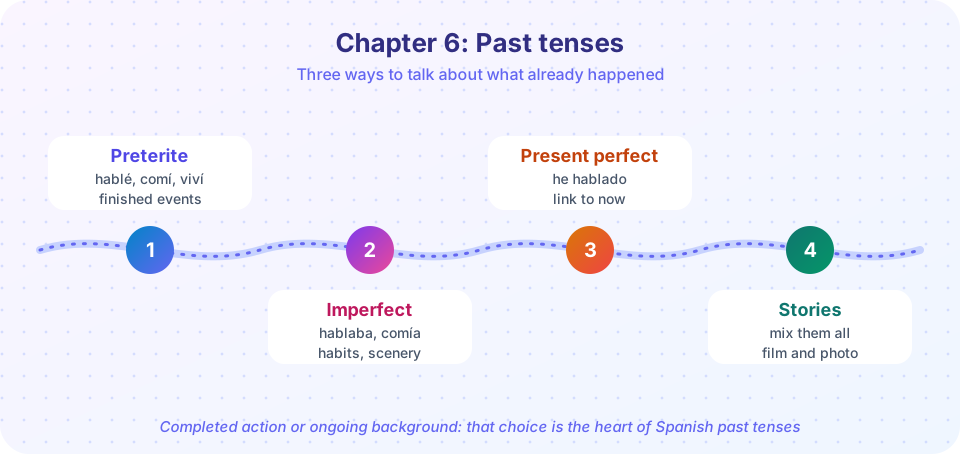
Every sentence about the past answers a small question: is this a completed event, or is it scenery and routine?
- The preterite (pretérito indefinido) reports events as finished: Ayer comí paella. (Yesterday I ate paella.) It is the tense of the plot.
- The imperfect (pretérito imperfecto) describes how things were, what used to happen and what was going on: Cuando era niño, comía paella los domingos. (When I was a child, I ate/used to eat paella on Sundays.) It is the tense of the scenery.
- The present perfect (pretérito perfecto) links the past to the present: Hoy he comido temprano. (Today I have eaten early.)
Choose the tense
Ask: finished event or background?
Time words help
What you will build
Why does Spanish have two past tenses?
English also has the distinction, but it hides it. Compare I lived in Madrid (a finished period) with I used to live in Madrid (a past habit) or I was living in Madrid (an ongoing state). Spanish gives the first one to the preterite (viví) and the other two to the imperfect (vivía). When you notice that English changes its phrasing, such as used to or was ...-ing, you are probably looking at an imperfect.
Here is a tiny story that already mixes all three ideas. Read it slowly:
Ayer llegué a casa a las seis. Hacía frío y llovía. Mi hermano miraba la televisión cuando entré. Me quité el abrigo, preparé un té y me senté con él. Hoy hemos hablado de ese día muchas veces.
Yesterday I arrived home at six. It was cold and raining. My brother was watching television when I came in. I took off my coat, made a tea and sat down with him. Today we have talked about that day many times.
The preterite verbs (llegué, entré, quité, preparé, senté) move the story forward. The imperfect verbs (hacía, llovía, miraba) paint the situation. The present perfect (hemos hablado) comes back to the present. By the end of the chapter you will be able to write a paragraph like this yourself.
Your roadmap
- The preterite: regular forms: endings, spelling changes and the few stem changes.
- Irregular preterite verbs: ser/ir, dar, ver, estar, tener, hacer and the other common irregulars.
- The imperfect: habits, descriptions and the only three irregular verbs.
- Preterite or imperfect?: the key skill, with the film-and-photo model and verbs that change meaning.
- The present perfect: he hablado, has comido and the participles.
- Chapter 6 review: recap, drills and a mixed quiz.
How to approach this chapter
Learn the forms first, because you cannot choose between tenses you cannot build. The preterite takes the most memorization, because about a dozen very common verbs are irregular (fui, tuve, hice, dije). The imperfect is almost perfectly regular. Then spend time on the choice, which is the real skill and improves mostly through reading and listening to stories. Whenever you read a Spanish paragraph about the past, underline the verbs and ask why the writer chose each tense. It is a habit that pays off quickly.
Do not translate word by word from English. English I played can be jugué (a game I played once, completely) or jugaba (I used to play, or I was playing), and only the situation tells you which.
Warm-up flashcards
Check your understanding
Quick check · 3 questions
of 3 answered You scored / 3 · perfect!
-
1. Which tense describes a finished event: "Yesterday I ate paella"?
Completed actions with a clear end use the preterite: Ayer comí paella. -
2. Which tense is used for habits in the past?
Habits and "used to" actions use the imperfect. -
3. What does "Hoy he comido temprano" show?
The present perfect connects the past action to the present period (today).
Summary
- Spanish has two main simple past tenses: preterite (events) and imperfect (scenery, habits).
- The present perfect links a past action to now.
- The choice depends on the speaker's view of the action, not on a fixed translation.
- You will learn forms first, then the choice, then the perfect.
Track your progress
Create a free account to tick off lessons and pick up where you left off on any device.
of Spanish for Beginners lessons completed