


















Lesson 37 of 51 · Future, Commands and Subjunctive Basics
Subjunctive basics in Spanish
Learn the Spanish present subjunctive: how to form it, when wishes, emotions, doubts and recommendations trigger it, and how to use cuando and ojalá.
The subjunctive has a reputation as the hardest part of Spanish, but its core idea is simple: Spanish has a mood for things that are real and certain (the indicative, which you have used until now) and a second mood for things that are wished, doubted, felt or not yet real. The subjunctive is that second mood. This lesson introduces it gently: the forms of the present subjunctive and the handful of triggers you will meet most often.
What you will learn
- Form the present subjunctive for regular, stem-changing and irregular verbs.
- Recognize the main triggers: wishes, requests, emotions, doubt and impersonal expressions.
- Use the pattern main clause + que + subjunctive with a change of subject.
- Use ojalá and cuando + subjunctive for future events.
Key terms
Modo: mood, the speaker's attitude to the action (fact versus wish or doubt). Modo indicativo: the mood of facts and certainty. Modo subjuntivo: the mood of wishes, doubts, emotions and unreal events. Cláusula subordinada: the second part of the sentence after que. Desencadenante: a trigger, an expression that requires the subjunctive.
A first example
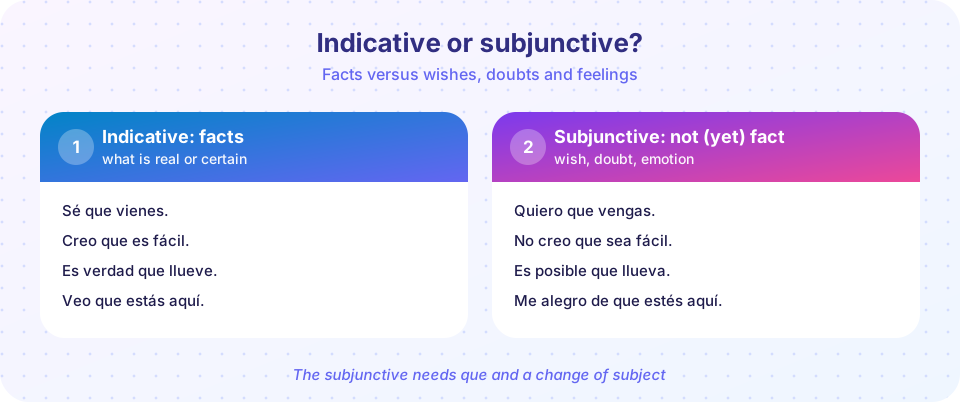
Compare these two sentences:
- Sé que vienes. I know that you are coming. (a fact)
- Quiero que vengas. I want you to come. (a wish about another person, not yet a fact)
In the first sentence the verb vienes is in the indicative because the speaker presents it as true. In the second the speaker does not say that the action happens; he or she only expresses the desire. So the verb vengas appears in the subjunctive. The same idea works for doubts (No creo que venga), emotions (Me alegro de que vengas) and recommendations (Te recomiendo que vengas).
How to form the present subjunctive
The recipe has three steps:
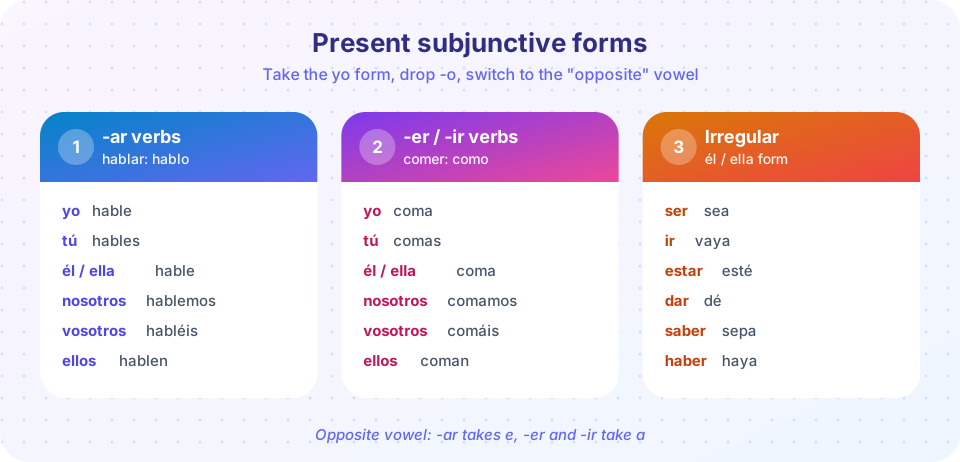
- Take the yo form of the present indicative (hablo, como, vivo, tengo, hago).
- Drop the -o.
- Add the "opposite vowel" endings: -ar verbs take -e, -es, -e, -emos, -éis, -en; -er and -ir verbs take -a, -as, -a, -amos, -áis, -an.
So hablo → habl- gives hable, hables, hable, hablemos, habléis, hablen. And como → com- → coma, comas, coma, comamos, comáis, coman. The yo form carries all of its irregularities with it: tengo → tenga, hago → haga, digo → diga, salgo → salga, vengo → venga, pongo → ponga, conozco → conozca, oigo → oiga, veo → vea.
Spelling changes
To keep pronunciation, -car, -gar and -zar verbs change like in the preterite: buscar → busque, llegar → llegue, empezar → empiece/empecemos (verbs with stem change keep it). Examples: Quiero que busques tu llave. Espero que llegue pronto.
Stem-changing verbs
-ar and -er stem changers follow the boot: all persons except nosotros and vosotros change (pensar → piense, pienses, piense, pensemos, penséis, piensen; volver → vuelva, vuelvas, vuelva, volvamos, volváis, vuelvan). -ir stem changers also change in nosotros and vosotros, in a weaker way (e → i, o → u): pedir → pida, pidas, pida, pidamos, pidáis, pidan; dormir → duerma, duermas, duerma, durmamos, durmáis, duerman; sentir → sienta, sintamos.
Six irregular verbs
Six very common verbs break the recipe: ser → sea, ir → vaya, estar → esté, dar → dé, saber → sepa, haber → haya. Their endings follow the same vowels (sea, seas, sea, seamos, seáis, sean), but the stems are special. Note the accents in esté, estés, estén and dé (the accent separates dé from the preposition de).
The main triggers
The classic memory aid is WEIRDO: Wishes and requests, Emotions, Impersonal expressions, Recommendations, Doubt and denial, Ojalá. Each of these asks the speaker to take a position other than "this is a fact":
| Type | Expression | Example |
|---|---|---|
| Wishes, requests | querer que, desear que, pedir que, preferir que | Quiero que me llames. |
| Recommendations | recomendar que, aconsejar que, sugerir que | Te recomiendo que pruebes el pastel. |
| Emotions | alegrarse de que, tener miedo de que, esperar que, sentir que | Me alegro de que estés aquí. |
| Impersonal opinions | es importante que, es necesario que, es mejor que, es posible que | Es importante que estudies. |
| Doubt, denial | dudar que, no creer que, no pensar que, no es verdad que | Dudo que llegue a tiempo. |
| Ojalá | ojalá (que) | Ojalá llueva mañana. |
Notice the change of subject in almost all of these: I want you to come. When the subject does not change, use the infinitive instead of que + subjunctive: Quiero estudiar (I want to study), but Quiero que estudies (I want you to study). Likewise Espero llegar (I hope to arrive) versus Espero que llegues.
The mood also reverses with belief: affirmative creer que and pensar que take the indicative (Creo que es fácil), but negative forms take the subjunctive (No creo que sea fácil) because the speaker no longer presents it as true. With saber, estar seguro de que the indicative stays: Sé que viene. Estoy seguro de que viene.
Cuando and future events
After cuando (when), Spanish uses the subjunctive if the event has not happened yet: Cuando llegues, llámame. (When you arrive, call me.) Cuando tenga dinero, viajaré. (When I have money, I will travel.) For habits and facts, cuando takes the indicative: Cuando llego a casa, ceno. (When I get home, I have dinner.) Similarly, para que (so that) almost always takes the subjunctive: Te lo explico para que lo entiendas. (I explain it to you so that you understand it.) Antes de que (before) also does.
Try it
This program applies the recipe, the spelling rules and the stem changes, and lists the irregular verbs. Check the forms carefully and add your own verbs to the dictionary.
Press Run (or Ctrl + Enter) to see the result here.
Program input · what you'd type while the program runs
Type the answers before you press Run, one per line. Each time the program reads a line (with input()), it gets the next line from this box.
Choose indicative or subjunctive for each sentence.
Now type the subjunctive forms.
A conversation with wishes
- —Mañana es mi examen. ¡Estoy nervioso! Tomorrow is my exam. I am nervous!
- —Espero que te vaya bien. Es importante que duermas esta noche. I hope it goes well for you. It is important that you sleep tonight.
- —Ojalá me acuerde de todo. I hope I remember everything.
- —Seguro que sí. Cuando termines, llámame. I am sure you will. When you finish, call me.
Observe vaya, duermas, acuerde and termines: four subjunctive forms in four short lines, triggered by espero que, es importante que, ojalá and cuando. Notice also that irle bien a alguien (to go well for someone) is a very common expression: Espero que te vaya bien. You can hear it every time someone has an interview, a trip or a test. Other everyday formulas built on the subjunctive: ¡Que lo pases bien! (Have a good time!), ¡Que descanses! (Rest well!), ¡Que tengas un buen día! (Have a nice day!), ¡Que te mejores! (Get well soon!). Each begins with a silent Espero: the wish is understood.
Common misconceptions
- "The subjunctive is a tense." It is a mood; it has present, past and other tenses of its own.
- "Use the subjunctive after every que." Only after triggers: Sé que, creo que, es verdad que take the indicative.
- "Use subjunctive when the subject is the same." With the same subject use the infinitive: Quiero comer, not Quiero que yo coma.
- "Ojalá always needs que." Ojalá alone works: Ojalá llueva. The que is optional.
Check your understanding
Quick check · 5 questions
of 5 answered You scored / 5 · perfect!
-
1. What is the subjunctive of "hablar" for tú?
Drop the -o of hablo and add the -ar subjunctive ending -es: hables. -
2. Which sentence needs the subjunctive?
A wish about another person requires the subjunctive. -
3. What is the subjunctive of "ser" for él?
Ser is irregular: sea, seas, sea... -
4. What happens with the same subject: "Quiero ___" (I want to eat)?
Use the infinitive when the subject does not change. -
5. Which clause takes the subjunctive: "___ llegues, llámame"?
Cuando with a future event needs the subjunctive.
Summary
- The subjunctive is a mood for wishes, doubts, emotions and non-facts.
- Form: yo present, drop -o, add the opposite vowel (-ar → e, -er/-ir → a); six verbs are irregular (sea, vaya, esté, dé, sepa, haya).
- Triggers: wishes, recommendations, emotions, impersonal opinions, doubt and denial, ojalá (WEIRDO).
- It needs que and a change of subject; the same subject takes the infinitive.
- Cuando, para que and antes de que with future events take the subjunctive.
Next: Commands
Track your progress
Create a free account to tick off lessons and pick up where you left off on any device.
of Spanish for Beginners lessons completed