


















Lesson 5 of 51 · Getting Started
Chapter 1 Review: Getting Started
Review chapter 1 of Spanish for Beginners: why Spanish is approachable, where it is spoken, how varieties differ and which study habits work, with a ten-question quiz.
You have finished the first chapter. It had little new vocabulary, but it set the frame for everything that follows: why Spanish is a friendly language for English speakers, where in the world it lives, how its varieties differ, and how to study so that what you learn stays. This review puts it on one page and then tests it.
If any row of the recap table feels shaky, reread that lesson before moving on. Chapter 2 starts the real work with sounds and your first conversations.
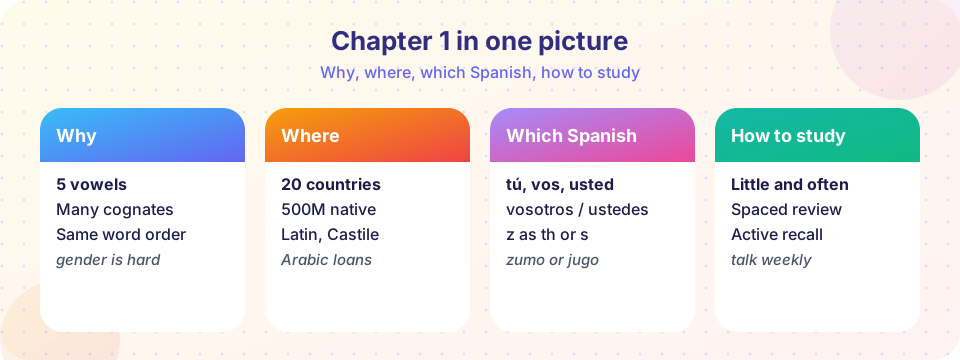
Recap table
| Lesson | Key ideas | Remember |
|---|---|---|
| The Big Picture | Five vowel sounds, regular spelling, many cognates, subject-verb-object order | Gender and verb endings are the hard parts |
| Spanish Around the World | 20 sovereign countries, about 500 million native speakers, origin in Latin and Castile | No variety is more correct than another |
| Regional differences | tú, vos, usted, vosotros, ustedes; z and c as th or s; ordenador and computadora | The shared core works everywhere |
| Study Habits | Little and often, spaced repetition, active recall, input and output | Learn the six classroom phrases |
Words and phrases from this chapter
| Spanish | English |
|---|---|
| hola | hello |
| gracias | thank you |
| por favor | please |
| no entiendo | I do not understand |
| más despacio, por favor | slower, please |
| ¿cómo se dice...? | how do you say...? |
| librería | bookstore (false friend of library) |
| embarazada | pregnant (false friend of embarrassed) |
A can-do checklist
Before you move on, check each statement honestly. If you cannot say yes, reread the lesson in brackets.
- I can name at least three features that make Spanish approachable for English speakers (The Big Picture).
- I can explain what a cognate is and give a false-friend warning such as embarazada or librería (The Big Picture).
- I can say roughly how many people speak Spanish and name five countries where it is official (Spanish Around the World).
- I know why one speaker says vosotros and another ustedes, and why z sounds different in Madrid and in Mexico City (Spanish Around the World).
- I have a 30-minute routine, or at least a 10-minute one, and I know when I will do it (Study Habits).
- I can ask for help in Spanish with No entiendo and Más despacio, por favor (Study Habits).
Your first mini-conversation
Even with a tiny vocabulary you can already hold a short exchange when you get lost. Read both parts aloud, then cover the English and try to say the lines from memory.
| Spanish | English |
|---|---|
| Hola. ¿Habla inglés? | Hello. Do you speak English? |
| Un poco, pero hablemos en español. | A little, but let us speak in Spanish. |
| No entiendo. | I do not understand. |
| ¿Puede repetir, por favor? | Can you repeat, please? |
| Más despacio, por favor. | Slower, please. |
| Gracias. Hablo un poco de español. | Thank you. I speak a little Spanish. |
Notice that every line uses words from this chapter or its close relatives. Do not worry yet about why each verb has its ending (habla, hablo, hablemos); Chapter 4 will explain it. For now treat these lines as ready-made phrases, which is exactly how children first learn them.
What to do between chapters
Take one day before starting Chapter 2 to set up your tools: a stack of paper cards or a flashcard app, a podcast or video channel in Spanish at your level, and one conversation partner or language exchange group you can message. Write your target schedule on a calendar. Many learners find that attaching the habit to an existing one, such as coffee in the morning or the bus ride home, makes it almost automatic. Come back to this review after Chapter 2 if you need to remember how to study; the routine does not change as the grammar grows.
Looking ahead
Chapter 2 is practical: you will learn letters, sounds, stress and your first greetings. As you go, remember the three habits from this chapter. First, reuse everything you learn within a day by saying it aloud. Second, review old material on a schedule so it does not fade. Third, keep a small notebook of phrases you actually need, such as the ones for introducing yourself, ordering a drink or asking for help. After Chapter 2 you will have enough Spanish for a simple, polite conversation with a neighbor, a classmate, or a stranger on a trip.
Try it
Mix everything in this drill, then use the flashcards to review the false friends and cognates once more. The drill is a fixed question list, not an adaptive test.
Check your understanding
Quick check · 9 questions
of 9 answered You scored / 9 · perfect!
-
1. Which feature makes Spanish easier for English speakers?
If you can read the letters you can say the word. Gender and verb endings are the challenges. -
2. What does 'éxito' mean?
Éxito is success. Exit is salida. -
3. Which language is spoken in Brazil?
Brazil is Portuguese-speaking, although it borders many Spanish-speaking countries. -
4. Which word is typical of Spain for 'juice'?
Spain says zumo; Latin America says jugo. -
5. In the Leitner system, a correct answer moves a card...
Higher boxes have longer gaps between reviews. -
6. What does 'No entiendo' mean?
Entender is to understand; No entiendo means I do not understand. -
7. 'Castellano' is another name for...
Castellano means Castilian, the language from Castile, which we call Spanish. -
8. Why should you write flashcards with phrases?
Tengo hambre shows a verb, a noun and a structure at once. -
9. Which pronunciation of the letter z is typical of Latin America?
Seseo: z and c before e or i sound like s in the Americas.
Summary
- You now have the map: why, where, which Spanish and how to study.
- Remember five vowels, many cognates, a few false friends.
- Spanish is official in 20 countries; varieties share one grammar core.
- A small daily routine with review beats cramming.
- Chapter 2 starts with the Spanish sound system.
Track your progress
Create a free account to tick off lessons and pick up where you left off on any device.
of Spanish for Beginners lessons completed