


















Lesson 23 of 51 · Daily Life and Questions
Question words in Spanish
Learn Spanish question words with accents, qué versus cuál, por qué versus porque, cuánto agreement, yes-or-no questions and dialogues to practice.
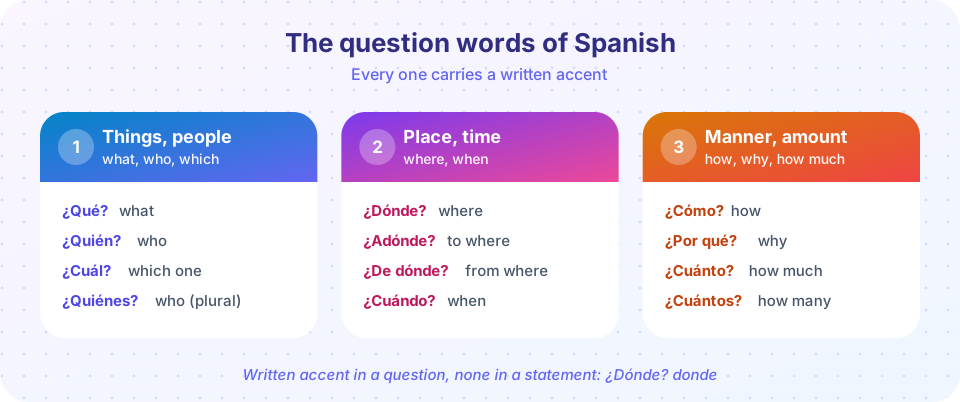
Asking questions is the fastest way to learn a language, because every answer gives you new words and gets you into a conversation. Spanish has a compact set of question words, and once you know them you can ask about almost anything. This lesson covers every important one, shows how to build both kinds of question, and explains the traps that catch English speakers: the accent marks, the difference between qué and cuál, and the difference between por qué and porque.
What you will learn
- Form yes-or-no questions with intonation, inversion and tags.
- Use qué, quién, cuál, dónde, adónde, cuándo, cómo, cuánto and por qué correctly.
- Decide between qué and cuál and between por qué and porque.
- Spell question words with the right accents and punctuation.
Key terms
Pregunta de sí o no: a yes-or-no question, such as ¿Hablas inglés? Palabra interrogativa: a question word such as dónde or cuándo. Tilde: the written accent mark (´) placed over a vowel. Inversión: putting the verb before the subject, ¿Habla Ana español? Pregunta indirecta: a question inside a statement, No sé dónde vive.
Yes-or-no questions
In English you usually need do or does to make a question: Do you speak English? Spanish has no such helper verb. The simplest method is to keep the statement exactly as it is and let your voice rise at the end, while writing the question marks:
- Tú hablas inglés. You speak English.
- ¿Tú hablas inglés? Do you speak English?
Because the verb ending already shows who is speaking, the pronoun is usually dropped: ¿Hablas inglés? A second method is inversion, placing the subject after the verb: ¿Habla Ana español? Is Ana speaking Spanish? / Does Ana speak Spanish? This is very common when the subject is a noun. A third method adds a short tag at the end of a statement: Hace calor, ¿verdad? (It is hot, isn't it?) or Vienes mañana, ¿no? (You are coming tomorrow, right?).
To answer, say sí (yes, with an accent) or no, and then usually repeat the verb: ¿Vives aquí? Sí, vivo aquí. Note that no appears twice in a negative answer: No, no vivo aquí. The first is the answer and the second is the negative word before the verb.
Information questions
When you want facts rather than yes or no, start with a question word, then the verb, then the subject if there is one. The order is almost always question word + verb + subject:
| Spanish | English | Answer pattern |
|---|---|---|
| ¿Qué estudias? | What are you studying? | Estudio biología. |
| ¿Quién es tu profesora? | Who is your teacher? | Es la señora Vega. |
| ¿Dónde vive Pablo? | Where does Pablo live? | Vive en Bogotá. |
| ¿Cuándo es el examen? | When is the exam? | Es el viernes. |
| ¿Cómo te llamas? | What is your name? (literally: how do you call yourself) | Me llamo Lucía. |
| ¿Por qué estudias español? | Why are you studying Spanish? | Porque quiero viajar. |
Notice that there is no do/does: ¿Dónde vive Pablo? is just "Where lives Pablo?" word for word. Also notice that a preposition goes before the question word, never at the end of the sentence. English says "Who are you talking to?" but Spanish must say ¿Con quién hablas? (With whom do you speak?). More examples: ¿De dónde eres? (Where are you from?), ¿Para quién es el regalo? (Who is the gift for?), ¿A qué hora llegas? (At what time do you arrive?).
Qué or cuál?
Both can translate "what" or "which", and learners mix them up constantly. A reliable rule of thumb:
- Use qué when you ask for a definition or when it comes directly before a noun: ¿Qué es un taco? (What is a taco?), ¿Qué libro lees? (Which/What book are you reading?).
- Use cuál (plural cuáles) when you choose among a set and the verb comes next: ¿Cuál es tu número de teléfono? (What is your phone number? - one out of many possible numbers), ¿Cuáles son tus colores favoritos?
Compare ¿Qué es la capital? (What is a capital city? a definition) with ¿Cuál es la capital de Perú? (Which one is the capital of Peru? a choice). Some speakers use qué before a noun even where English says "which", and cuál before a noun is common in some regions of Latin America but is considered non-standard by many grammars, so qué + noun is the safe choice.
Quién, dónde, adónde, de dónde
Quién (who) has a plural, quiénes, which you use when you expect several people: ¿Quiénes son esos chicos? Dónde asks for location: ¿Dónde está el baño? Use adónde (or a dónde) when the verb shows movement toward a place: ¿Adónde vas? (Where are you going?). Use de dónde for origin: ¿De dónde vienes? In everyday speech many people say ¿Dónde vas? even though ¿Adónde vas? is the careful form.
Cuándo, cómo, cuánto
Cuándo asks about time: ¿Cuándo llegas? Cómo asks about manner, condition, or name: ¿Cómo estás?, ¿Cómo se dice "thank you" en español? (How do you say "thank you" in Spanish?). Used alone, ¿Cómo? means "Pardon?" or "What did you say?", which is a handy survival word.
Cuánto agrees with the noun that follows, exactly like an adjective ending in -o:
| Form | Example |
|---|---|
| cuánto (masc. sing.) | ¿Cuánto pan quieres? |
| cuánta (fem. sing.) | ¿Cuánta leche hay? |
| cuántos (masc. pl.) | ¿Cuántos años tienes? |
| cuántas (fem. pl.) | ¿Cuántas hermanas tienes? |
When cuánto stands alone with a verb it does not change: ¿Cuánto cuesta? (How much does it cost?). Ask about someone's age with tener: ¿Cuántos años tienes? Never use ser for age.
Por qué, porque, por que, porqué
Four spellings look almost the same, and Spanish uses all of them:
- ¿Por qué? (two words, accent) asks "why?" in a question: ¿Por qué llegas tarde?
- porque (one word, no accent) means "because": Llego tarde porque pierdo el autobús.
- por que (two words, no accent) is "for which" and is fairly rare: Esta es la razón por que luché.
- el porqué (one word, accent, with a masculine article) is a noun, "the reason": No entiendo el porqué de su enfado.
For now, memorize the first two and you will be right nearly all of the time.
Common misconceptions
- "Accents on question words are optional." They are not. Dónde with an accent is a question word; donde without one means "where" in a statement: Vivo donde nací.
- "Spanish needs do in questions." It does not: ¿Hablas inglés?, never ¿Haces hablar inglés?
- "A question word can end the sentence." Prepositions come first: ¿Con quién hablas?, never ¿Quién hablas con?
Questions inside statements
When a question word sits inside a longer sentence (an indirect question), it keeps its accent but you drop the question marks: No sé dónde está la estación. (I don't know where the station is.) Dime cuándo llegas. (Tell me when you arrive.) Pregúntale cómo se llama. (Ask him how he is called.) This pattern is extremely useful when you politely ask for help: ¿Puede decirme dónde está el museo? (Can you tell me where the museum is?)
Two short dialogues
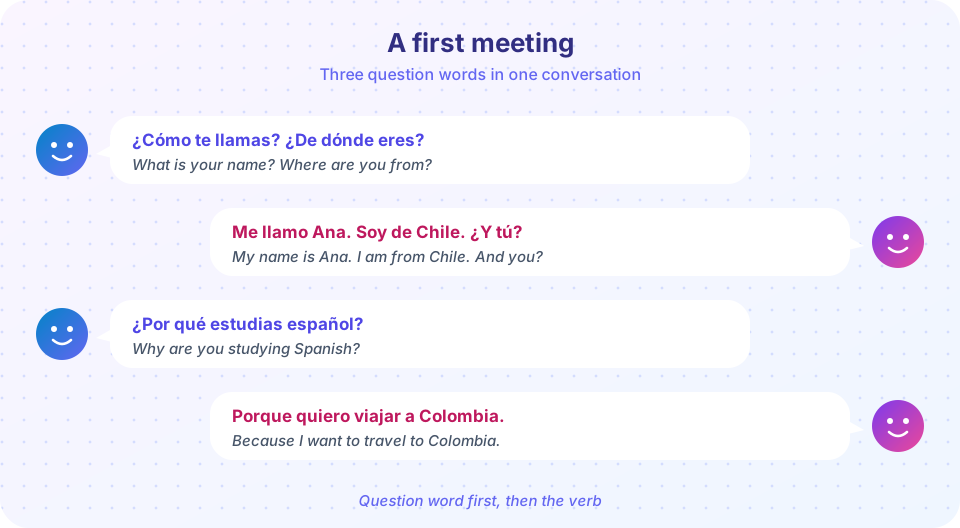
Here is the same conversation in text, with English below:
- —Hola, ¿cómo te llamas? Hi, what is your name?
- —Me llamo Ana. ¿Y tú? My name is Ana. And you?
- —Soy Marco. ¿De dónde eres? I am Marco. Where are you from?
- —Soy de Chile. ¿Por qué estudias español? I am from Chile. Why are you studying Spanish?
- —Porque quiero viajar a Colombia. Because I want to travel to Colombia.
Try it
First practice the choice of question word. Type the missing word with its accent; if you forget the accent the exercise says "almost".
Now match each question word to its meaning, then play a second round.
Each demo runs on the page: no data leaves your browser. The score only counts the words you type, so try the exercise twice, once looking at the lesson and once from memory.
Check your understanding
Quick check · 5 questions
of 5 answered You scored / 5 · perfect!
-
1. Which sentence is correct?
The preposition must come before the question word in Spanish. -
2. Which word completes: "¿___ es la capital de México?" (a choice of one specific city)?
Cuál is used when you pick one item from a set, followed directly by ser. -
3. Which spelling means "because"?
Porque, one word without an accent, introduces the answer. -
4. How do you say "How many sisters do you have?"
Cuántas must agree with the feminine plural noun hermanas. -
5. What does "¿Cómo?" mean when said alone?
Alone, ¿Cómo? is a polite request to repeat what was said.
Summary
- Yes-or-no questions use rising intonation, inversion or a tag such as ¿verdad?
- Information questions follow question word + verb + subject, with no do/does.
- Prepositions go before the question word: ¿De dónde eres?
- Qué asks for definitions and goes before nouns; cuál chooses among options.
- Cuánto agrees in gender and number; por qué asks, porque answers.
- Question words keep their accent inside indirect questions but lose the question marks.
Next: Numbers, time and dates
Track your progress
Create a free account to tick off lessons and pick up where you left off on any device.
of Spanish for Beginners lessons completed