


















Lesson 30 of 51 · Past Tenses
Irregular preterite verbs in Spanish
Memorize the common irregular preterite verbs: ser and ir, dar, ver, estar, tener, hacer, decir and more, with patterns, examples and drills.
Many of the most common Spanish verbs are irregular in the preterite: ser, ir, tener, hacer, decir, poder. That sounds like bad news, but the irregularities follow clear patterns, and learning the patterns lets you cover about two dozen verbs with a handful of rules. In this lesson you will meet the three groups, practise them and learn how to avoid the classic mistakes.
What you will learn
- Recognize and use the identical preterite of ser and ir.
- Use the u-stem, i-stem and j-stem groups with their shared endings.
- Conjugate dar and ver with the regular -er/-ir endings but no accents.
- Use irregular preterites in short stories.
Key terms
Raíz irregular: an irregular stem, such as tuv- for tener. Terminaciones sin acento: endings with no written accent: -e, -iste, -o, -imos, -isteis, -ieron. Verbo irregular: a verb that does not follow the regular pattern. Ser / ir: two verbs with identical preterite forms. Pretérito: the preterite tense.
Ser and ir: the same forms
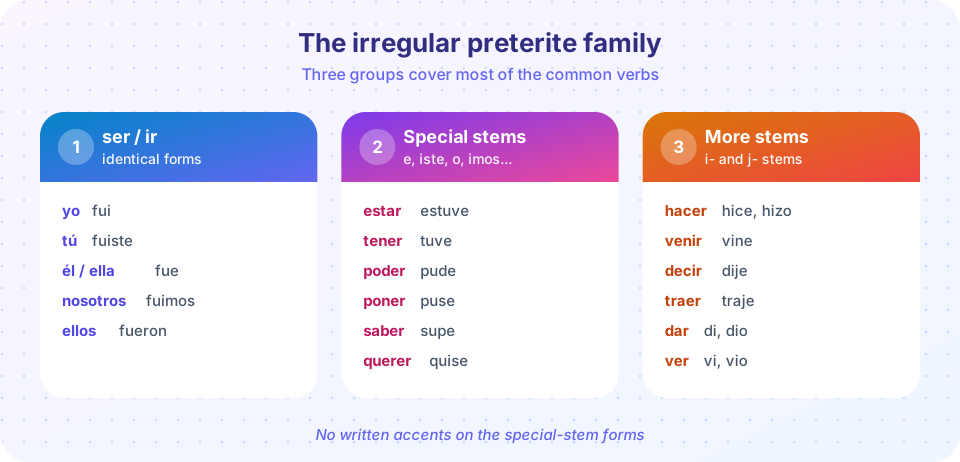
The verbs ser (to be) and ir (to go) have the same preterite forms. Context shows which verb is meant.
| Person | ser / ir |
|---|---|
| yo | fui |
| tú | fuiste |
| él, ella, usted | fue |
| nosotros | fuimos |
| vosotros | fuisteis |
| ellos, ellas, ustedes | fueron |
Fui a la playa. means "I went to the beach" (ir is followed by a and a place). Fui profesor. means "I was a teacher" (ser with a noun). La película fue muy buena. means "The movie was very good". Notice that the forms have no accents: fui, fue are one-syllable words.
The special-stem verbs
A large group of verbs changes its stem and then takes one shared set of endings: -e, -iste, -o, -imos, -isteis, -ieron. These endings have no written accents, which differs from the regular -er/-ir forms (comí, comió).
| Infinitive | Stem | yo | él | Example |
|---|---|---|---|---|
| estar | estuv- | estuve | estuvo | Estuve en casa. |
| tener | tuv- | tuve | tuvo | Tuvimos una fiesta. |
| poder | pud- | pude | pudo | No pude venir. |
| poner | pus- | puse | puso | Puse las llaves en la mesa. |
| saber | sup- | supe | supo | Supe la noticia ayer. |
| querer | quis- | quise | quiso | Quise llamarte. |
| venir | vin- | vine | vino | Vinieron en autobús. |
| hacer | hic- | hice | hizo | Hice la tarea. |
| andar | anduv- | anduve | anduvo | Anduvimos un kilómetro. |
Two details are essential. First, hacer keeps the c sound in all forms except the third person singular, where it becomes z: hice, hiciste, hizo, hicimos, hicisteis, hicieron. Second, the j-stem verbs below lose the i in the ellos ending:
- decir → dij-: dije, dijiste, dijo, dijimos, dijisteis, dijeron (not dijieron).
- traer → traj-: traje, trajiste, trajo, trajimos, trajisteis, trajeron.
- conducir → conduj-: conduje, condujiste, condujo, condujimos, condujisteis, condujeron.
Verbs built from these also share the pattern: mantener → mantuvo, obtener → obtuvo, componer → compuso, predecir → predijo, contener, detener, suponer, proponer and so on.
Dar and ver
Dar (to give) and ver (to see) are -er/-ir style in the preterite, with no accents because every form is short:
- dar: di, diste, dio, dimos, disteis, dieron
- ver: vi, viste, vio, vimos, visteis, vieron
Example: Le di un regalo a mi hermana. (I gave my sister a present.) Vimos una película increíble. (We saw an incredible movie.)
Other useful irregulars
- haber (impersonal hay) has hubo (there was/were) in the preterite: Hubo una tormenta. (There was a storm.)
- oír, creer, leer, caer use the y-pattern you saw in the last lesson.
- -ucir verbs (conducir, traducir, producir) take -uj- stems: traduje, tradujeron.
- Verbs with spelling endings such as construir → construyó, construyeron.
Putting them together
Here is a short story using the irregular preterite:
El sábado fui al mercado con mi hermana. Hicimos las compras, vimos a unos amigos y tuvimos tiempo para tomar un café. Ella dijo que quería comprar unas flores, pero no pudo encontrar ninguna. Volvimos a casa y puse la compra en la cocina.
On Saturday I went to the market with my sister. We did the shopping, saw some friends and had time for a coffee. She said that she wanted to buy some flowers, but she couldn't find any. We went back home and I put the groceries in the kitchen.
Look at pudo encontrar: poder in the preterite means that someone managed to do something (or in the negative, failed to). You will see more of these meaning changes in the lesson on preterite versus imperfect.
Common misconceptions
- "Dijieron is the right plural of dijo." The j-stem verbs drop the i: dijeron, trajeron.
- "Fue always means he was." Fue can be "went" or "was" and context decides: Fue a Madrid versus Fue difícil.
- "Hacer is regular in the preterite." It has the stem hic- and hizo.
- "Tuvieron, tuvimos need accents." Special-stem forms never take an accent.
Meaning changes with some verbs
A few verbs carry extra meaning in the preterite, because the preterite presents the action as complete. Supe la verdad means "I found out the truth" (and did not know before). Pude abrir la puerta means "I managed to open the door", while No pude abrirla means "I tried and failed". Quise llamarte means "I tried to call you" and No quise ir means "I refused to go". Tuve una idea means "I got an idea". These meaning changes are a favorite exam topic; you will contrast them with the imperfect in the lesson on preterite or imperfect.
Memory strategies
Do not try to memorize 20 verbs one by one. Build three small lists and say them aloud: the u-group (estar, tener, poder, poner, saber, andar: estuv-, tuv-, pud-, pus-, sup-, anduv-), the i-group (querer, venir, hacer: quis-, vin-, hic-) and the j-group (decir, traer, conducir). Then write one sentence for each verb about your own life: Ayer estuve en la biblioteca. Hice la cena. Vine en autobús. Personal sentences are far easier to remember than abstract tables.
A short dialogue to read aloud:
- —¿Qué hiciste el fin de semana? What did you do over the weekend?
- —El sábado fui al cine y el domingo estuve en casa. ¿Y tú? On Saturday I went to the cinema and on Sunday I was at home. And you?
- —Yo vine a la ciudad con unos amigos y vimos un concierto. I came to the city with some friends and we saw a concert.
Try it
Run the table below to see all the irregular patterns together. Then read each row aloud.
Press Run (or Ctrl + Enter) to see the result here.
Program input · what you'd type while the program runs
Type the answers before you press Run, one per line. Each time the program reads a line (with input()), it gets the next line from this box.
Type the missing irregular preterite forms.
Match each infinitive with its yo preterite form.
Check your understanding
Quick check · 5 questions
of 5 answered You scored / 5 · perfect!
-
1. What does "Fui al parque" mean?
Fui can come from ir or ser; with a + place it is "I went". -
2. What is the correct preterite of "decir" for ellos?
After j the ending is -eron: dijeron. -
3. How do you say "She did the homework"?
Hacer in the third person singular is hizo. -
4. Which verb has the preterite stem "tuv-"?
Tener becomes tuve, tuviste, tuvo... -
5. What is the preterite of "ver" for yo?
Vi has no written accent because it is a one-syllable word.
Summary
- Ser and ir share fui, fuiste, fue, fuimos, fuisteis, fueron.
- Special-stem verbs (estar, tener, poder, poner, saber, querer, venir, hacer, decir, traer) use the unaccented endings -e, -iste, -o, -imos, -isteis, -ieron.
- Hacer has hizo; j-stems have -eron (dijeron, trajeron).
- Dar and ver use short forms: di, dio; vi, vio.
- Poder, querer, saber and tener change meaning in the preterite (managed, tried, found out, got).
Next: The imperfect
Track your progress
Create a free account to tick off lessons and pick up where you left off on any device.
of Spanish for Beginners lessons completed