


















Lesson 26 of 51 · Daily Life and Questions
Daily routine and reflexive verbs in Spanish
Talk about your day in Spanish with reflexive verbs like levantarse, ducharse and acostarse: pronouns, position, stem changes, time words and a conjugator.
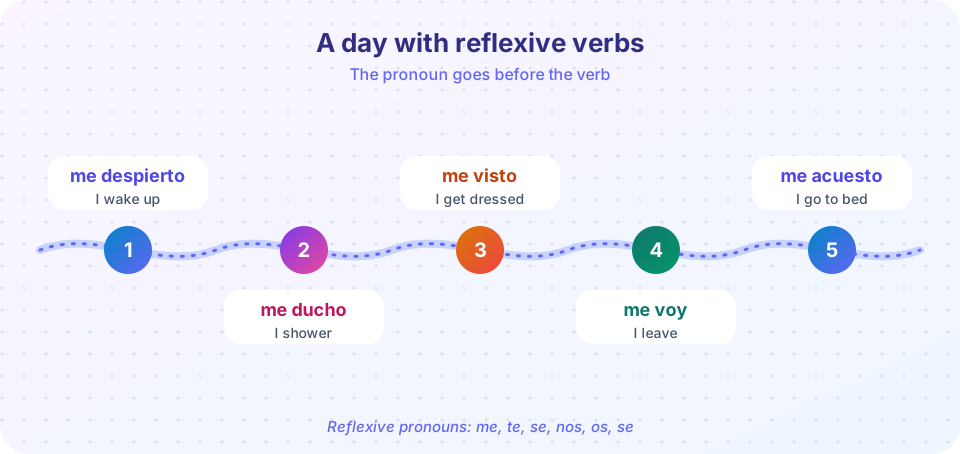
Think about your morning: you wake up, wash your face, brush your teeth, get dressed. In Spanish, many of these everyday actions are reflexive, which means the person who does the action is also the one who receives it. The verb comes with a small extra pronoun: me despierto, me lavo, me visto. Learning reflexive verbs lets you describe your daily routine, one of the most common topics in any beginner conversation.
What you will learn
- Recognize reflexive verbs ending in -se and conjugate them in the present.
- Place reflexive pronouns before conjugated verbs and attach them to infinitives.
- Use stem-changing reflexive verbs such as despertarse, acostarse and vestirse.
- Describe a routine with time words and sequence words.
Key terms
Verbo reflexivo: a verb whose action returns to the subject; the infinitive ends in -se. Pronombre reflexivo: me, te, se, nos, os, se. Rutina diaria: daily routine. Cambio de raíz: a stem change, e.g. despertar becomes despierto. Adverbio de frecuencia: siempre, a veces, nunca.
What makes a verb reflexive?
Compare two sentences:
- Lavo el coche. I wash the car. The car receives the action.
- Me lavo. I wash (myself). I do it and I receive it.
When the dictionary form ends in -se (lavarse, levantarse, ducharse) the verb is listed in its reflexive form. Conjugate it by first dropping -se, conjugating the verb normally, and then putting the matching pronoun before it:
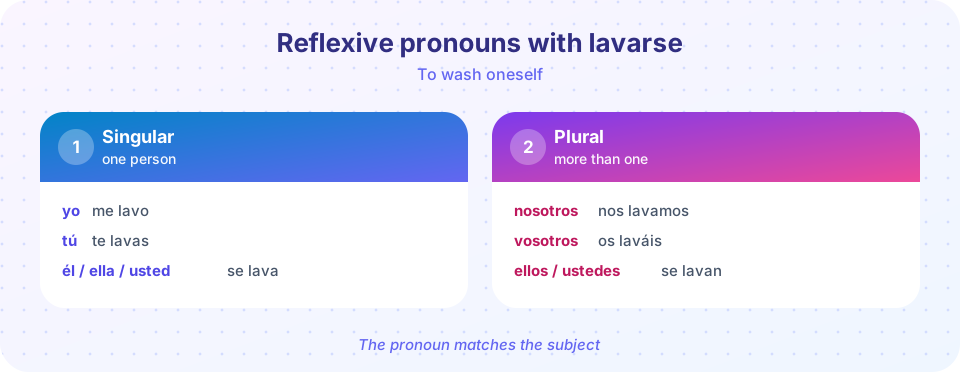
Each pronoun matches the subject: Yo me lavo. Tú te lavas. Ella se lava. Nosotros nos lavamos. Vosotros os laváis. Ellos se lavan. In practice you can drop the subject pronoun, because the reflexive pronoun already identifies the person: Me lavo las manos. Never drop the reflexive pronoun itself.
The essential reflexive verbs
| Verb | Meaning | Yo form | Notes |
|---|---|---|---|
| levantarse | to get up | me levanto | regular |
| despertarse | to wake up | me despierto | e becomes ie |
| ducharse | to shower | me ducho | regular |
| bañarse | to bathe | me baño | regular |
| lavarse | to wash oneself | me lavo | regular |
| peinarse | to comb one's hair | me peino | regular |
| cepillarse | to brush | me cepillo | regular |
| vestirse | to get dressed | me visto | e becomes i |
| ponerse | to put on | me pongo | irregular yo |
| quitarse | to take off | me quito | regular |
| sentarse | to sit down | me siento | e becomes ie |
| acostarse | to go to bed | me acuesto | o becomes ue |
| dormirse | to fall asleep | me duermo | o becomes ue |
| irse | to leave | me voy | irregular |
| llamarse | to be called | me llamo | regular |
The stem change affects every form except nosotros and vosotros: me acuesto, te acuestas, se acuesta, nos acostamos, os acostáis, se acuestan. The verb irse is the irregular ir plus the pronoun: me voy, te vas, se va, nos vamos, os vais, se van. It means to leave or go away, while ir alone means to go.
Body parts and clothes
English says "I wash my hands." Spanish uses the reflexive pronoun to show whose hands, and then a definite article: Me lavo las manos. (literally: I wash myself the hands.) The same applies to Me cepillo los dientes (I brush my teeth), Me pongo el abrigo (I put on my coat), Se quita los zapatos (he takes off his shoes). Do not say Me lavo mis manos; it sounds unnatural.
Where the pronoun goes
With a conjugated verb, the pronoun comes first: Me levanto temprano. With infinitives and gerunds you can place it in one of two ways:
- Before the conjugated verb: Me voy a duchar. Me estoy vistiendo.
- Attached to the end: Voy a ducharme. Estoy vistiéndome. (A written accent is added to the gerund: vistiéndome.)
Whichever pattern you choose, the pronoun must match the subject: Nos vamos a acostar or Vamos a acostarnos, never Vamos a acostarse. In negative sentences, put no before the pronoun: No me levanto temprano.
Talking about a routine
Combine the verbs with time and sequence words:
- Times: a las siete, por la mañana, por la tarde, por la noche, temprano, tarde.
- Frequency: siempre (always), normalmente (usually), a menudo (often), a veces (sometimes), nunca (never), todos los días (every day).
- Sequence: primero (first), luego or después (then, later), antes de + infinitive (before doing), después de + infinitive (after doing), por fin (at last).
A sample day, with translation:
Normalmente me despierto a las seis y media. Primero me levanto, luego me ducho y me visto. Después de desayunar, me cepillo los dientes y me voy al trabajo. Por la noche me acuesto a las once.
Usually I wake up at six thirty. First I get up, then I shower and get dressed. After having breakfast, I brush my teeth and leave for work. At night I go to bed at eleven.
Note después de desayunar: after a preposition Spanish uses the infinitive, where English uses "-ing".
Reflexive or not?
Some verbs change meaning when they become reflexive. Poner means to put, ponerse means to put on (clothes). Dormir is to sleep, dormirse is to fall asleep. Ir is to go, irse is to leave. Llamar is to call someone, llamarse means to be named: Me llamo Sara literally means "I call myself Sara". Reflexive pronouns can also express reciprocal actions among several people: Nos queremos mucho (We love each other a lot), Se escriben cada semana (They write to each other every week).
Common misconceptions
- "Reflexive means the action is always about washing." It also covers feelings and changes of state: me divierto (I have fun), se enfada (he gets angry).
- "Drop the pronoun if you drop the subject." The subject can go; the reflexive pronoun cannot.
- "I wake my brother up" uses despertar without se: Despierto a mi hermano. Me despierto means I wake myself up.
Asking about routines
To ask someone about their day you need the tú forms and a question word: ¿A qué hora te levantas? (What time do you get up?), ¿Cuándo te duchas, por la mañana o por la noche?, ¿Te acuestas tarde los fines de semana? The answers repeat the verb with yo: Me levanto a las siete. With a stranger or an older person use usted, whose reflexive pronoun is se: ¿A qué hora se levanta usted?
Weekends often change the routine. Useful phrases are los lunes, los fines de semana (on weekends), entre semana (during the week), de lunes a viernes (from Monday to Friday) and los domingos (on Sundays). Try saying: Entre semana me levanto temprano, pero los domingos me quedo en la cama hasta las diez. Here quedarse means to stay and is also reflexive: me quedo, te quedas, se queda. Finally, remember that despertarse is the moment you open your eyes, while levantarse is when you actually get out of bed; Spanish speakers often use both in one sentence.
Try it
This conjugator shows eight reflexive verbs in the present. Look at the stem-changing forms and the nosotros and vosotros exceptions.
Press Run (or Ctrl + Enter) to see the result here.
Program input · what you'd type while the program runs
Type the answers before you press Run, one per line. Each time the program reads a line (with input()), it gets the next line from this box.
Now complete the routine sentences. Check pronouns and conjugated forms.
Check your understanding
Quick check · 5 questions
of 5 answered You scored / 5 · perfect!
-
1. What does "me lavo las manos" mean?
The reflexive pronoun me means the washing returns to the speaker; las manos takes the definite article. -
2. What is the correct form of "acostarse" for nosotros?
Stem changes do not apply to nosotros and vosotros: nos acostamos. -
3. Which sentence puts the pronoun in a correct place?
With yo, the attached infinitive pronoun must be me: ducharme. -
4. How do you say "She puts on her coat"?
Spanish uses the reflexive pronoun and a definite article for clothes. -
5. What does "Me llamo Sara" literally mean?
Llamarse is reflexive: I call myself Sara.
Summary
- Reflexive verbs end in -se and use me, te, se, nos, os, se before the verb.
- With infinitives and gerunds you may place the pronoun before the conjugated verb or attach it.
- Stem changes apply except for nosotros and vosotros; irse is irregular.
- Body parts and clothes take articles: me lavo las manos.
- Time and sequence words (primero, luego, antes de) turn verbs into a routine story.
Next: Chapter 5 review
Track your progress
Create a free account to tick off lessons and pick up where you left off on any device.
of Spanish for Beginners lessons completed