


















Lesson 17 of 51 · Present Tense Verbs
Present Tense Verbs: The Big Picture
Chapter 4 overview: subject pronouns, infinitives, verb endings and how the Spanish present tense works, plus a map of the ser, estar, regular and irregular verb lessons.
Verbs are where Spanish gets its energy. In English a verb barely changes: I speak, you speak, we speak, they speak; only he speaks is different. In Spanish, the verb ending changes for every person: hablo, hablas, habla, hablamos, hablan. That sounds like more to learn, and it is. But it also brings a gift: the ending already tells you who is doing the action, so Spanish speakers often drop the subject pronoun altogether. Hablo español means "I speak Spanish" without needing yo.
This chapter teaches the present tense, the form you use for what happens now, what happens regularly, and often what will happen soon. You start with the two verbs meaning "to be", then regular verbs in three families, then the irregular ones you cannot avoid.
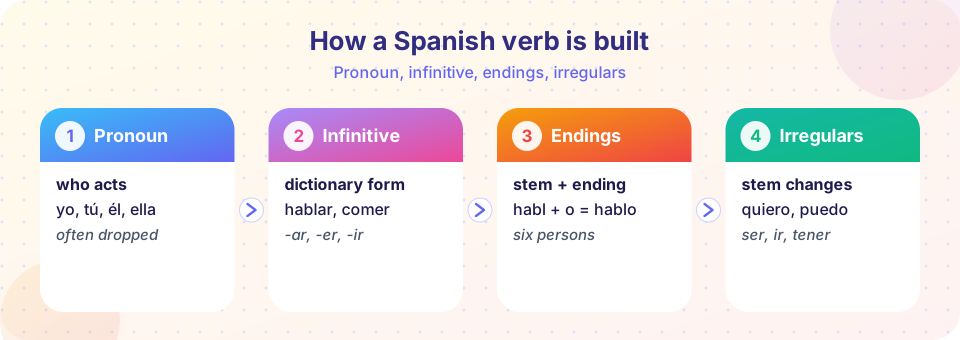
What you will learn
- The vocabulary of verbs: infinitive, conjugation, person and number.
- The Spanish subject pronouns and when to leave them out.
- What the present tense is used for.
- The order of the lessons and how the three verb families work.
Key terms
Infinitive: the dictionary form of a verb, ending in -ar, -er or -ir (hablar, comer, vivir).
Conjugation: the set of forms a verb takes for each person.
Stem: the infinitive without its ending (habl-, com-, viv-).
Person and number: first (I, we), second (you), third (he, she, it, they); singular or plural.
Irregular verb: a verb that does not follow the normal pattern of its family.
Subject pronouns
The subject of a sentence is who or what does the action. Spanish has twelve subject pronouns, because it distinguishes gender in the plural and has formal and informal "you":
| Person | Singular | Plural |
|---|---|---|
| 1st | yo (I) | nosotros / nosotras (we) |
| 2nd, informal | tú (you) | vosotros / vosotras (you all, mainly Spain) |
| 2nd, formal | usted (you) | ustedes (you all) |
| 3rd | él (he), ella (she) | ellos, ellas (they) |
Nosotras, vosotras and ellas are used for groups of only women; any group with at least one man uses the masculine form. Usted is grammatically third person: it takes the same verb ending as él and ella. Ustedes takes the same ending as ellos. In Latin America ustedes replaces vosotros for all plural "you". English has no neuter pronoun for things, but Spanish needs none: it is simply expressed by the verb.
Dropping the pronoun
Because each ending identifies the person, subject pronouns are optional and usually left out:
- Hablo español. I speak Spanish. (No yo needed.)
- ¿Vives aquí? Do you live here?
- Comemos a las dos. We eat at two.
Use a pronoun when you want emphasis or contrast (Yo hablo español, ella habla inglés: I speak Spanish, she speaks English), when the verb form is ambiguous (usted come and él come share a form), or when you answer a question (¿Quién habla? Yo). Overusing yo, tú and nosotros is a typical beginner habit that sounds slightly unnatural.
Three families
Every regular Spanish verb belongs to one of three families, according to the last two letters of the infinitive. Each family has its own set of endings that attach to the stem:
- -ar verbs: hablar, trabajar, estudiar, comprar (the biggest family).
- -er verbs: comer, beber, aprender, leer, vender.
- -ir verbs: vivir, escribir, abrir, recibir, subir.
The lesson Regular Verbs in the Present gives you the endings. Learn them as a chant, aloud, until they are automatic.
The present tense and its uses
Spanish uses the present for what English spreads across several forms:
- Habit and fact: Trabajo en un banco. I work in a bank. El agua hierve a 100 grados. Water boils at 100 degrees.
- Right now: Hablo contigo. I am talking to you. (Spanish has a separate "-ing" form, but the simple present is used much more.)
- Near future: Mañana viajo a Madrid. Tomorrow I am travelling to Madrid.
- Vivid past in stories: the "historical present" in narration.
So you do not need separate tenses for I speak and I am speaking; the one form hablo covers both in most cases.
Common misconceptions
"I must always say yo, tú, él." No. The ending carries the information; including the pronoun adds emphasis.
"Usted needs the 2nd-person ending." Usted is grammatically third person: usted habla, not usted hablas.
"Regular verbs have no endings in the present." They have six forms; only the he/she form of English looks like the stem.
"I need to learn every irregular verb now." Only a dozen very common verbs are irregular in the present; you will meet them in the last lesson of this chapter and practice them all course long.
What the lessons cover
| Lesson | What it gives you |
|---|---|
| Ser and Estar: Two Verbs for "To Be" | Identity, origin and characteristics versus location and states |
| Regular Verbs in the Present | The endings of -ar, -er and -ir verbs, negatives and questions |
| Irregular Verbs in the Present | Stem changes, yo-go verbs, ir, tener, hacer and more |
| Chapter 4 Review | A one-page recap and a ten-question quiz |
Who is acting?
Three families
Stem plus ending
Irregulars
Try it
The drill checks the pronoun rules from this overview, and the flashcards give you ten high-frequency verbs in the infinitive. Both are fixed lists, not adaptive tests.
Check your understanding
Quick check · 4 questions
of 4 answered You scored / 4 · perfect!
-
1. What is an infinitive?
Hablar, comer and vivir are infinitives. -
2. Why can Spanish speakers often omit the subject pronoun?
Hablo can only mean I speak, so yo is optional. -
3. Which pronoun do Latin Americans use for 'you all'?
Latin America uses ustedes for all plural you. -
4. What does 'Mañana viajo a Madrid' mean?
The present tense can express a near-future plan.
Summary
- Spanish verbs change their endings for every person; the ending tells you who acts.
- Subject pronouns are optional and used for emphasis or contrast.
- Regular verbs fall into -ar, -er and -ir families, each with its own endings.
- The present covers habit, now, and often the near future.
- The next lesson tackles the two verbs for "to be": ser and estar.
Track your progress
Create a free account to tick off lessons and pick up where you left off on any device.
of Spanish for Beginners lessons completed