


















Lesson 9 of 51 · Sounds, Greetings and Basics
Stress and Accent Marks
Learn where to stress Spanish words, the three stress rules, when to write the accent mark, diphthongs, and accents that separate words like tu and tú.
In every Spanish word of more than one syllable, one syllable is pronounced louder, longer and a bit higher than the rest. Put the stress in the wrong place and a word can become hard to recognize, or become a different word: hablo (I speak) and habló (he spoke) differ only in stress. The good news is that Spanish has a simple system. Three rules tell you where the stress falls, and a written accent mark appears exactly when a word breaks those rules. So once you know the rules, spelling tells you the stress, and the stress tells you whether you need an accent.
This lesson teaches the system, shows the few accents that distinguish words, and ends with a small tool that applies the rules to any word.
What you will learn
- How to divide a word into syllables.
- The three stress rules and the names aguda, llana and esdrújula.
- When Spanish writes an accent mark and why.
- Words that differ only by an accent (tu and tú).
Key terms
Syllable: a unit of sound built around a vowel or a diphthong (pa-la-bra has three).
Tonic syllable: the stressed syllable of a word.
Acute accent (tilde): the mark ´ over a vowel. It always shows stress.
Aguda, llana, esdrújula: words stressed on the last, second-to-last and third-to-last syllable.
Counting syllables
First cut the word into syllables. A syllable has exactly one vowel nucleus (a vowel or a diphthong, see the previous lessons). A consonant between two vowels goes with the following vowel: ca-sa, ma-ña-na. Two consonants are usually split: can-tar, es-pa-ñol, per-so-na. The exceptions are clusters like pr, br, tr, dr, cr, gr, fl, pl, bl, cl, which stay together and go with the next vowel: a-pren-der, ha-blar, li-bro, ma-dre. The digraphs ch, ll and rr count as single consonants, so they are never split: pe-rro, ca-lle, mu-cho.
The three stress rules
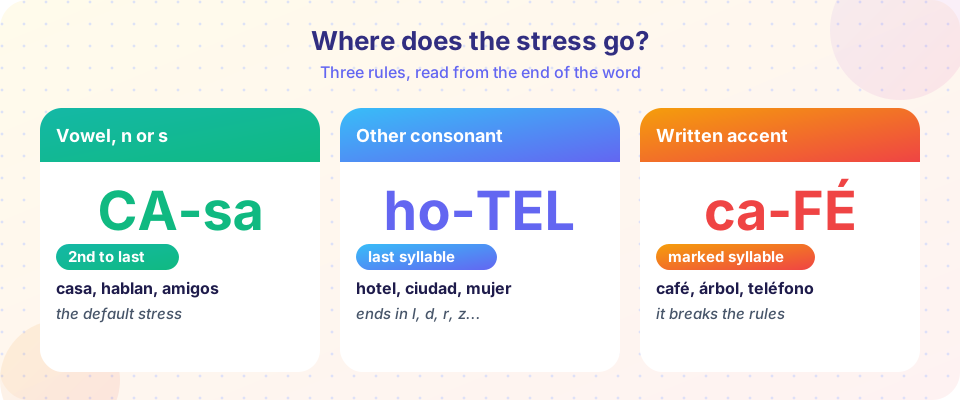
- Ends in a vowel, n or s: stress the second-to-last syllable. CA-sa, HA-blan (they speak), a-MI-gos (friends), CO-men, li-te-ra-TU-ra.
- Ends in any other consonant: stress the last syllable. ho-TEL, ciu-DAD, mu-JER, ha-BLAR, ver-DAD.
- A written accent mark overrides the rules. The accented syllable is stressed: ca-FÉ, CAN-ción, ÁR-bol, TE-lé-fo-no.
Why the strange choice of n and s? Because the final -n and -s are the endings of plural nouns and third-person verbs, so most words end in them or in a vowel, and the second-to-last syllable is by far the most common stress position. Spanish simply chose that as the default.
The names for the three patterns help you read grammar explanations: aguda (stress on last syllable), llana or grave (stress on the second-to-last), esdrújula (third-to-last, always with an accent). There is also a rare sobresdrújula, fourth-to-last, found in verbs with pronouns (dígamelo).
When to write the accent
Write the accent only when the word breaks the default:
- Aguda ending in a vowel, n or s: café, sofá, canción, adiós, también, inglés. (The default for those endings is the second-to-last, so being stressed on the last needs a mark.)
- Llana ending in a consonant other than n or s: árbol, lápiz, fácil, azúcar, débil. (The default for those endings is the last, so stress on the second-to-last needs a mark.)
- Esdrújula, always: teléfono, música, rápido, plátano, cámara.
Examples that do not need a mark: hotel, ciudad, mujer (aguda ending in a normal consonant), casa, amigos, hablan (llana ending in vowel, n or s).
Monosyllables normally have no written accent (sol, pan, ver, fue, dio), with some exceptions you see below.
Accents that distinguish words
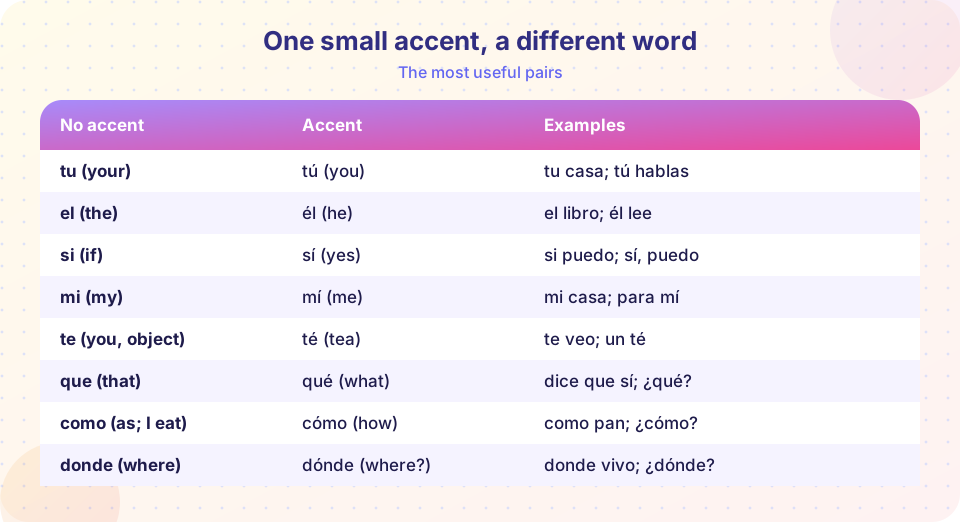
A handful of short words are spelled the same but differ in meaning, and the accent tells them apart. This is called the tilde diacrítica. The most useful pairs:
| No accent | With accent | Examples |
|---|---|---|
| tu (your) | tú (you) | tu casa; tú hablas |
| el (the) | él (he) | el libro; él lee |
| si (if) | sí (yes) | si puedo; sí, puedo |
| mi (my) | mí (me, after a preposition) | mi casa; para mí |
| te (you, object) | té (tea) | te veo; un té |
| que (that) | qué (what) | dice que sí; ¿qué? |
Question and exclamation words also carry the accent: qué, cómo, dónde, cuándo, quién, cuál, cuánto. ¿Dónde vives? (Where do you live?) but la ciudad donde vivo (the city where I live).
Accents on diphthongs and hiatus
An accent can also split a diphthong. Pais would be read PAIS (one syllable), but país is pa-ÍS. The accent on í keeps it a separate syllable. Likewise día is DÍ-a and María is ma-RÍ-a. In diphthongs the accent goes on the strong vowel (adiós, también, lección) and on the second vowel when both are weak (cuídate, interviú).
Stress in action
Let us apply the rules to five longer words, one step at a time. Universidad: it ends in d, so the stress falls on the last syllable, u-ni-ver-si-DAD, with no accent. Estudiantes: it ends in s, so the stress goes on the second-to-last, es-tu-DIAN-tes, again with no accent. Miércoles: the stress is on the third-to-last syllable, MIÉR-co-les, so it is an esdrújula and needs the accent. Teléfono: three syllables from the end, so the accent is required. Lápiz: it ends in z, so the default stress would be the last syllable, but it is stressed on the first, so it gets an accent.
Stress can change the meaning of a verb. Compare término (TÉR-mi-no, term or end), termino (ter-MI-no, I finish) and terminó (ter-mi-NÓ, he or she finished). Likewise canto (I sing) and cantó (he sang), hablo (I speak) and habló (he spoke). When you read Spanish aloud and you see an accent, give that syllable more force.
When you listen, you will notice that the stressed syllable is often a little louder, longer and higher. Use that to find word boundaries in fast speech. When you learn a new word, learn its stressed syllable at the same time and write the syllables on a card with the stressed one in capitals, as the Python tool above does.
Common misconceptions
"The accent mark is decoration." It changes pronunciation and sometimes meaning: hablo (I speak) versus habló (he spoke), papa (potato) versus papá (dad).
"Capital letters do not take accents." They do. África, Álvaro and ¿Cómo estás? are correct even in capitals.
"Every word ending in -s is stressed on the last syllable." The opposite: ending in s means the default is the second-to-last syllable (amigos).
Try it
The Python tool below applies the syllable and stress rules from this lesson. It is a simplified rule engine, so treat it as a study aid; it does not know exceptional words and cannot hear. Then a drill and flashcards for the accent pairs.
Press Run (or Ctrl + Enter) to see the result here.
Program input · what you'd type while the program runs
Type the answers before you press Run, one per line. Each time the program reads a line (with input()), it gets the next line from this box.
Check your understanding
Quick check · 5 questions
of 5 answered You scored / 5 · perfect!
-
1. Which syllable is stressed in 'ciudad'?
It ends in d, a consonant other than n or s, so the stress is on the last syllable. -
2. Which word needs an accent?
Árbol is stressed on the second-to-last syllable but ends in l, so it needs the accent. -
3. What is the difference between 'tu' and 'tú'?
The accent distinguishes the possessive tu from the pronoun tú. -
4. Which words are called esdrújulas?
Teléfono and música are esdrújulas. -
5. How many syllables does 'país' have?
The accent on í keeps it separate: pa-ís.
Summary
- Words ending in a vowel, n or s stress the second-to-last syllable; others stress the last.
- A written accent marks any stress that breaks those rules, and esdrújulas always have one.
- Accents also distinguish tu/tú, el/él, si/sí, mi/mí, te/té, que/qué.
- Question words carry an accent: qué, cómo, dónde, cuándo.
- An accent on í or ú keeps it as its own syllable: pa-ís, dí-a.
Track your progress
Create a free account to tick off lessons and pick up where you left off on any device.
of Spanish for Beginners lessons completed