


















Lesson 22 of 51 · Daily Life and Questions
Chapter 5 overview: Daily life and questions
See what chapter 5 of Spanish for Beginners covers: question words, numbers, time, food, shopping and daily routines, with a roadmap of every lesson.
You can already greet people, describe things and use the present tense. Chapter 5 is where Spanish starts to feel useful on an ordinary day. You will learn to ask questions properly, to say numbers, times and dates, to order a meal and pay for it, and to talk about your own daily routine.
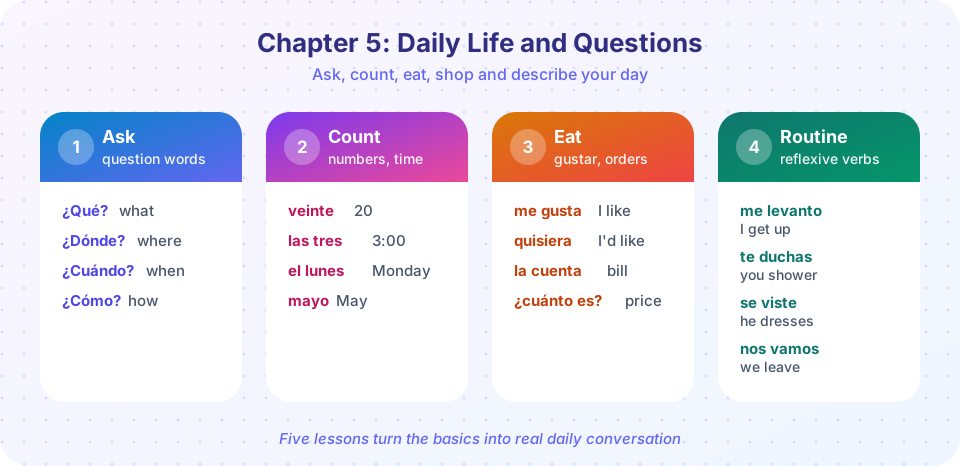
The big picture
Almost every real conversation is made of a few simple moves. Someone asks something (¿Dónde está la estación?), someone gives a number or a time (Son las cinco y media), someone expresses a preference or a need (Me gusta el café, pero quisiera un té), and someone reports what they do (Me levanto a las siete). Each lesson in this chapter trains one of those moves, and each ends with practice that you can run in your browser.
The chapter also introduces three grammar ideas that will come back again and again:
- Question words carry a written accent in questions and no accent in statements (¿Por qué? versus porque).
- Numbers behave like adjectives in a few cases: doscientas casas, veintiún años.
- Reflexive verbs use a small pronoun that shows the action returns to the person doing it: me lavo, te lavas, se lava.
Spanish uses an opening question mark and an opening exclamation mark: ¿Cómo estás? and ¡Qué bien! The upside-down mark warns the reader early that a question or exclamation is coming. Always write both marks.
Your roadmap
Chapter 5 at a glance
Five lessons, one skill each
Why it matters
How to study
The lessons in this chapter, in order:
- Question words: qué, quién, dónde, cuándo, cómo, por qué, cuánto, cuál and how to build both yes-or-no and information questions.
- Numbers, time and dates: counting to a million, telling the time, days, months and the date.
- Food, restaurants and shopping: gustar, quisiera, ordering, paying and asking prices.
- Daily routine and reflexive verbs: levantarse, ducharse, vestirse and talking about your day.
- Chapter 5 review: one picture, one table and ten mixed questions.
What you will be able to do
By the end of the chapter you should be able to do the following in Spanish, with a few mistakes but without freezing:
- Ask someone's name, origin, age, address and reasons: ¿Cómo te llamas? ¿De dónde eres? ¿Cuántos años tienes? ¿Dónde vives? ¿Por qué estudias español?
- Understand and give times, prices, phone numbers and dates, such as Son las ocho y media, Cuesta cuarenta y cinco euros, el veintitrés de abril.
- Order food and drink, say what you like, and pay: Quisiera una ensalada. Me encanta el queso. La cuenta, por favor.
- Describe a normal day from morning to night: Me levanto a las siete, me ducho, desayuno y me voy al trabajo.
How to use this chapter
Read each lesson once without stopping, then go back and run every demo. The demos are small on purpose: a gap-fill that tells you whether an accent is missing, a matching game, a clock and a number converter, a bill calculator and a verb conjugator. After every lesson, say five sentences aloud about your own life using the new pattern. Speaking, even alone, creates memory in a way that silent reading does not. A course on a website cannot replace talking with people, so try to find a language partner, a class, or a Spanish-speaking neighbour as soon as you can, and use these lessons as preparation for those conversations.
Notice also what this chapter does not try to do. It does not teach every food, every number pattern or every reflexive verb. It teaches the structures that let you build your own sentences. If you need a word that is not here, look it up and drop it into the pattern you already know: Me gusta el mango works exactly like Me gusta el café.
A first look at the vocabulary
Warm up with the cards below. They preview words from all four lessons. Flip each card in your head before you click it.
Check your understanding
Quick check · 3 questions
of 3 answered You scored / 3 · perfect!
-
1. Which mark opens a Spanish question?
Spanish uses an opening ¿ and a closing ?. The opening mark tells you early that a question is coming. -
2. Which of these is a reflexive sentence?
In "Me lavo las manos" the pronoun me shows that the action returns to the speaker. -
3. What will you learn to say with "Son las cinco"?
Son las + hour is the standard way to tell the time.
Summary
- Chapter 5 teaches questions, numbers, time, food and routines.
- Spanish questions open with ¿ and close with ?.
- Numbers, times and dates are everyday tools for travel and friendship.
- Reflexive verbs describe actions you do to or for yourself.
Next: Question words
Track your progress
Create a free account to tick off lessons and pick up where you left off on any device.
of Spanish for Beginners lessons completed