


















Lesson 25 of 51 · Daily Life and Questions
Food, restaurants and shopping in Spanish
Say what you like with gustar, order politely with quisiera, ask prices and pay in Spanish, with food words, restaurant dialogues, drills and a bill calculator.
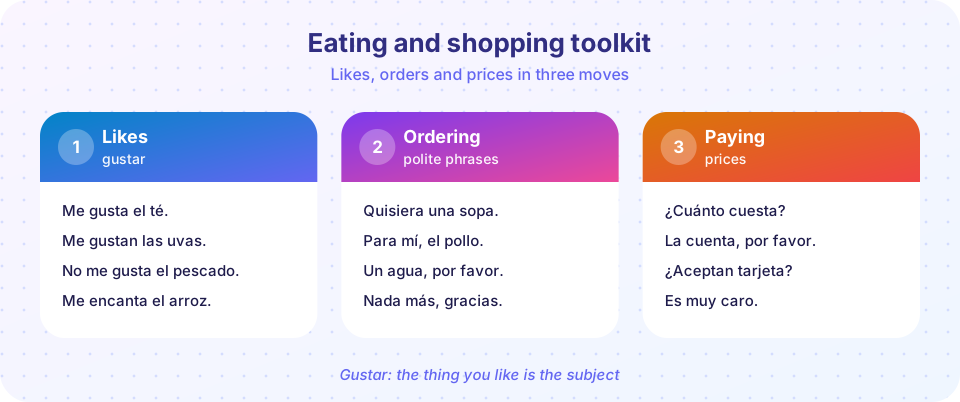
Food is one of the best reasons to learn Spanish. Whether you are eating tapas in Seville, tacos in Mexico City or empanadas in Buenos Aires, you will need three skills: saying what you like, ordering politely and handling money. This lesson teaches the verb gustar, a set of polite ordering phrases, essential food vocabulary and the questions you need for shopping.
What you will learn
- Use gustar and encantar with singular and plural things.
- Order food and drink politely with quisiera, me gustaría, para mí and pedir.
- Ask prices and pay: ¿Cuánto cuesta?, la cuenta, tarjeta, efectivo.
- Name common foods, drinks, meals and table items.
Key terms
Gustar: to be pleasing; the thing liked is the grammatical subject. Pronombre de objeto indirecto: me, te, le, nos, os, les, used with gustar. Quisiera: "I would like", a very polite request form of querer. La carta / el menú: the menu (carta in Spain, menú in much of Latin America). La propina: the tip.
Gustar: saying what you like
English says "I like coffee" with I as the subject. Spanish says literally "Coffee is pleasing to me": Me gusta el café. The thing that pleases you is the subject, and the verb agrees with it. That is why you only need two verb forms most of the time:
- gusta for one thing or an infinitive: Me gusta el té. Me gusta cantar.
- gustan for several things: Me gustan las manzanas.
The small pronoun before the verb shows who is pleased:
| Person | Pronoun | Example |
|---|---|---|
| I | me | Me gusta la sopa. |
| you (informal) | te | ¿Te gusta el queso? |
| he, she, you (formal) | le | A Ana le gusta el pan. |
| we | nos | Nos gustan los postres. |
| you all (Spain) | os | ¿Os gusta el vino? |
| they, you all | les | A ellos les gustan las frutas. |
To add emphasis or to say whose preference it is, add a + person: A mí me gusta el café, pero a ti te gusta el té. For a third person the extra phrase also clears up who le means: A Pedro le gusta el pescado. To say you do not like something, put no before the pronoun: No me gusta la cebolla. To say you really love it, use encantar, which works the same way: Me encanta el chocolate. Nos encantan las fresas. Two more verbs with the same pattern are interesar and molestar; you will see them later.
Common misconceptions
- "Me gusto means I like." Me gusto would mean "I please myself" or "I like myself". You want me gusta plus the thing.
- "Gustar must match the person." It matches the thing liked: Me gustan las uvas (plural), Me gusta el vino (singular).
- "Gusto mucho el café is natural." It is not. Say Me gusta mucho el café.
Food and drink words
Spanish nouns come with articles, so learn them together: el pan, la leche, el queso, el arroz, los frijoles (las judías in Spain), el pollo, el pescado, la carne, las verduras, la fruta, la manzana, la naranja, el huevo, la sopa, la ensalada. Drinks: el agua (feminine, but el before stressed a), el café, el té, la cerveza, el vino, el jugo (el zumo in Spain), el refresco. Meals: el desayuno (breakfast), el almuerzo or la comida (lunch; la comida also means "food"), la cena (dinner). Mealtimes differ by country: in Spain lunch is often around two in the afternoon and dinner often after nine in the evening, later than in many other places.
At the table you will hear el tenedor (fork), el cuchillo (knife), la cuchara (spoon), el plato (plate or dish), el vaso (glass), la taza (cup), la botella (bottle), la servilleta (napkin). Common phrases around the meal are ¡Buen provecho! (enjoy your meal) and ¡Salud! (cheers).
When you are hungry or thirsty, Spanish uses tener, not ser or estar: Tengo hambre (I am hungry), Tengo sed (I am thirsty), Tenemos mucha hambre. Use mucha (feminine), because hambre and sed are feminine nouns.
Ordering politely
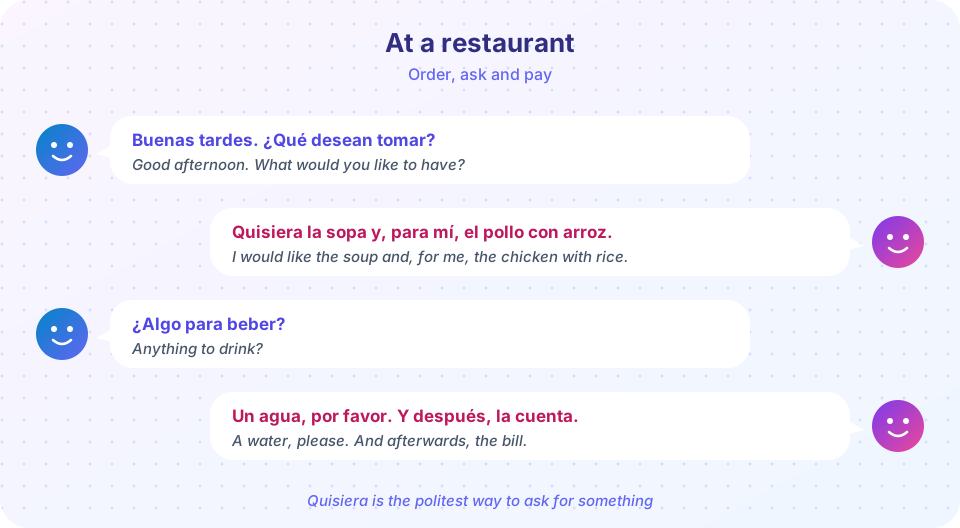
Direct quiero ("I want") is clear but can sound abrupt, like "Give me." These phrases sound more polite:
- Quisiera... I would like... (Quisiera una mesa para dos.)
- Me gustaría... I would like... (Me gustaría probar la paella.)
- Para mí... For me... (Para mí, el pollo con arroz.)
- Voy a tomar... I am going to have... (Voy a tomar un café.)
- ¿Me trae...? Could you bring me...? (¿Me trae la cuenta, por favor?)
Use pedir (e becomes i: pido, pides, pide, pedimos, pedís, piden) for "to order or ask for": Pido una ensalada. Do not confuse it with preguntar, which means to ask a question. The waiter may ask ¿Qué desean tomar? (What would you like?), ¿Algo más? (Anything else?) or ¿Cómo lo quiere? (How do you want it?). A natural customer reply is Nada más, gracias. (Nothing else, thank you.) At the end say La cuenta, por favor. La cuenta works in every Spanish-speaking country. Tipping customs vary by country, so look at what locals do: it is often around ten percent in many Latin American places, and smaller in Spain, where the service charge is usually included in prices.
Shopping and prices
To ask a price, use cuesta (singular) or cuestan (plural): ¿Cuánto cuesta el pan? ¿Cuánto cuestan las naranjas? A seller replies Cuesta dos euros or Cuestan tres euros el kilo. You can also ask ¿Cuánto es? (How much is it?) or ¿Cuánto es todo? (How much is it altogether?). Useful measures are un kilo de, medio kilo de, un litro de, una docena de, un poco de, una botella de and un paquete de: Quiero medio kilo de queso y una docena de huevos.
Opinions about price: Es caro / barato (it is expensive / cheap), Es demasiado caro (too expensive), ¿Tiene algo más barato? (Do you have something cheaper?). Paying: ¿Puedo pagar con tarjeta? (Can I pay by card?), Pago en efectivo (I pay cash), ¿Aceptan tarjeta? (Do you accept cards?). Currency names vary: euros in Spain, pesos in Mexico, Colombia and Argentina (each with its own value), soles in Peru, quetzales in Guatemala.
Putting it together: at the market
Here is a short market scene. Read it twice, then cover the English and translate it back.
- —Buenos días. ¿Qué desea? Good morning. What would you like?
- —Buenos días. Quisiera medio kilo de tomates y una docena de huevos. Good morning. I would like half a kilo of tomatoes and a dozen eggs.
- —Muy bien. ¿Algo más? Very well. Anything else?
- —Sí, ¿cuánto cuestan las naranjas? Yes, how much are the oranges?
- —Cuestan dos euros el kilo. They cost two euros a kilo.
- —Un kilo, por favor. ¿Cuánto es todo? One kilo, please. How much is everything?
- —Son siete euros con cincuenta. That is seven euros fifty.
Notice three details. First, desea is the polite "you" form of the seller (usted). Second, medio (half) is an adjective and agrees with the noun it describes: medio kilo, media docena. Third, con joins euros and cents, siete euros con cincuenta. You will also hear Son siete cincuenta in fast speech. Sellers rarely say por favor as often as English speakers do, but customers usually do, and gracias closes every transaction.
Try it
Flip the cards to practice the food words. Use Listen if your browser supports speech.
Now fill the gaps with gusta, gustan, an indirect pronoun or an ordering word.
This Python program builds a bill the way a restaurant would. Change the order list and run it again.
Press Run (or Ctrl + Enter) to see the result here.
Program input · what you'd type while the program runs
Type the answers before you press Run, one per line. Each time the program reads a line (with input()), it gets the next line from this box.
Check your understanding
Quick check · 5 questions
of 5 answered You scored / 5 · perfect!
-
1. Which sentence is correct?
The thing liked (las uvas) is plural, so the verb is gustan. -
2. What does "Para mí, el pollo" mean?
Para mí means "for me" and is used when you order. -
3. Which is the most polite way to ask for a coffee?
Quisiera sounds more polite than quiero. -
4. How do you say "I am thirsty"?
Hunger and thirst use tener: tengo hambre, tengo sed. -
5. How do you ask the price of several oranges?
The verb cuestan agrees with the plural noun.
Summary
- Gustar agrees with the thing liked: gusta (one or infinitive), gustan (several).
- Pronouns me, te, le, nos, os, les show who likes; a mí, a ti, a Ana add emphasis or clarity.
- Order politely with quisiera, me gustaría and para mí; pedir means to ask for or order.
- Cuesta / cuestan ask prices; hunger and thirst use tener.
Track your progress
Create a free account to tick off lessons and pick up where you left off on any device.
of Spanish for Beginners lessons completed