


















Lesson 14 of 51 · Nouns, Articles and Adjectives
Articles: El, La, Un, Una
Learn the Spanish definite and indefinite articles, the contractions al and del, the el agua rule, and when Spanish uses an article where English does not.
Articles are the small words that come before nouns, and in Spanish they do two jobs at once. Like English the and a, they tell you whether you mean a specific thing or any thing. Unlike English, they also tell you the gender and number of the noun. So el, la, los and las all mean "the", and un, una, unos and unas all mean "a" or "some". The right form comes from the noun that follows.
Once you have the eight forms in your head, the more interesting task is knowing when to use an article. Spanish uses the in several places where English leaves it out, and leaves out a in places where English requires it. This lesson gives you both the forms and the habits.
What you will learn
- The four definite articles (el, la, los, las) and four indefinite articles (un, una, unos, unas).
- The contractions al and del.
- The el agua rule for feminine nouns that start with a stressed a.
- Where Spanish uses or drops articles compared with English.
Key terms
Definite article: points to a specific thing, "the": el libro (the book we both know).
Indefinite article: introduces something non-specific, "a, an, some": un libro (a book, any book).
Contraction: two words fused into one: a + el = al, de + el = del.
Stressed a-: a noun that begins with a stressed a sound, such as agua or águila.
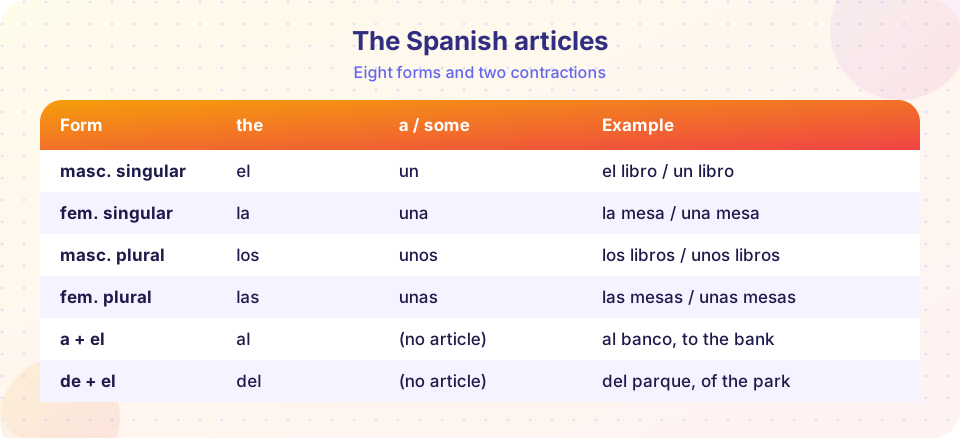
The eight forms
| Singular | Plural | |
|---|---|---|
| Masculine, the | el libro | los libros |
| Feminine, the | la mesa | las mesas |
| Masculine, a / some | un libro | unos libros |
| Feminine, a / some | una mesa | unas mesas |
Definite articles point to something specific that you and the listener both know: Dame el libro (Give me the book). Indefinite articles introduce something new or non-specific: Quiero un libro (I want a book). In the plural, unos and unas mean "some" or "a few": unos amigos (some friends), unas flores (some flowers). With numbers they mean "about": unos veinte alumnos (about twenty students).
The article must match the noun, not the speaker. A woman says el libro when she speaks about a book, because libro is masculine.
Contractions: al and del
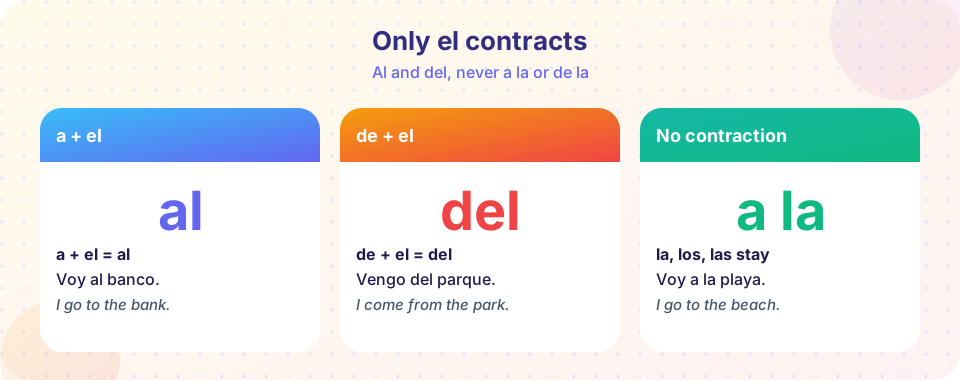
Two prepositions fuse with el:
- a + el = al: Voy al banco. (I am going to the bank.)
- de + el = del: Vengo del parque. (I come from the park.)
No other article contracts: a la playa, de la ciudad, a los amigos, de las casas. The contraction is also skipped when El is a capitalized part of a proper name: Voy a El Salvador (I am going to El Salvador). For everything else the rule is simple: write al and del whenever the next word is an ordinary noun that takes el, as in al parque and del libro. A el and de el are not used.
The el agua rule
Feminine nouns that begin with a stressed a sound take el (not la) in the singular, to avoid two similar vowels in a row: el agua (the water), el águila (the eagle), el hambre (the hunger), el alma (the soul), el arma (the weapon), el área. These nouns are still feminine: the adjective stays feminine (el agua fría, cold water), and the plural uses las (las aguas, las águilas). If the a is not stressed, normal rules apply: la amiga, la avenida, la acacia.
Where Spanish uses "the" and English does not
- General statements. English says Coffee is good; Spanish says El café es bueno. Me gusta la música (I like music). Los gatos son animales independientes (Cats are independent animals).
- Days of the week. El lunes tengo clase (On Monday I have class). The plural means a habit: Los lunes voy al gimnasio (On Mondays I go to the gym).
- Time of day. Son las tres (It is three o'clock), A las ocho (At eight), Es la una (It is one o'clock).
- Languages as subjects. El español es fácil. After hablar, estudiar and de, the article is usually dropped: Hablo español, Estudio inglés, clase de francés.
- Titles when talking about someone. El señor García es profesor. When talking directly to the person, drop it: Buenos días, señor García.
- Body parts and clothes instead of the English possessive. Me lavo las manos (I wash my hands). Me duele la cabeza (My head hurts).
- Some countries and cities traditionally take it: la India, los Estados Unidos, el Perú, la Argentina; modern usage often drops it (Perú, Argentina). Check how native speakers say it.
Where Spanish drops "a"
- Professions and roles after ser. Soy estudiante. Ella es médica. (English: I am a student, she is a doctor.) If you add an adjective, the article returns: Es una médica excelente.
- After tener, buscar, llevar and sin with general or negative meaning. No tengo coche (I do not have a car), Busco casa (I am looking for a house), sin dinero (without money).
- With otro, medio, cierto, tal. otro libro (another book, never un otro), medio kilo (half a kilo).
- Plural some is often dropped. Tengo libros and Tengo unos libros both exist; the version without the article sounds neutral.
Practice routine
To make articles automatic, add a daily five-minute habit. Look around the room and name ten objects with their articles out loud: la lámpara, el cuaderno, la puerta, el teléfono, las llaves. If you do not know a word, look it up and learn it with its article at once. After a week you will have seventy words and a stronger feel for gender than any rule could give you.
Common misconceptions
"I can skip the articles; people understand me anyway." You will be understood, but dropping el or la in general statements ("Café es bueno") sounds telegraphic and may be hard to parse.
"Use la for water because it is feminine." The singular article is el: el agua. The noun is feminine; the article is a sound rule.
"Un estudiante and estudiante are the same." After ser, Soy estudiante sounds like a category; Soy un estudiante sounds odd without more information.
"Al means a el and I can use either." A el is wrong in standard Spanish; write al.
Try it
First an article chooser that looks gender up in a small lexicon and applies the rules above. Then a drill and flashcards. The chooser is a rule engine for the nouns in its list, not a general tool.
Press Run (or Ctrl + Enter) to see the result here.
Program input · what you'd type while the program runs
Type the answers before you press Run, one per line. Each time the program reads a line (with input()), it gets the next line from this box.
Check your understanding
Quick check · 5 questions
of 5 answered You scored / 5 · perfect!
-
1. Which article goes with 'mesa' (the table)?
Mesa is feminine singular: la mesa. -
2. How do you say 'to the bank'?
A + el becomes al. -
3. Why is it 'el agua' and not 'la agua'?
The singular article is el; the noun and its adjectives stay feminine. -
4. How do you say 'I am a teacher' (profession, no adjective)?
Professions after ser usually drop the indefinite article. -
5. What does 'unos amigos' mean?
Unos is the plural of un: some.
Summary
- Definite: el, la, los, las. Indefinite: un, una, unos, unas.
- A + el = al; de + el = del; no other contractions.
- Feminine nouns starting with a stressed a- take el in the singular: el agua fría.
- Spanish uses the definite article for general statements, days, times, languages as subjects and body parts.
- It drops the indefinite article after ser for professions and with negatives like No tengo coche.
Next: Adjectives and Agreement
Track your progress
Create a free account to tick off lessons and pick up where you left off on any device.
of Spanish for Beginners lessons completed