


















Lesson 33 of 51 · Past Tenses
The present perfect in Spanish
Learn the Spanish present perfect with haber and past participles, irregular participles, uses, time words, and regional differences, with practice.
The present perfect connects the past with the present. In English, it is I have eaten, she has finished, we have never been there. Spanish builds it the same way, with the helper verb haber and a past participle: he comido, ha terminado, nunca hemos estado allí. It is formed easily, but the uses differ a little between Spain and Latin America, so listen to the speakers you meet.
What you will learn
- Conjugate haber in the present and build regular and irregular participles.
- Use the present perfect for experiences, recent events and unfinished periods.
- Place pronouns and negatives correctly (Lo he visto, No he comido).
- Compare the present perfect with the preterite.
Key terms
Pretérito perfecto: the present perfect (he hablado). Participio pasado: the past participle (hablado, comido, hecho). Haber: the helper verb "to have" used only for compound tenses. Tener: the verb "to have" meaning possession; it does not form this tense. Periodo no terminado: an unfinished time period such as hoy or esta semana.
Forms
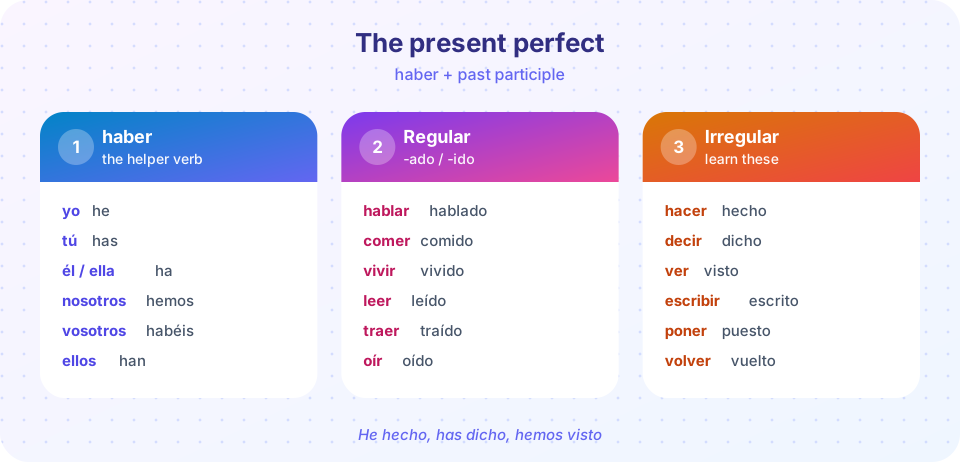
Take the present tense of haber: he, has, ha, hemos, habéis, han. Add the past participle, which ends in -ado for -ar verbs and -ido for -er and -ir verbs:
- hablar → hablado: He hablado con ella.
- comer → comido: ¿Has comido ya?
- vivir → vivido: Hemos vivido aquí diez años.
Verbs whose stem ends in a, e, o take a written accent on the í: leer → leído, creer → creído, traer → traído, oír → oído, caer → caído, reír → reído.
Irregular participles
About a dozen common verbs, and the verbs built from them, have irregular participles. Memorize this core list:
| Infinitive | Participle | Related |
|---|---|---|
| abrir | abierto | |
| cubrir | cubierto | descubrir → descubierto |
| decir | dicho | predecir → predicho |
| escribir | escrito | describir → descrito |
| hacer | hecho | deshacer → deshecho |
| morir | muerto | |
| poner | puesto | componer → compuesto |
| resolver | resuelto | |
| romper | roto | |
| ver | visto | prever → previsto |
| volver | vuelto | devolver → devuelto |
Ir has ido and ser has sido: Hemos ido al cine. Siempre ha sido amable.
The rules of word order
Haber and the participle are inseparable. Nothing may come between them, not even no or a pronoun. Negatives and object pronouns go before haber: No he comido. Lo he visto. Nunca te he mentido. Questions keep the pair together: ¿Has terminado la tarea? The participle in this tense never changes for gender or number: Ellas han llegado, hemos escrito las cartas. (Contrast with the participle used as an adjective, which does agree: la puerta está abierta, las cartas están escritas.)
When to use it
- Life experience (no specific time): ¿Has estado en México? Sí, he estado dos veces. Words: alguna vez (ever), nunca / jamás (never), ya (already), todavía no / aún no (not yet), muchas veces.
- Recent events with a link to now: Ha llamado tu madre. (Your mother has called.) Han abierto una tienda nueva. (They have opened a new shop.)
- Unfinished time periods: hoy, esta mañana, esta semana, este año, este mes: Esta semana he trabajado mucho. (This week I have worked a lot.)
- Results that still matter: He perdido las llaves. (I have lost my keys, so I cannot get in.)
Compare it with the preterite, which is used for finished periods: Ayer trabajé mucho. (Yesterday I worked a lot.) El año pasado viajé a Perú. (Last year I traveled to Peru.) If the time word names a completed period (ayer, anoche, el año pasado, en 2020), use the preterite.
Regional differences. In central and northern Spain, the present perfect is frequently used for anything that happened today or recently: Hoy me he levantado a las seis. In much of Latin America (Mexico, Argentina, Chile and others), speakers often use the preterite for the same events: Hoy me levanté a las seis. Both are correct. In some places, such as parts of Peru and Colombia, the perfect is used more. Follow the people around you, and always understand both.
Two useful relatives
Acabar de + infinitive means "to have just": Acabo de llegar. (I have just arrived.) Acabamos de comer. (We have just eaten.) Haber in the imperfect gives the pluperfect (past perfect): Ya había comido cuando llegaste. (I had already eaten when you arrived.) You will see more of these forms in later study.
Common misconceptions
- "Use tener: Tengo comido." For this tense you need haber: He comido.
- "The participle agrees with the subject." After haber it never changes: ellas han salido.
- "I can put no between haber and the participle." No: No he ido, never He no ido.
- "Present perfect is always used for the same events as in English." In Spanish it is used less for completed past events and more for unfinished periods and recent news.
Side by side: perfect or preterite?
| Meaning | Present perfect | Preterite |
|---|---|---|
| Today (unfinished period) | Hoy he comido temprano. | Hoy comí temprano (Latin America). |
| This week | Esta semana he viajado a Sevilla. | Esta semana viajé a Sevilla (common in Latin America). |
| Yesterday (finished) | no: Ayer he comido | Ayer comí temprano. |
| Life experience | Nunca he probado el mole. | Nunca probé el mole (also correct, narrative). |
| Just happened | Ha llegado mi padre. | Llegó mi padre. |
The simplest rule for beginners: use the present perfect when the time word is unfinished or absent, and the preterite when the time word is finished (ayer, la semana pasada, en 2018). Then adapt to the region where you will speak.
A conversation about experiences
- —¿Has probado la paella alguna vez? Have you ever tried paella?
- —Sí, la he probado dos veces. La primera vez fue en Valencia. Yes, I have tried it twice. The first time was in Valencia.
- —¿Y has estado en México? And have you been to Mexico?
- —No, todavía no he viajado allí, pero he visto muchas fotos. No, I have not traveled there yet, but I have seen a lot of photos.
Notice how the conversation starts with the present perfect (life experience, no specific time) but moves to the preterite as soon as a specific past moment appears (La primera vez fue en Valencia). That switch is typical: perfect for "has it ever happened?", preterite for "when and how did it happen?".
Try it
Build participles and the full conjugation with this program. Notice the accents on leído, traído, oído.
Press Run (or Ctrl + Enter) to see the result here.
Program input · what you'd type while the program runs
Type the answers before you press Run, one per line. Each time the program reads a line (with input()), it gets the next line from this box.
Complete the present perfect forms.
Check your understanding
Quick check · 5 questions
of 5 answered You scored / 5 · perfect!
-
1. Which is correct?
No goes before haber, which stays with its participle. -
2. What is the participle of "hacer"?
Hacer has an irregular participle: hecho. -
3. Which sentence uses the present perfect for an unfinished period?
Esta semana has not ended, so the present perfect is natural. -
4. What does "Acabo de llegar" mean?
Acabar de + infinitive means to have just done something. -
5. How do you form the participle of "leer"?
Stems ending in a vowel take a written accent: leído.
Summary
- Present perfect = he, has, ha, hemos, habéis, han + past participle (-ado, -ido).
- Irregular participles: abierto, dicho, escrito, hecho, muerto, puesto, resuelto, roto, visto, vuelto (and compounds).
- Nothing comes between haber and the participle; negatives and pronouns go before.
- Use it for experiences, recent events and unfinished periods; Latin America often prefers the preterite.
- Acabar de + infinitive means "to have just done".
Next: Chapter 6 review
Track your progress
Create a free account to tick off lessons and pick up where you left off on any device.
of Spanish for Beginners lessons completed