


















Lesson 38 of 51 · Future, Commands and Subjunctive Basics
Commands in Spanish (the imperative)
Learn how to give commands in Spanish: tú, usted, ustedes, nosotros and vosotros forms, negative commands, irregular verbs and pronouns attached to verbs.
Telling someone what to do is a basic communicative need: Come in. Sit down. Call me. Don't worry. Spanish has a special set of forms for this, called the imperative, and it changes depending on whom you are addressing (a friend, a stranger, a group) and on whether the command is positive or negative. The system looks complicated at first, but it reuses forms you already know, especially the subjunctive from the last lesson.
What you will learn
- Give affirmative and negative commands to tú, usted, ustedes, nosotros and vosotros.
- Use the eight irregular affirmative tú commands: di, haz, ve, pon, sal, sé, ten, ven.
- Attach object and reflexive pronouns to commands, with written accents.
- Give directions and everyday instructions politely.
Key terms
Imperativo: the mood of commands. Mandato afirmativo / negativo: a positive or negative command. Pronombre enclítico: a pronoun attached to the end of a verb (dímelo). Tuteo / ustedeo: using tú or usted to address someone. Acento ortográfico: a written accent kept to preserve the original stress.
Tú commands (informal, singular)
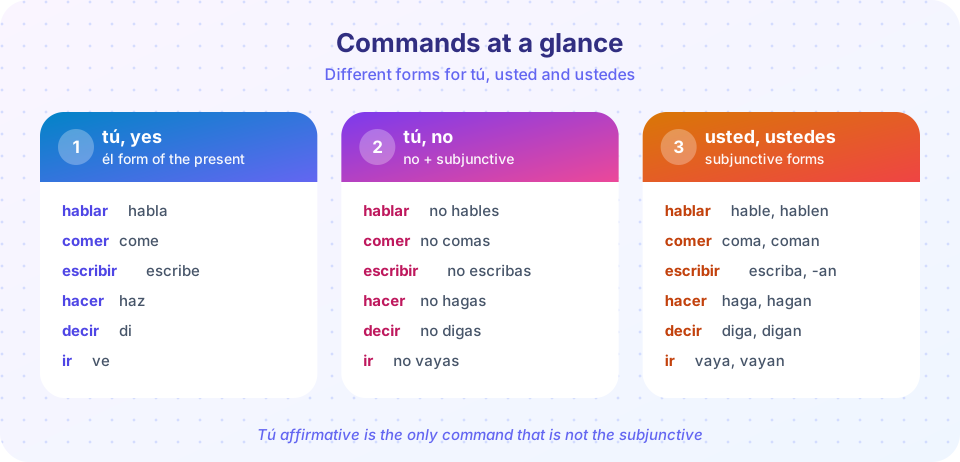
Affirmative: use the él/ella form of the present indicative: Habla más despacio. (Speak more slowly.) Come tus verduras. Escribe tu nombre aquí. Stem-changing verbs keep their stem change: piensa, vuelve, pide, duerme, cierra. Eight verbs have short irregular forms. Memorize them as a list:
| Infinitive | Command | Example |
|---|---|---|
| decir | di | Di la verdad. |
| hacer | haz | Haz la tarea. |
| ir | ve | Ve a casa. |
| poner | pon | Pon la mesa. |
| salir | sal | Sal de aquí. |
| ser | sé | Sé amable. |
| tener | ten | Ten cuidado. |
| venir | ven | Ven aquí. |
Negative: use no + the present subjunctive tú form: No hables tan rápido. No comas eso. No escribas en la pared. No hagas ruido. No digas nada. No vayas solo. No seas tonto. All the irregular affirmative forms disappear in the negative: haz becomes no hagas, ve becomes no vayas.
Usted and ustedes commands (formal)
For people you address as usted (one person) or ustedes (several), the affirmative and the negative commands use the subjunctive forms: Hable más despacio, por favor. Coma algo. Escriba su nombre. Hagan la fila. No hablen aquí. Adding por favor or usted softens the order: Pase usted. Siéntese, por favor. In Latin America ustedes is the plural for everybody; in Spain a group of friends is addressed with vosotros.
Nosotros and vosotros commands
- Nosotros ("let's ..."): use the subjunctive nosotros form or vamos a + infinitive: Comamos ahora. Hablemos mañana. Vamos a comer. Escribamos un correo. The command Vamos alone means "let's go". The reflexive form drops the final s before nos: Sentémonos (let's sit down), Levantémonos (let's get up), Vámonos (let's leave).
- Vosotros (Spain): the affirmative takes the infinitive with the final -r replaced by -d: hablad, comed, escribid. The negative is no + subjunctive: No habléis, no comáis, no escribáis. Reflexive: levantaos (the d drops); the one exception is idos (from irse).
Pronouns and commands
Pronouns behave differently in affirmative and negative commands:
- Affirmative: attach the pronoun to the end of the verb: Dime la verdad. Cómpralo. Siéntate. Háblame. Dímelo. Dáselo.
- Negative: put the pronoun before the verb: No me digas eso. No lo compres. No te sientes. No me lo des.
When you add one or two pronouns to a verb, the stress must stay on the same syllable, so a written accent often appears: compra + lo = cómpralo, escribe + me = escríbeme, di + me + lo = dímelo, sienta + se (usted) = siéntese. Short forms such as dame, dime, ponlo, hazlo do not need an accent, since the natural stress falls on the right syllable already. When two pronouns appear together, the indirect object comes first, and le/les becomes se before lo/la/los/las: Dáselo (Give it to him), Cómpraselo (Buy it for him).
Using commands politely
In Spanish, a bare command to a stranger sounds abrupt. Add por favor or soften with a question: ¿Podría cerrar la puerta? (Could you close the door?) ¿Me puede ayudar? (Can you help me?) Quisiera pedirle un favor. The conditional or present of poder in a question is the standard polite choice. Shop signs and recipes often use the infinitive: No fumar (No smoking), Empujar (Push), Añadir sal (Add salt). Parents, teachers and friends use tú commands more freely: Ven aquí. Siéntate. Cállate.
Directions: the essential vocabulary
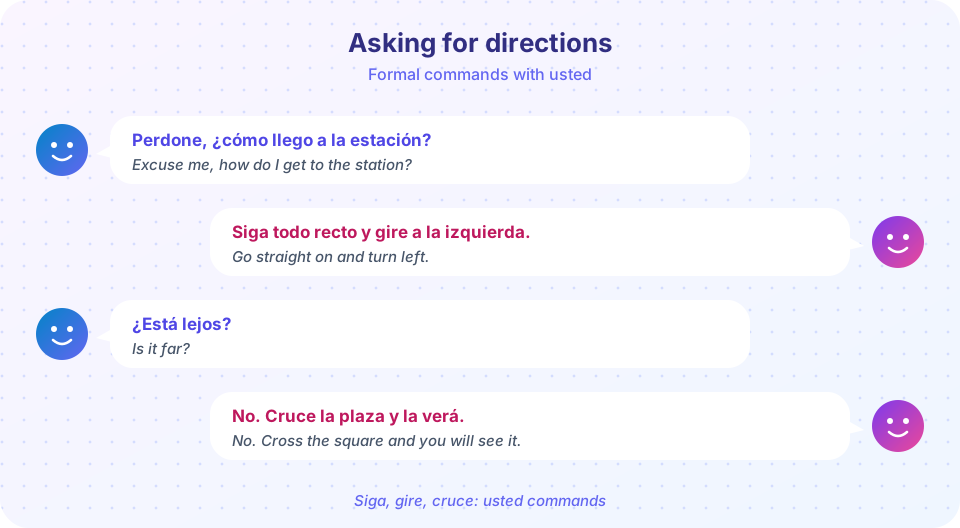
A common use of formal commands is giving directions: Siga todo recto (Go straight on), Gire a la izquierda / a la derecha (Turn left / right; in much of Latin America doble is used instead of gire), Cruce la calle (Cross the street), Tome la segunda calle (Take the second street), Pare aquí (Stop here), Llegará a una plaza (You will arrive at a square). Place words: al final de, a la esquina, enfrente de, al lado de, cerca de, lejos de. Ask: ¿Cómo llego a ...? ¿Dónde está ...? ¿Está lejos?
Common misconceptions
- "Negative commands are the same as positive with no." No: Habla becomes no hables, not no habla.
- "Use the infinitive after no." In writing and speech the standard form is no hables, not no hablar (the infinitive appears mostly in signs).
- "Haz and ve are regular." They are among the eight irregular affirmative tú commands: di, haz, ve, pon, sal, sé, ten, ven.
- "Pronouns always go before the verb." Not in affirmative commands: dímelo, siéntate, háblame.
Commands in daily situations
In the classroom (teacher to students, ustedes): Abran el libro en la página diez. Lean el texto. Escriban las respuestas. No hablen. Students answer with polite requests: ¿Puede repetir, por favor?
At home (parent to child, tú): Lávate las manos. Haz la tarea. Ponte el abrigo. No grites. Ven a cenar.
At a hotel (guest to receptionist, usted): Mande las maletas a mi habitación. Despiérteme a las siete, por favor. Llámeme un taxi. Notice the pronouns attached to formal commands (despiérteme, llámeme) and the extra politeness of por favor.
In a recipe (a friendly tú style): Corta la cebolla. Añade un poco de sal. Mezcla bien. Cocina a fuego lento durante diez minutos. Many modern recipe books and websites use tú commands; older books often use se + verb (Se corta la cebolla) or the infinitive (Cortar la cebolla).
Between friends (nosotros): Vamos a comer. Salgamos temprano. Pidamos la cuenta. The nosotros command is warm and inclusive, like "let's".
A small habit pays off quickly: when you learn a new verb, write its three commands for tú (positive and negative) and usted. For abrir: abre, no abras, abra. For cerrar: cierra, no cierres, cierre. For esperar: espera, no esperes, espere. Say them aloud in a context that matters to you.
Try it
The table prints six command forms for fourteen common verbs. Compare the positive and negative tú commands, then check the usted and nosotros forms.
Press Run (or Ctrl + Enter) to see the result here.
Program input · what you'd type while the program runs
Type the answers before you press Run, one per line. Each time the program reads a line (with input()), it gets the next line from this box.
Type the correct command.
Check your understanding
Quick check · 5 questions
of 5 answered You scored / 5 · perfect!
-
1. What is the affirmative tú command of "hacer"?
Hacer is one of the eight irregular affirmative tú commands: haz. -
2. What is the negative tú command of "comer"?
Negative tú commands use the subjunctive: no comas. -
3. How do you say "Tell me" (to a friend)?
Informal affirmative: di + me = dime. Dígame is the formal form. -
4. Which sentence is correct?
In negative commands the pronoun goes before the subjunctive verb: no lo compres. -
5. How do you say "Let's sit down" in one word?
The final s of the nosotros command drops before nos: sentémonos.
Summary
- Tú affirmative = él form of the present; eight irregulars: di, haz, ve, pon, sal, sé, ten, ven.
- Tú negative, usted, ustedes and nosotros commands use subjunctive forms.
- Vosotros affirmative replaces -r with -d (hablad); the negative is no habléis.
- Pronouns attach to affirmative commands (with accents) and precede negative ones.
- Add por favor or use the conditional in a question to sound polite.
Next: Chapter 7 review
Track your progress
Create a free account to tick off lessons and pick up where you left off on any device.
of Spanish for Beginners lessons completed