Practice social Spanish: introductions, phone calls, invitations, opinions, agreeing and disagreeing, filler words and strategies when you do not understand.
Social conversation is where Spanish becomes personal. You introduce yourself, talk on the phone, make plans and share opinions. These exchanges depend less on advanced grammar and more on useful formulas, a polite tone and a few tricks for keeping the conversation going when you get lost. This lesson gathers those formulas in realistic dialogues.
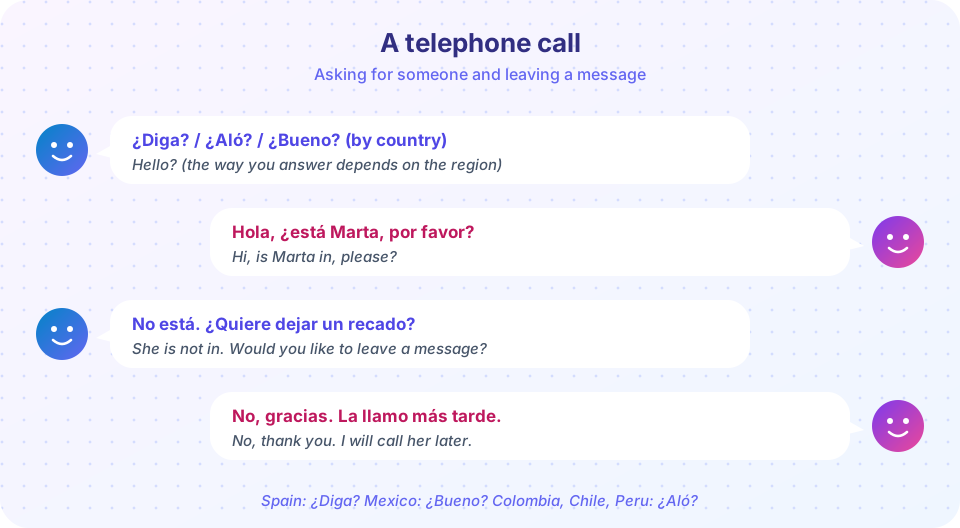
A typical phone conversation, with the different ways of answering the phone.
Presentarse: to introduce oneself.
Recado: message (dejar un recado).
Quedar: to arrange to meet (¿Quedamos a las ocho?).
Muletilla: a filler word such as pues, bueno, o sea.
Registro: the level of formality (tú versus usted).
—Hola, me llamo Laura. ¿Y tú? Hi, my name is Laura. And you?
—Soy Daniel. Mucho gusto. I am Daniel. Nice to meet you.
—Encantada. ¿De dónde eres? Delighted. Where are you from?
—Soy de Canadá, pero vivo en Madrid desde hace un año. I am from Canada, but I have lived in Madrid for a year.
—¿A qué te dedicas? What do you do (for a living)?
—Soy ingeniero. Trabajo en una empresa de software. ¿Y tú? I am an engineer. I work in a software company. And you?
—Yo soy profesora de inglés. I am an English teacher.
Notice three patterns. First, ser + profession needs no article: Soy ingeniero, Soy profesora. Second, desde hace + time expresses how long something has been going on, with the verb in the present: Vivo aquí desde hace un año. Third, encantado (man) and encantada (woman) agree with the speaker, not with the other person. Other greetings: ¿Cómo está usted? (formal), ¿Qué tal? (informal), Igualmente (likewise), Un placer (a pleasure), Hasta luego, Nos vemos, Que te vaya bien.
—¿Diga? Hello? (answering in Spain)
—Hola, buenos días. ¿Está Marta, por favor? Hello, good morning. Is Marta there, please?
—¿De parte de quién? Who is calling?
—De parte de Daniel. It is Daniel.
—Un momento. Lo siento, no está. ¿Quiere dejar un recado? One moment. I am sorry, she is not in. Would you like to leave a message?
—No, gracias. La llamo más tarde. No, thank you. I will call her later.
The way you answer varies: ¿Diga? or ¿Dígame? in Spain, ¿Bueno? in Mexico, ¿Aló? in Colombia, Peru, Chile and several other countries, and Hola in Argentina and many other places. To end: Gracias, hasta luego. Chao. Voice messages usually begin with Hola, soy... and end with Llámame cuando puedas (Call me when you can). For video calls: No te escucho / No te oigo bien (I cannot hear you well), Se corta la conexión (the connection is cutting out).
—¿Quieres venir al cine esta noche? Do you want to come to the cinema tonight?
—¡Claro! ¿A qué hora? Sure! At what time?
—A las ocho. ¿Quedamos delante del cine? At eight. Shall we meet in front of the cinema?
—Perfecto. Nos vemos a las ocho menos cinco. Perfect. See you at five to eight.
A refusal sounds polite when you give a reason: Lo siento, no puedo. Tengo que estudiar. (I am sorry, I can't. I have to study.) Me encantaría, pero ya tengo planes. (I would love to, but I already have plans.) ¿Qué tal el sábado? (How about Saturday?) Other useful patterns: ¿Te apetece...? (Do you feel like...? mainly Spain), ¿Quieres...? (Do you want...?), ¿Qué te parece si...? (What do you think about...?), Podríamos... (We could...), Vamos a... (Let's...). Accept with Vale (Spain), De acuerdo, Está bien, Claro que sí, ¡Con mucho gusto!
Opinions combine what you know: Creo que..., Pienso que..., Me parece que..., En mi opinión... with the indicative. Remember that negative forms take the subjunctive: No creo que sea buena idea. To agree: Tienes razón, Estoy de acuerdo, Claro, Exacto, Sí, tienes toda la razón. To disagree politely: No estoy de acuerdo, No lo creo, Depende, Puede ser, pero... A soft disagreement is more natural than a direct No. To ask someone: ¿Qué opinas?, ¿Qué te parece?, ¿Tú qué piensas?
Fluent speech is full of small words that give the speaker time and show attention: bueno (well), pues (well, so), a ver (let's see), o sea (I mean), es que (the thing is...), ¿verdad? and ¿no? (right?), vale (okay, Spain), claro (of course), ya (I see), ¡qué bien! (how nice!). Mhm and ajá are the equivalent of "uh-huh". Using two or three of them makes you sound more natural immediately: Pues, no sé... A ver, ¿qué tal el sábado?
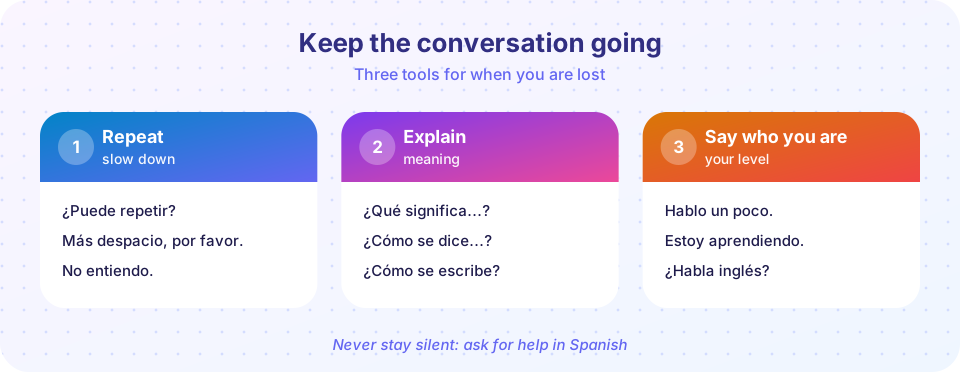
Nobody understands everything, even in their own language. The best learners are not the ones who never get lost but those who have a toolbox for when they do: ¿Puede repetir, por favor? Más despacio, por favor. No entiendo. ¿Qué significa "recado"? ¿Cómo se dice "recado" en inglés? ¿Cómo se escribe? Hablo un poco de español. Estoy aprendiendo español. Use puede with strangers (usted) and puedes with friends. Never just nod; ask for clarification, and people will usually be happy to slow down.
Common misconceptions
"Encantado must agree with the other person." It agrees with the speaker: a woman says encantada.
"Use the present perfect for how long: he vivido (I have lived)." For something that continues, Spanish prefers vivo aquí desde hace un año.
"Filler words show poor Spanish." They are normal in fluent speech; bueno, pues, a ver give thinking time.
"A direct no is the polite way to refuse." Add a reason or alternative: Me encantaría, pero...
Beginners worry about what to say after the greeting. Good small-talk topics are the weather (Hace mucho calor hoy, ¿verdad?), your trip (¿Es tu primera vez aquí?), food (¿Has probado la tortilla?), work or studies (¿Qué estudias?), family (¿Tienes hermanos?) and plans (¿Qué vas a hacer este fin de semana?). Questions from chapter 5 and the past tenses from chapter 6 are all you need. For example: ¿Qué hiciste el fin de semana pasado? Fui a la playa con unos amigos. ¿Y tú? Reply with a short answer plus the same question back, as in English. If the other person says something you do not catch, say Perdona, ¿cómo dices? (informal) or Perdone, ¿cómo dice? (formal): both are friendlier than a blank face.
Some topics need care. Spanish speakers often talk about politics and football with passion, but with strangers it is wise to listen first. Compliments on food, the city and the language go down very well: ¡Qué rico! (How tasty!), ¡Qué bonita es la ciudad!, Hablas muy bien español. Reply to compliments modestly: Gracias, estoy aprendiendo.
<style>*{box-sizing:border-box}body{margin:0;padding:14px;font-family:system-ui,-apple-system,'Segoe UI',sans-serif;background:linear-gradient(135deg,#faf5ff,#eff6ff);color:#1e1b4b}.card{background:#fff;border-radius:18px;box-shadow:0 8px 22px rgba(67,56,202,.16);padding:16px;max-width:560px;margin:0 auto}button{font:inherit;font-weight:600;border:0;border-radius:999px;padding:8px 16px;margin:4px 4px 0 0;color:#fff;background:linear-gradient(135deg,#6366f1,#ec4899);cursor:pointer}button.alt{background:#eef2ff;color:#3730a3}input{font:inherit;padding:6px 10px;border:2px solid #c7d2fe;border-radius:10px;width:150px}.small{font-size:.85rem;color:#475569}</style><style>.cols{display:flex;gap:12px}.col{flex:1;display:flex;flex-direction:column;gap:8px}.t{padding:10px;border-radius:12px;background:#eef2ff;cursor:pointer;text-align:center;font-weight:600;border:2px solid transparent}.t.sel{border-color:#6366f1;background:#e0e7ff}.t.done{background:#dcfce7;cursor:default}.t.bad{background:#fee2e2}</style><divclass="card"><pclass="small">Click a Spanish word, then its English meaning.</p><divclass="cols"><divclass="col"id="L"></div><divclass="col"id="R"></div></div><pid="msg"class="small"></p><buttonid="again"class="alt">New round</button></div><script>var pairs=[["Mucho gusto","Nice to meet you"],["¿De parte de quién?","Who is calling?"],["¿Quedamos?","Shall we meet?"],["Tienes razón","You are right"],["Más despacio","More slowly"],["Lo siento","I am sorry"]];var sel=null,done=0;functionshuffle(a){return a.map(function(x){return[Math.random(),x];}).sort(function(p,q){return p[0]-q[0];}).map(function(p){return p[1];});}functionbuild(){done=0;sel=null;document.getElementById('msg').textContent='';varL=document.getElementById('L'),R=document.getElementById('R');L.innerHTML='';R.innerHTML='';shuffle(pairs.map(function(p,i){return[p[0],i];})).forEach(function(p){var d=document.createElement('div');d.className='t';d.textContent=p[0];d.dataset.i=p[1];d.onclick=function(){if(d.classList.contains('done'))return;Array.prototype.forEach.call(L.children,function(c){c.classList.remove('sel');});d.classList.add('sel');sel=d;};L.appendChild(d);});shuffle(pairs.map(function(p,i){return[p[1],i];})).forEach(function(p){var d=document.createElement('div');d.className='t';d.textContent=p[0];d.dataset.i=p[1];d.onclick=function(){if(!sel||d.classList.contains('done'))return;if(sel.dataset.i===d.dataset.i){sel.className='t done';d.className='t done';sel=null;done++;if(done===pairs.length)document.getElementById('msg').textContent='All matched. Well done!';}else{d.classList.add('bad');setTimeout(function(){d.classList.remove('bad');},500);}};R.appendChild(d);});}
document.getElementById('again').onclick=build;build();</script>
Choose the best reply.
Choose a reply
<style>*{box-sizing:border-box}body{margin:0;padding:14px;font-family:system-ui,-apple-system,'Segoe UI',sans-serif;background:linear-gradient(135deg,#faf5ff,#eff6ff);color:#1e1b4b}.card{background:#fff;border-radius:18px;box-shadow:0 8px 22px rgba(67,56,202,.16);padding:16px;max-width:560px;margin:0 auto}button{font:inherit;font-weight:600;border:0;border-radius:999px;padding:8px 16px;margin:4px 4px 0 0;color:#fff;background:linear-gradient(135deg,#6366f1,#ec4899);cursor:pointer}button.alt{background:#eef2ff;color:#3730a3}input{font:inherit;padding:6px 10px;border:2px solid #c7d2fe;border-radius:10px;width:150px}.small{font-size:.85rem;color:#475569}</style><style>.q{margin:0 0 14px;padding:10px 12px;border-radius:12px;background:#f8fafc}.q .s{font-weight:700;margin-bottom:6px}.q .e{font-size:.85rem;color:#475569;font-style:italic}.q button{background:#eef2ff;color:#3730a3}.q button.right{background:#16a34a;color:#fff}.q button.wrong{background:#dc2626;color:#fff}.fb{font-size:.9rem;margin-top:6px}</style><divclass="card"><divid="box"></div><pid="score"class="small"></p></div><script>var items=[{"s":"¿Quieres venir al cine esta noche?","o":["Sí, claro. ¿A qué hora?","Sí, soy ingeniero."],"a":0,"x":"Accept the invitation and ask for the time.","en":"Do you want to come to the cinema tonight?"},{"s":"¿Cómo se dice \"recado\" en inglés?","o":["Message.","Me duele la cabeza."],"a":0,"x":"The question asks for a translation.","en":"How do you say \"recado\" in English?"},{"s":"No creo que sea buena idea.","o":["Tienes razón.","Aquí lo tiene."],"a":0,"x":"Tienes razón agrees with the opinion.","en":"I do not think it is a good idea."},{"s":"¿De parte de quién?","o":["De parte de Ana.","Mucho gusto."],"a":0,"x":"On the phone, give your name this way.","en":"Who is calling?"}];var good=0,done=0;var box=document.getElementById('box');
items.forEach(function(it,k){var d=document.createElement('div');d.className='q';var s=document.createElement('div');s.className='s';s.textContent=it.s;d.appendChild(s);var e=document.createElement('div');e.className='e';e.textContent=it.en;d.appendChild(e);var fb=document.createElement('div');fb.className='fb';
it.o.forEach(function(o,j){var b=document.createElement('button');b.textContent=o;b.onclick=function(){if(d.dataset.done)return;d.dataset.done='1';done++;if(j===it.a){good++;b.className='right';fb.textContent='Correct. '+it.x;}else{b.className='wrong';fb.textContent='Not quite. '+it.x;}document.getElementById('score').textContent='Score: '+good+' / '+done;};d.appendChild(b);});
d.appendChild(fb);box.appendChild(d);});</script>
Fill in the missing words.
Social gap fill
<style>*{box-sizing:border-box}body{margin:0;padding:14px;font-family:system-ui,-apple-system,'Segoe UI',sans-serif;background:linear-gradient(135deg,#faf5ff,#eff6ff);color:#1e1b4b}.card{background:#fff;border-radius:18px;box-shadow:0 8px 22px rgba(67,56,202,.16);padding:16px;max-width:560px;margin:0 auto}button{font:inherit;font-weight:600;border:0;border-radius:999px;padding:8px 16px;margin:4px 4px 0 0;color:#fff;background:linear-gradient(135deg,#6366f1,#ec4899);cursor:pointer}button.alt{background:#eef2ff;color:#3730a3}input{font:inherit;padding:6px 10px;border:2px solid #c7d2fe;border-radius:10px;width:150px}.small{font-size:.85rem;color:#475569}</style><style>.row{margin:0 0 12px;padding:10px 12px;border-radius:12px;background:#f8fafc}.ok{background:#dcfce7}.no{background:#fee2e2}.near{background:#fef9c3}.en{font-size:.85rem;color:#475569;font-style:italic}</style><divclass="card"><divid="list"></div><buttonid="chk">Check answers</button><buttonid="rst"class="alt">Clear</button><pid="score"class="small"></p></div><script>var items=[{"s":"Soy de Chile, pero vivo en Madrid ___ hace un año.","a":["desde"],"en":"I am from Chile, but I have lived in Madrid for a year."},{"s":"Lo siento, no ___. Tengo que estudiar.","a":["puedo"],"en":"I am sorry, I cannot. I have to study."},{"s":"¿___ a las ocho? (shall we meet)","a":["quedamos"],"en":"Shall we meet at eight?"},{"s":"___ razón. (you are right)","a":["tienes"],"en":"You are right."},{"s":"¿Puede ___, por favor? (repeat)","a":["repetir"],"en":"Can you repeat, please?"},{"s":"No ___ que sea buena idea.","a":["creo"],"en":"I do not think it is a good idea."}];functionstrip(t){return t.normalize('NFD').replace(/[\u0300-\u036f]/g,'');}var list=document.getElementById('list');
items.forEach(function(it,k){var d=document.createElement('div');d.className='row';var p=it.s.split('___');d.appendChild(document.createTextNode(p[0]));var inp=document.createElement('input');inp.id='f'+k;inp.setAttribute('aria-label','answer '+(k+1));d.appendChild(inp);d.appendChild(document.createTextNode(p[1]||''));var e=document.createElement('div');e.className='en';e.textContent=it.en;d.appendChild(e);var m=document.createElement('div');m.className='small';m.id='m'+k;d.appendChild(m);d.id='r'+k;list.appendChild(d);});
document.getElementById('chk').onclick=function(){var good=0;items.forEach(function(it,k){var v=document.getElementById('f'+k).value.trim().toLowerCase();var r=document.getElementById('r'+k),m=document.getElementById('m'+k);var ex=it.a.indexOf(v)>=0;var near=!ex&&it.a.some(function(a){returnstrip(a)===strip(v)&&v!=='';});if(ex){good++;r.className='row ok';m.textContent='Correct';}elseif(near){r.className='row near';m.textContent='Almost: check the accent. Answer: '+it.a[0];}else{r.className='row no';m.textContent=v?'Not quite. Answer: '+it.a[0]:'Answer: '+it.a[0];}});document.getElementById('score').textContent='Score: '+good+' / '+items.length;};
document.getElementById('rst').onclick=function(){items.forEach(function(it,k){document.getElementById('f'+k).value='';document.getElementById('r'+k).className='row';document.getElementById('m'+k).textContent='';});document.getElementById('score').textContent='';};</script>