


















Lesson 13 of 51 · Nouns, Articles and Adjectives
Gender and Plural of Nouns
Learn how to tell if a Spanish noun is masculine or feminine from its ending, the common exceptions, how to form plurals, and how to name people and animals.
Gender is the first thing English speakers worry about in Spanish, and it is easier than its reputation. You do not need to memorize ten thousand nouns one by one. Most Spanish nouns reveal their gender by their ending, a few big families of endings follow reliable rules, and a short list of common exceptions can be learned in an afternoon. Plurals are even simpler: three small rules cover almost everything.
In this lesson you will learn to predict gender from the shape of a word, to avoid the famous exceptions, to name male and female people and animals, and to form plurals correctly, including the cases where the spelling changes. Along the way you will meet the first grammar terms of the course that you will keep using: singular, plural, masculine and feminine.
What you will learn
- How to predict gender from noun endings, and which endings are always one gender.
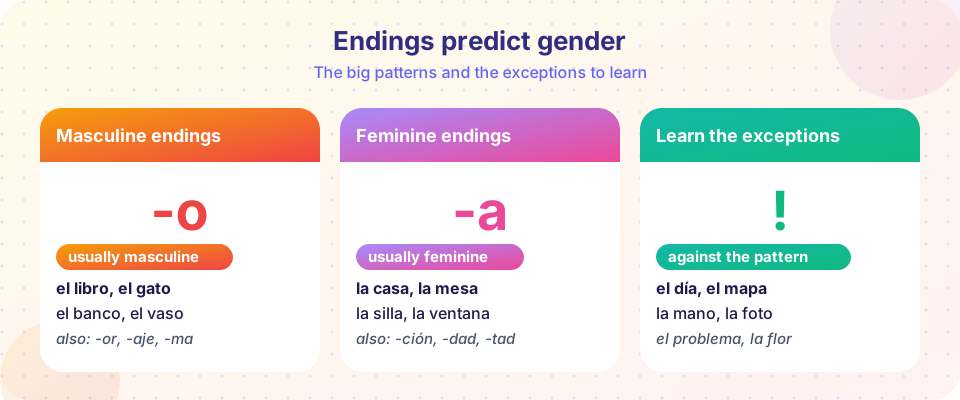
- The common exceptions you must memorize (el día, la mano, el problema).
- How to form feminine versions of nouns for people and animals.
- The plural rules: add -s, add -es, change z to c, and accent adjustments.
Key terms
Masculine noun: takes el (the) and un (a): el libro, un coche.
Feminine noun: takes la and una: la mesa, una casa.
Suffix: an ending added to a word stem, such as -ción or -dad.
Common-gender noun (sustantivo común): one form for both genders, where only the article changes: el estudiante, la estudiante.
The two big endings: -o and -a
- Nouns ending in -o are usually masculine: el libro (book), el gato (cat), el vaso (glass), el banco (bank), el amigo (friend), el cuaderno (notebook).
- Nouns ending in -a are usually feminine: la casa (house), la mesa (table), la silla (chair), la ventana (window), la escuela (school), la amiga (female friend), la comida (food).
Careful: a few common words break the pattern; we list them in a moment.
These two rules cover most nouns of Latin origin.
Reliable suffixes
Some endings are almost always feminine:
- -ción, -sión: la nación, la canción (song), la televisión, la decisión.
- -dad, -tad, -tud: la ciudad (city), la libertad (freedom), la actitud (attitude).
- -umbre: la costumbre (custom).
- -ie: la serie, la especie.
Some endings are almost always masculine:
- -or: el amor (love), el color, el dolor (pain), el calor (heat), el sabor (flavor). Exceptions: la flor (flower), la labor (labor).
- -aje: el viaje (trip), el paisaje (landscape), el garaje.
- -ma (of Greek origin): el problema, el sistema, el tema (topic), el programa, el idioma (language), el clima (climate), el poema.
- Days of the week, and many rivers and mountains: el lunes, el martes, el Amazonas.
- Languages: el español, el inglés.
Nouns ending in -e or in a consonant other than the suffixes above are unpredictable: el coche (car), la noche (night), el nombre (name), la leche (milk), el papel (paper), la sal (salt), el árbol (tree), la flor (flower). Learn them with their article.
Famous exceptions
| Looks like... | But is... | Examples |
|---|---|---|
| ends in -a, masculine | masculine | el día, el mapa, el planeta, el sofá, el tema, el idioma |
| ends in -o, feminine | feminine | la mano (hand), la foto (short for fotografía), la moto (short for motocicleta), la radio |
Why? La foto and la moto are shortened forms of feminine words; el día and el mapa come from words whose Latin or Greek gender was masculine. You do not need the history; just memorize the dozen exceptions above.
People and animals
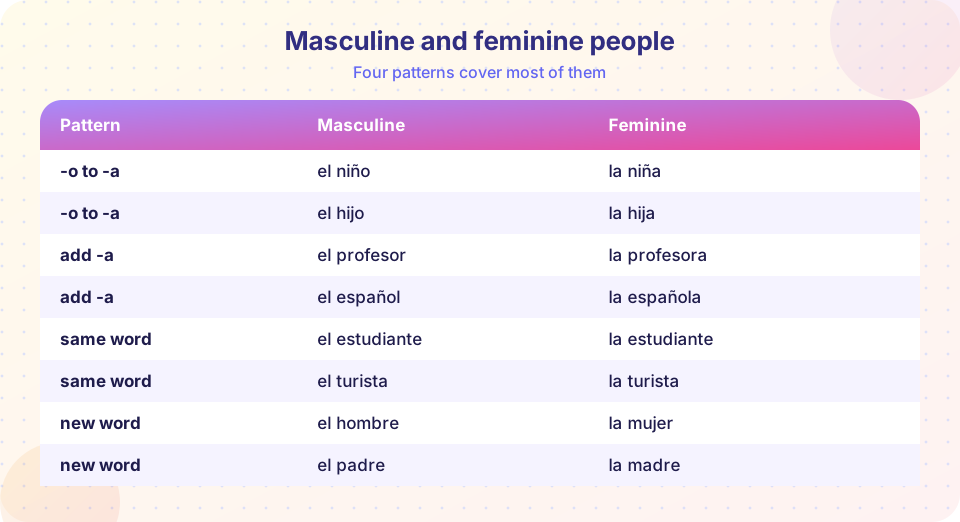
For people and animals, gender usually follows the sex of the being. Four patterns cover most of them:
- -o becomes -a: el niño / la niña (boy / girl), el hijo / la hija (son / daughter), el amigo / la amiga.
- Add -a to a consonant: el profesor / la profesora (teacher), el doctor / la doctora, el español / la española, el león / la leona (lion).
- Same word, different article (nouns ending in -e, -ista, -ante): el / la estudiante (student), el / la turista (tourist), el / la artista, el / la cantante (singer), el / la joven (young person).
- Different words: el hombre / la mujer (man / woman), el padre / la madre (father / mother), el rey / la reina (king / queen), el toro / la vaca (bull / cow).
A few nouns have a fixed gender whatever the sex of the person: la persona (person) is always feminine, even for a man; el bebé (baby) is masculine in form for both. El personaje (character) is masculine.
Plural nouns
Forming the plural is mostly mechanical:
| Ending | Rule | Examples |
|---|---|---|
| vowel | add -s | casa → casas, libro → libros, café → cafés |
| consonant | add -es | ciudad → ciudades, papel → papeles, mujer → mujeres, flor → flores |
| -z | change z to c and add -es | lápiz → lápices, luz → luces, pez → peces |
| -s after a stressed vowel | add -es | país → países, inglés → ingleses, autobús → autobuses |
| -s after an unstressed vowel | no change | el lunes → los lunes, la crisis → las crisis |
Two accent adjustments matter. Words ending in -ión lose the written accent in the plural because the stress is now correct without it: canción → canciones, nación → naciones, camión → camiones. A few words gain an accent to keep their stress in the right place: examen → exámenes, joven → jóvenes, origen → orígenes, imagen → imágenes.
Mixed groups
A plural masculine noun can include both sexes: los padres means parents (or fathers), los hijos means children (or sons), los reyes means kings or king and queen, los profesores can mean teachers of both sexes. Feminine plural applies only to groups with only females: las profesoras.
Learning gender in practice
Do not try to learn long lists of nouns by gender in isolation. Instead, collect nouns in themes (the kitchen, the classroom, the family) and always write them with their article. When you meet a new word, ask three questions: What is its ending? Does that ending belong to one of the reliable families? Is it a known exception? If the answer to the last two is no, treat the word as a normal item to memorize with its article. After a few hundred words, your ear will tell you when something sounds wrong.
Common misconceptions
"Every word ending in -a is feminine." Many common ones are not: el día, el mapa, el problema, el idioma.
"The gender tells you something about the thing." It does not. A table is feminine only because the word is.
"Plurals are formed by adding -s." Only after a vowel. After a consonant, add -es.
"La agua is correct." For feminine nouns that begin with a stressed a- sound, the singular article is el to avoid two a sounds, but the noun stays feminine: el agua fría (cold water), las aguas frías. You will see this again in the article lesson.
Try it
First a plural maker that applies the rules above. It is a small rule engine, so it does not know exceptions beyond the words we listed. Then a gender drill and flashcards for the exceptions.
Press Run (or Ctrl + Enter) to see the result here.
Program input · what you'd type while the program runs
Type the answers before you press Run, one per line. Each time the program reads a line (with input()), it gets the next line from this box.
Check your understanding
Quick check · 5 questions
of 5 answered You scored / 5 · perfect!
-
1. Which noun is feminine?
Words ending in -dad are feminine. -
2. What is the feminine of 'el profesor'?
Add -a to a consonant: profesora. -
3. What is the plural of 'ciudad'?
After a consonant, add -es. -
4. 'Los padres' can mean...
A masculine plural covers a mixed group; los padres means parents or fathers. -
5. Which plural is correct?
Words ending in unstressed -s do not change in the plural.
Summary
- -o is usually masculine and -a usually feminine; learn exceptions like el día and la mano.
- -ción, -dad, -tad, -tud, -umbre are feminine; -or, -aje and Greek -ma are masculine.
- People: -o to -a, add -a, same word, or a different word.
- Plurals: add -s after a vowel, -es after a consonant, z to c, unstressed -s unchanged.
- Accents move: canción to canciones, joven to jóvenes.
Track your progress
Create a free account to tick off lessons and pick up where you left off on any device.
of Spanish for Beginners lessons completed