Customs, etiquette and holidays in the Spanish-speaking world
Learn greetings, titles, names, mealtimes, famous festivals and cultural references from Spain and Latin America, so your Spanish fits the situation.
Words are only half of communication. The other half is knowing what is polite, what people do at the table and how they celebrate. Spanish-speaking cultures are diverse: Spain, Mexico, Argentina, Peru and Cuba differ a lot, and within each country there are differences too. So treat this lesson as a first map, not a rulebook. When you are in doubt, watch what the people around you do and follow their lead.
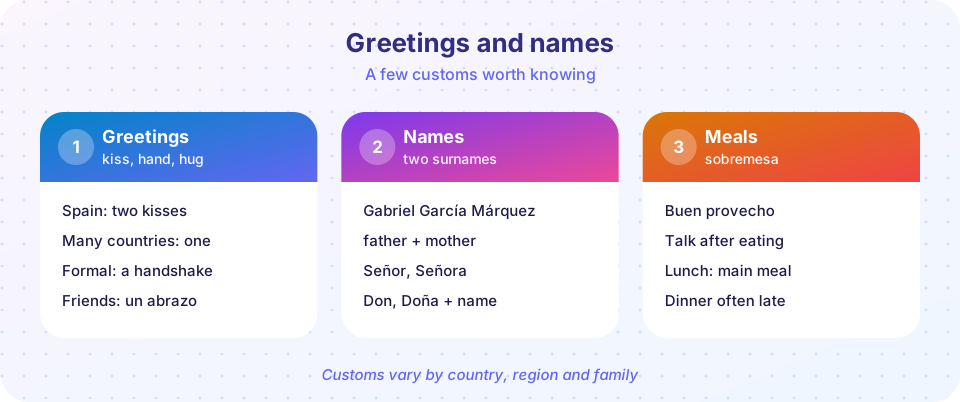
Some customs worth knowing: how people greet, how they name each other and how they eat together.
Saludo: a greeting.
Apellido: surname (most people have two).
Don / Doña: a respectful title used with a first name.
Sobremesa: relaxed time at the table after a meal.
Fiesta patronal: a local festival for a town's patron saint.
When you meet someone, the typical greetings depend on the country and the relationship:
In Spain, friends and acquaintances usually greet each other, including men and women, with two kisses on the cheeks (right cheek first, then left). Men who are close friends or relatives may hug.
In much of Latin America, a greeting between a woman and a man, or between two women, is often one kiss on the right cheek. In some countries, such as Mexico, Colombia and Argentina, this is very common; the number varies by country and context.
In formal or business situations, a firm handshake (un apretón de manos) is the standard greeting, accompanied by Mucho gusto or Encantado/a. Men who are close friends often give un abrazo (a hug), with a pat on the back.
People often stand closer than in some other cultures, and touching an arm during a conversation is normal. Do not take a step back unless you feel uncomfortable.
Ask yourself: is it a friend or a business contact? Is it a formal event? If you do not know, a friendly handshake and a smile are always accepted. People will let you know if they prefer a kiss. ¿Te saludo con un beso o con la mano? is a polite way to ask.
Most Spanish-speaking people have two surnames: the first is the father's first surname, the second the mother's first surname. The writer Gabriel García Márquez is called García Márquez, and people often shorten his name to García Márquez or Gabo, but never Márquez alone. Women traditionally keep their own surnames when they marry, although some add the husband's name with de. Forms to address people: señor (Mr.), señora (Mrs.), señorita (Miss, used less and less) and doctor/a, licenciado/a, ingeniero/a, profesor/a, which are used as titles for professionals in many countries. Don and doña with the first name (don Carlos, doña Elena) show respect to an older or respected person: Buenos días, doña Elena. Many people use first names quickly, but wait for an invitation before dropping the formal usted.
Mealtimes differ by country. In Spain, lunch (la comida) is often the main meal, around two or three in the afternoon, and dinner (la cena) is often after nine in the evening. In Mexico, many people eat the main meal (la comida) in the early afternoon and a lighter dinner later. In Argentina, dinner is also late. Many workplaces historically had a long lunch break, which gave rise to the (often exaggerated) image of the siesta. Today many people no longer nap, and in big cities shops and offices work through the day, though some small shops and offices in smaller towns still close for part of the afternoon.
Before eating, people say ¡Buen provecho! (Enjoy your meal), also when they pass tables in a restaurant. When you drink together, say ¡Salud!. After a meal comes the sobremesa: the time spent at the table, talking over coffee or dessert. It can last for an hour or more, and it is seen as a pleasant part of the meal, not wasted time. In a restaurant, you usually need to ask for the bill (La cuenta, por favor) because waiters do not bring it automatically; they would consider that rushing you. Tipping customs vary by country; check locally.
Attitudes to time differ. In many places social events start later than the announced time, and arriving exactly on time to a party can mean arriving before the host is ready. For business meetings, appointments with doctors, trains and flights, punctuality matters as it does everywhere. If you are not sure, ask: ¿A qué hora empieza exactamente? (What time does it exactly start?) The reply a las ocho en punto means "at eight sharp".
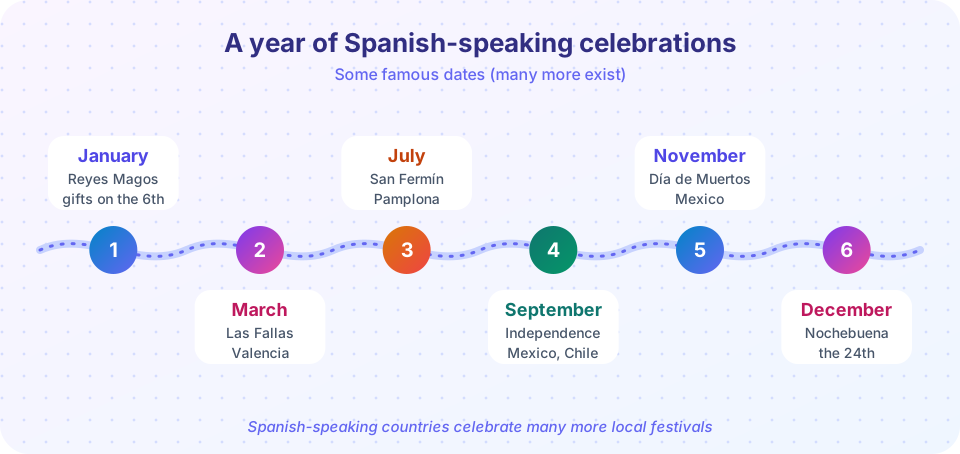
A year of famous celebrations in the Spanish-speaking world.
The calendar is full of festivals. A few famous examples: Día de los Reyes Magos (6 January), when children receive gifts in Spain and some Latin American countries; Semana Santa (Holy Week), with solemn processions in Sevilla and Antigua Guatemala; Las Fallas in Valencia (March), where giant sculptures are burned; San Fermín in Pamplona (July); La Tomatina in Buñol (last Wednesday of August); the national days of Mexico (16 September) and Chile (18 September); Día de Muertos in Mexico (1-2 November), a family celebration with altars, marigolds and food to remember the dead (it is a joyful remembrance rather than a sad event); and Nochebuena on 24 December, often the main Christmas dinner. In Spain people eat twelve grapes at midnight on 31 December. In many Latin American countries a girl's fifteenth birthday is celebrated with a quinceañera, a large party.
Spanish-speaking culture is wide: the writers Miguel de Cervantes (Don Quijote), Gabriel García Márquez, Jorge Luis Borges, Isabel Allende and Pablo Neruda; the artists Pablo Picasso, Salvador Dalí, Frida Kahlo and Diego Rivera; music and dance such as flamenco, tango, salsa, cumbia, mariachi and reggaeton; and dishes such as tortilla española (a potato omelet), paella, tacos, empanadas, arepas and ceviche. Note that tortilla means different things: in Spain a potato omelet, in Mexico a flat bread of corn or wheat.
Common misconceptions
"Everyone in Latin America is the same." The region includes many countries with very different histories, foods, accents and customs.
"Everyone takes a siesta." Many people do not; a long lunch is more typical than sleeping.
"A kiss on the cheek is always required." It depends on the relationship and country; a handshake is acceptable.
"Spanish people eat late because they are lazy." Schedules are linked to history, climate and work patterns, and they are changing.
<style>*{box-sizing:border-box}body{margin:0;padding:14px;font-family:system-ui,-apple-system,'Segoe UI',sans-serif;background:linear-gradient(135deg,#faf5ff,#eff6ff);color:#1e1b4b}.card{background:#fff;border-radius:18px;box-shadow:0 8px 22px rgba(67,56,202,.16);padding:16px;max-width:560px;margin:0 auto}button{font:inherit;font-weight:600;border:0;border-radius:999px;padding:8px 16px;margin:4px 4px 0 0;color:#fff;background:linear-gradient(135deg,#6366f1,#ec4899);cursor:pointer}button.alt{background:#eef2ff;color:#3730a3}input{font:inherit;padding:6px 10px;border:2px solid #c7d2fe;border-radius:10px;width:150px}.small{font-size:.85rem;color:#475569}</style><style>.pill{display:inline-block;padding:5px 12px;margin:3px;border-radius:999px;background:#eef2ff;color:#3730a3;font-weight:600;cursor:pointer}.pill.on{background:linear-gradient(135deg,#6366f1,#ec4899);color:#fff}li{margin:6px 0}</style><divclass="card"style="max-width:640px"><divid="m"></div><h3id="h"style="margin:.6em 0 .2em"></h3><ulid="l"></ul><pclass="small">Dates for movable festivals change every year. Many more local festivals exist.</p></div><script>varM=['January','February','March','April','May','June','July','August','September','October','November','December'];varD={0:['6 January: Día de los Reyes Magos (Three Kings Day), when children in Spain and many Latin American countries traditionally get gifts.'],1:['Carnaval takes place in February or early March in many places (the date depends on Easter), for example in Barranquilla (Colombia) and Santa Cruz de Tenerife (Spain).'],2:['15-19 March: Las Fallas in Valencia, with huge sculptures that are burned on the last night.','Semana Santa (Holy Week) falls in March or April.'],3:['Semana Santa (Holy Week) falls in March or April, with processions in cities such as Sevilla and Antigua Guatemala.'],5:['24 June: Inti Raymi in Cusco (Peru), a festival of the sun; 23-24 June: Noche de San Juan in Spain.'],6:['6-14 July: San Fermín in Pamplona, famous for the running of the bulls.'],7:['Last Wednesday of August: La Tomatina, a tomato fight in Buñol (Spain).'],8:['16 September: Independence Day in Mexico (the Grito).','18 September: Fiestas Patrias in Chile.'],9:['12 October: Fiesta Nacional de España (Spain); in several countries the date is a holiday with other names.'],10:['1-2 November: Día de Muertos in Mexico, with altars and offerings; Todos los Santos in Spain and elsewhere.'],11:['16-24 December: Las Posadas in Mexico.','24 December: Nochebuena, the main Christmas celebration in many countries.','31 December: Nochevieja; in Spain people eat twelve grapes at midnight.']};var cur=0;functionrender(){var p=document.getElementById('m');p.innerHTML='';M.forEach(function(n,i){var b=document.createElement('span');b.className='pill'+(i===cur?' on':'');b.textContent=n.slice(0,3);b.onclick=function(){cur=i;render();};p.appendChild(b);});
document.getElementById('h').textContent=M[cur];var l=document.getElementById('l');l.innerHTML='';(D[cur]||['No single famous festival here, but every town has its own fiestas patronales.']).forEach(function(t){var li=document.createElement('li');li.textContent=t;l.appendChild(li);});}render();</script>
Which greeting would fit? Choose the best answer.
Greetings and customs
<style>*{box-sizing:border-box}body{margin:0;padding:14px;font-family:system-ui,-apple-system,'Segoe UI',sans-serif;background:linear-gradient(135deg,#faf5ff,#eff6ff);color:#1e1b4b}.card{background:#fff;border-radius:18px;box-shadow:0 8px 22px rgba(67,56,202,.16);padding:16px;max-width:560px;margin:0 auto}button{font:inherit;font-weight:600;border:0;border-radius:999px;padding:8px 16px;margin:4px 4px 0 0;color:#fff;background:linear-gradient(135deg,#6366f1,#ec4899);cursor:pointer}button.alt{background:#eef2ff;color:#3730a3}input{font:inherit;padding:6px 10px;border:2px solid #c7d2fe;border-radius:10px;width:150px}.small{font-size:.85rem;color:#475569}</style><style>.q{margin:0 0 14px;padding:10px 12px;border-radius:12px;background:#f8fafc}.q .s{font-weight:700;margin-bottom:6px}.q .e{font-size:.85rem;color:#475569;font-style:italic}.q button{background:#eef2ff;color:#3730a3}.q button.right{background:#16a34a;color:#fff}.q button.wrong{background:#dc2626;color:#fff}.fb{font-size:.9rem;margin-top:6px}</style><divclass="card"><divid="box"></div><pid="score"class="small"></p></div><script>var items=[{"s":"A business meeting in Bogotá with a new contact.","o":["A handshake and \"Mucho gusto\"","A big hug"],"a":0,"x":"A handshake is the safe, formal choice.","en":""},{"s":"Meeting a friend of a friend in Madrid.","o":["Two kisses (if she or he offers)","No greeting"],"a":0,"x":"Two cheek kisses are typical in Spain among acquaintances.","en":""},{"s":"You walk past people eating in a restaurant.","o":["¡Buen provecho!","¡Buenas noches!"],"a":0,"x":"Buen provecho wishes people an enjoyable meal.","en":""},{"s":"You want the bill at a restaurant.","o":["La cuenta, por favor.","Quiero pagar ahora mismo."],"a":0,"x":"Waiters usually wait to be asked.","en":""},{"s":"How to address an older neighbour with respect.","o":["doña Elena","Elena, tú"],"a":0,"x":"Doña + first name shows respect.","en":""}];var good=0,done=0;var box=document.getElementById('box');
items.forEach(function(it,k){var d=document.createElement('div');d.className='q';var s=document.createElement('div');s.className='s';s.textContent=it.s;d.appendChild(s);var e=document.createElement('div');e.className='e';e.textContent=it.en;d.appendChild(e);var fb=document.createElement('div');fb.className='fb';
it.o.forEach(function(o,j){var b=document.createElement('button');b.textContent=o;b.onclick=function(){if(d.dataset.done)return;d.dataset.done='1';done++;if(j===it.a){good++;b.className='right';fb.textContent='Correct. '+it.x;}else{b.className='wrong';fb.textContent='Not quite. '+it.x;}document.getElementById('score').textContent='Score: '+good+' / '+done;};d.appendChild(b);});
d.appendChild(fb);box.appendChild(d);});</script>
Culture words
<style>*{box-sizing:border-box}body{margin:0;padding:14px;font-family:system-ui,-apple-system,'Segoe UI',sans-serif;background:linear-gradient(135deg,#faf5ff,#eff6ff);color:#1e1b4b}.card{background:#fff;border-radius:18px;box-shadow:0 8px 22px rgba(67,56,202,.16);padding:16px;max-width:560px;margin:0 auto}button{font:inherit;font-weight:600;border:0;border-radius:999px;padding:8px 16px;margin:4px 4px 0 0;color:#fff;background:linear-gradient(135deg,#6366f1,#ec4899);cursor:pointer}button.alt{background:#eef2ff;color:#3730a3}input{font:inherit;padding:6px 10px;border:2px solid #c7d2fe;border-radius:10px;width:150px}.small{font-size:.85rem;color:#475569}</style><style>.fc{height:150px;border-radius:18px;display:flex;flex-direction:column;align-items:center;justify-content:center;font-size:1.7rem;font-weight:700;color:#fff;cursor:pointer;text-align:center;padding:10px;background:linear-gradient(135deg,#6366f1,#a78bfa)}.fc.back{background:linear-gradient(135deg,#ec4899,#f59e0b)}</style><divclass="card"><divclass="small"id="cnt"></div><divclass="fc"id="fc"tabindex="0"role="button"aria-label="Flashcard, press to flip"></div><pclass="small">Click the card to flip it. Try to answer before you flip.</p><buttonid="prev"class="alt">Previous</button><buttonid="next">Next</button><buttonid="shuf"class="alt">Shuffle</button><buttonid="say"class="alt">Listen</button></div><script>var cards=[["un abrazo","a hug"],["un apretón de manos","a handshake"],["¡Buen provecho!","Enjoy your meal!"],["la sobremesa","time at the table after eating"],["doña / don","respectful titles"],["Nochebuena","Christmas Eve"],["Día de Muertos","Day of the Dead"],["la quinceañera","fifteenth birthday party"]];var i=0,front=true,fc=document.getElementById('fc');functionshow(){var c=cards[i];fc.className='fc'+(front?'':' back');fc.textContent=front?c[0]:c[1];document.getElementById('cnt').textContent='Card '+(i+1)+' of '+cards.length+(front?' (Spanish)':' (English)');}
fc.onclick=function(){front=!front;show();};
fc.onkeydown=function(e){if(e.key==='Enter'||e.key===' '){front=!front;show();}};
document.getElementById('next').onclick=function(){i=(i+1)%cards.length;front=true;show();};
document.getElementById('prev').onclick=function(){i=(i-1+cards.length)%cards.length;front=true;show();};
document.getElementById('shuf').onclick=function(){cards.sort(function(){return Math.random()-0.5;});i=0;front=true;show();};
document.getElementById('say').onclick=function(){try{var u=newSpeechSynthesisUtterance(cards[i][0]);u.lang='es-ES';speechSynthesis.speak(u);}catch(e){document.getElementById('cnt').textContent='Speech is not available here.';}};show();</script>