Practice Spanish travel conversations: airport check-in, hotel booking, train tickets, directions and health problems, with translations and drills.
Travel is the best reason to learn Spanish for many people. Fortunately, the situations you meet when traveling are predictable: you check in, you ask for a room, you buy a ticket, you ask the way, and (hopefully not) you need a pharmacy. Each situation has a set of standard phrases. Learn them well and you will be able to handle most of a trip with confidence.
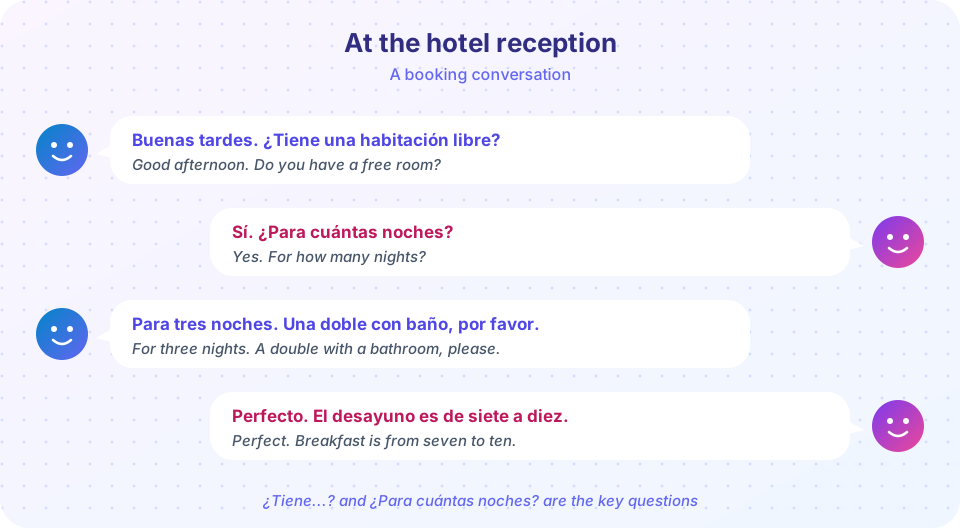
A hotel booking conversation. The questions repeat in almost every hotel.
El billete / el boleto: a ticket (billete in Spain, boleto in much of Latin America).
La tarjeta de embarque: boarding pass.
La habitación doble / individual: double or single room.
Ida y vuelta: round trip.
Doler: to hurt; it works like gustar.
—Buenos días. Su pasaporte, por favor. Good morning. Your passport, please.
—Aquí lo tiene. Here you are.
—¿Tiene algo que facturar? Do you have anything to check in?
—Sí, una maleta. Yes, one suitcase.
—Muy bien. Aquí tiene su tarjeta de embarque. Su vuelo sale a las diez y media por la puerta doce. Very well. Here is your boarding pass. Your flight leaves at ten thirty from gate twelve.
—¿Hay algún retraso? Is there any delay?
—No, el vuelo está a la hora. Buen viaje. No, the flight is on time. Have a good trip.
Useful words: el aeropuerto (airport), el vuelo (flight), la maleta (suitcase), el equipaje de mano (hand luggage), la aduana (customs), el control de seguridad (security check), la salida / la llegada (departure / arrival), el retraso (delay), perder el vuelo (to miss the flight). In Spain billete means ticket; in Latin America you say boleto or pasaje. Notice that the agent speaks to you with usted and uses Aquí tiene ("Here you are"), a formula that you can use too when you hand over a document.
—Buenas tardes. ¿Tiene una habitación libre? Good afternoon. Do you have a free room?
—Sí. ¿Para cuántas noches? Yes. For how many nights?
—Para tres noches. Quisiera una habitación doble con baño. For three nights. I would like a double room with a bathroom.
—Tenemos una en el segundo piso. Cuesta cien euros por noche. We have one on the second floor. It costs one hundred euros a night.
—¿Incluye el desayuno? Does it include breakfast?
—Sí, se sirve de siete a diez en el comedor. Yes, it is served from seven to ten in the dining room.
—¿Cuál es la contraseña del wifi? What is the wifi password?
—Está en la tarjeta. La salida es antes de las doce. It is on the card. Check-out is before twelve.
Useful words: la reserva (booking), la llave / la tarjeta (key), el ascensor (elevator), la planta baja (ground floor), el primer piso, la toalla, el aire acondicionado, la calefacción. Problems: No funciona el aire acondicionado. ¿Podría darme otra toalla? Mi habitación está muy ruidosa. Notice the polite conditional podría and the impersonal se in se sirve (is served).
—Un billete de ida y vuelta a Sevilla, por favor. A round-trip ticket to Seville, please.
—¿Para qué día? For which day?
—Para el viernes por la mañana, y la vuelta el domingo por la tarde. For Friday morning, and the return on Sunday afternoon.
—El tren sale a las nueve y diez. Son cuarenta y cinco euros. The train leaves at nine ten. It is forty-five euros.
—¿De qué andén sale? From which platform does it leave?
—Del andén cuatro. From platform four.
Key words: ida (one way), ida y vuelta (round trip), el andén (platform), la vía (track), la parada (stop), la estación (station), el horario (timetable), transbordo (change of train), directo (direct). For buses: el autobús (Spain), el camión (Mexico), la guagua (Caribbean), el colectivo (Argentina). When you ask the way, you already know the commands: Siga todo recto, gire a la derecha, cruce el puente.
—Buenos días. ¿Qué le pasa? Good morning. What is the matter?
—Me duele la cabeza y tengo fiebre. I have a headache and a fever.
—¿Desde cuándo? Since when?
—Desde ayer por la noche. También me duelen los ojos. Since last night. My eyes hurt too.
—Voy a examinarle. Tome esta medicina dos veces al día y descanse. I am going to examine you. Take this medicine twice a day and rest.
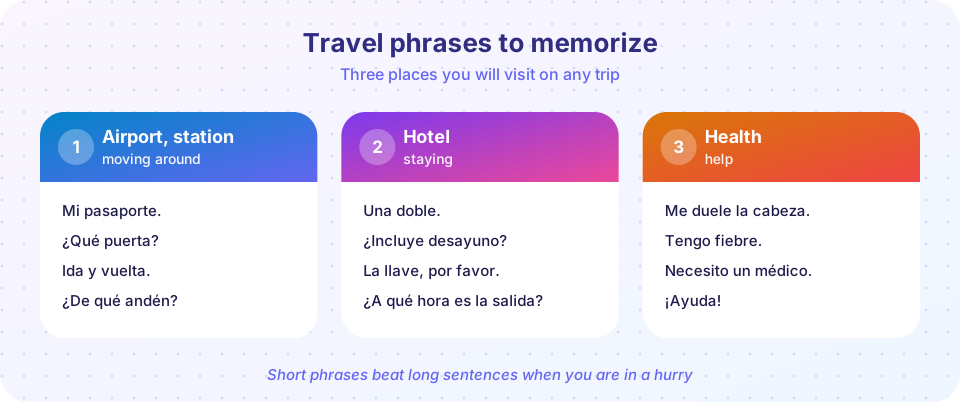
The verb doler (o becomes ue) works exactly like gustar: the part of the body is the subject. Use duele for one thing and duelen for plural: Me duele la garganta (My throat hurts), Me duelen los pies (My feet hurt), Le duele el estómago a mi hermana. To say what is wrong, you can also use tener: Tengo fiebre, tengo tos (cough), tengo gripe (flu), tengo náuseas. Or estar: Estoy enfermo/a, estoy mareado/a (dizzy), estoy resfriado/a (I have a cold). Useful emergency phrases: ¡Ayuda!, ¡Socorro!, Necesito un médico, Llame a una ambulancia, ¿Dónde está la farmacia?, ¿Hay un hospital cerca?, Soy alérgico a la penicilina. You do not need to memorize every one of them today, but save the short list on your phone before you travel.
This lesson teaches language only. It does not give medical advice. In a real emergency, call the local emergency number (112 in the European Union, 911 in many American countries) and follow professional guidance.
You will often combine travel dialogues with directions. Practice this short exchange, in which a tourist speaks to a passer-by:
—Disculpe, ¿hay un banco por aquí? Excuse me, is there a bank around here?
—Sí, siga por esta calle hasta el semáforo y gire a la derecha. Está al lado de la farmacia. Yes, follow this street to the traffic light and turn right. It is next to the pharmacy.
—¿Está lejos? Is it far?
—No, está a cinco minutos andando. No, it is five minutes on foot.
—Muchas gracias. Thank you very much.
—De nada. Que tenga un buen día. You're welcome. Have a nice day.
Notice hay (is there) for existence and está for location, a cinco minutos andando (five minutes away on foot) and the farewell Que tenga un buen día, a subjunctive wish. Useful additions: en coche / en autobús / en metro / en taxi (by car, bus, metro, taxi), la salida del metro, el semáforo, la esquina, la manzana (block, in Latin America; in Spain manzana also means apple and a city block).
"Me duele los pies is correct." The verb agrees with the thing that hurts: Me duelen los pies.
"You can use tú with everyone abroad." With officials, receptionists and older people, usted is safer; they will often switch to tú if they want you to.
"Spanish word for ticket is the same everywhere." It is billete in Spain and boleto (or pasaje) in much of Latin America; both are understood.
"Coger el autobús is fine everywhere." In some Latin American countries coger has a vulgar meaning, so use tomar there (tomar el autobús).
<style>*{box-sizing:border-box}body{margin:0;padding:14px;font-family:system-ui,-apple-system,'Segoe UI',sans-serif;background:linear-gradient(135deg,#faf5ff,#eff6ff);color:#1e1b4b}.card{background:#fff;border-radius:18px;box-shadow:0 8px 22px rgba(67,56,202,.16);padding:16px;max-width:560px;margin:0 auto}button{font:inherit;font-weight:600;border:0;border-radius:999px;padding:8px 16px;margin:4px 4px 0 0;color:#fff;background:linear-gradient(135deg,#6366f1,#ec4899);cursor:pointer}button.alt{background:#eef2ff;color:#3730a3}input{font:inherit;padding:6px 10px;border:2px solid #c7d2fe;border-radius:10px;width:150px}.small{font-size:.85rem;color:#475569}</style><style>.fc{height:150px;border-radius:18px;display:flex;flex-direction:column;align-items:center;justify-content:center;font-size:1.7rem;font-weight:700;color:#fff;cursor:pointer;text-align:center;padding:10px;background:linear-gradient(135deg,#6366f1,#a78bfa)}.fc.back{background:linear-gradient(135deg,#ec4899,#f59e0b)}</style><divclass="card"><divclass="small"id="cnt"></div><divclass="fc"id="fc"tabindex="0"role="button"aria-label="Flashcard, press to flip"></div><pclass="small">Click the card to flip it. Try to answer before you flip.</p><buttonid="prev"class="alt">Previous</button><buttonid="next">Next</button><buttonid="shuf"class="alt">Shuffle</button><buttonid="say"class="alt">Listen</button></div><script>var cards=[["¿Tiene una habitación libre?","Do you have a free room?"],["un billete de ida y vuelta","a round-trip ticket"],["¿De qué andén sale?","Which platform does it leave from?"],["Me duele la cabeza","I have a headache"],["¿Dónde está la farmacia?","Where is the pharmacy?"],["Necesito un médico","I need a doctor"],["¿Incluye el desayuno?","Does it include breakfast?"],["Aquí tiene mi pasaporte","Here is my passport"]];var i=0,front=true,fc=document.getElementById('fc');functionshow(){var c=cards[i];fc.className='fc'+(front?'':' back');fc.textContent=front?c[0]:c[1];document.getElementById('cnt').textContent='Card '+(i+1)+' of '+cards.length+(front?' (Spanish)':' (English)');}
fc.onclick=function(){front=!front;show();};
fc.onkeydown=function(e){if(e.key==='Enter'||e.key===' '){front=!front;show();}};
document.getElementById('next').onclick=function(){i=(i+1)%cards.length;front=true;show();};
document.getElementById('prev').onclick=function(){i=(i-1+cards.length)%cards.length;front=true;show();};
document.getElementById('shuf').onclick=function(){cards.sort(function(){return Math.random()-0.5;});i=0;front=true;show();};
document.getElementById('say').onclick=function(){try{var u=newSpeechSynthesisUtterance(cards[i][0]);u.lang='es-ES';speechSynthesis.speak(u);}catch(e){document.getElementById('cnt').textContent='Speech is not available here.';}};show();</script>
Choose the best phrase for each situation.
What would you say?
<style>*{box-sizing:border-box}body{margin:0;padding:14px;font-family:system-ui,-apple-system,'Segoe UI',sans-serif;background:linear-gradient(135deg,#faf5ff,#eff6ff);color:#1e1b4b}.card{background:#fff;border-radius:18px;box-shadow:0 8px 22px rgba(67,56,202,.16);padding:16px;max-width:560px;margin:0 auto}button{font:inherit;font-weight:600;border:0;border-radius:999px;padding:8px 16px;margin:4px 4px 0 0;color:#fff;background:linear-gradient(135deg,#6366f1,#ec4899);cursor:pointer}button.alt{background:#eef2ff;color:#3730a3}input{font:inherit;padding:6px 10px;border:2px solid #c7d2fe;border-radius:10px;width:150px}.small{font-size:.85rem;color:#475569}</style><style>.q{margin:0 0 14px;padding:10px 12px;border-radius:12px;background:#f8fafc}.q .s{font-weight:700;margin-bottom:6px}.q .e{font-size:.85rem;color:#475569;font-style:italic}.q button{background:#eef2ff;color:#3730a3}.q button.right{background:#16a34a;color:#fff}.q button.wrong{background:#dc2626;color:#fff}.fb{font-size:.9rem;margin-top:6px}</style><divclass="card"><divid="box"></div><pid="score"class="small"></p></div><script>var items=[{"s":"At a hotel desk you want a room for two nights.","o":["Tengo una habitación.","¿Tiene una habitación libre para dos noches?"],"a":1,"x":"You ask whether they have a free room.","en":""},{"s":"You want to know which platform your train uses.","o":["¿De qué andén sale?","¿Cuánto cuesta el tren?"],"a":0,"x":"De qué andén asks about the platform.","en":""},{"s":"Your stomach hurts.","o":["Me duele el estómago.","Me duelen el estómago."],"a":0,"x":"One body part: duele.","en":""},{"s":"You need a pharmacy.","o":["¿Dónde está la farmacia?","¿Qué hora es?"],"a":0,"x":"Dónde está asks for location.","en":""},{"s":"You hand your passport to the agent.","o":["Aquí lo tiene.","Aquí te lo doy."],"a":0,"x":"Aquí lo tiene is the polite formal formula.","en":""}];var good=0,done=0;var box=document.getElementById('box');
items.forEach(function(it,k){var d=document.createElement('div');d.className='q';var s=document.createElement('div');s.className='s';s.textContent=it.s;d.appendChild(s);var e=document.createElement('div');e.className='e';e.textContent=it.en;d.appendChild(e);var fb=document.createElement('div');fb.className='fb';
it.o.forEach(function(o,j){var b=document.createElement('button');b.textContent=o;b.onclick=function(){if(d.dataset.done)return;d.dataset.done='1';done++;if(j===it.a){good++;b.className='right';fb.textContent='Correct. '+it.x;}else{b.className='wrong';fb.textContent='Not quite. '+it.x;}document.getElementById('score').textContent='Score: '+good+' / '+done;};d.appendChild(b);});
d.appendChild(fb);box.appendChild(d);});</script>
Now fill in the missing words.
Travel gap fill
<style>*{box-sizing:border-box}body{margin:0;padding:14px;font-family:system-ui,-apple-system,'Segoe UI',sans-serif;background:linear-gradient(135deg,#faf5ff,#eff6ff);color:#1e1b4b}.card{background:#fff;border-radius:18px;box-shadow:0 8px 22px rgba(67,56,202,.16);padding:16px;max-width:560px;margin:0 auto}button{font:inherit;font-weight:600;border:0;border-radius:999px;padding:8px 16px;margin:4px 4px 0 0;color:#fff;background:linear-gradient(135deg,#6366f1,#ec4899);cursor:pointer}button.alt{background:#eef2ff;color:#3730a3}input{font:inherit;padding:6px 10px;border:2px solid #c7d2fe;border-radius:10px;width:150px}.small{font-size:.85rem;color:#475569}</style><style>.row{margin:0 0 12px;padding:10px 12px;border-radius:12px;background:#f8fafc}.ok{background:#dcfce7}.no{background:#fee2e2}.near{background:#fef9c3}.en{font-size:.85rem;color:#475569;font-style:italic}</style><divclass="card"><divid="list"></div><buttonid="chk">Check answers</button><buttonid="rst"class="alt">Clear</button><pid="score"class="small"></p></div><script>var items=[{"s":"Me ___ la cabeza.","a":["duele"],"en":"My head hurts."},{"s":"Me ___ los pies.","a":["duelen"],"en":"My feet hurt."},{"s":"Un billete de ___ y vuelta, por favor.","a":["ida"],"en":"A round-trip ticket, please."},{"s":"¿___ el desayuno?","a":["incluye"],"en":"Does it include breakfast?"},{"s":"La salida es ___ de las doce.","a":["antes"],"en":"Check-out is before twelve."},{"s":"Quisiera una habitación ___ con baño.","a":["doble"],"en":"I would like a double room with a bathroom."}];functionstrip(t){return t.normalize('NFD').replace(/[\u0300-\u036f]/g,'');}var list=document.getElementById('list');
items.forEach(function(it,k){var d=document.createElement('div');d.className='row';var p=it.s.split('___');d.appendChild(document.createTextNode(p[0]));var inp=document.createElement('input');inp.id='f'+k;inp.setAttribute('aria-label','answer '+(k+1));d.appendChild(inp);d.appendChild(document.createTextNode(p[1]||''));var e=document.createElement('div');e.className='en';e.textContent=it.en;d.appendChild(e);var m=document.createElement('div');m.className='small';m.id='m'+k;d.appendChild(m);d.id='r'+k;list.appendChild(d);});
document.getElementById('chk').onclick=function(){var good=0;items.forEach(function(it,k){var v=document.getElementById('f'+k).value.trim().toLowerCase();var r=document.getElementById('r'+k),m=document.getElementById('m'+k);var ex=it.a.indexOf(v)>=0;var near=!ex&&it.a.some(function(a){returnstrip(a)===strip(v)&&v!=='';});if(ex){good++;r.className='row ok';m.textContent='Correct';}elseif(near){r.className='row near';m.textContent='Almost: check the accent. Answer: '+it.a[0];}else{r.className='row no';m.textContent=v?'Not quite. Answer: '+it.a[0]:'Answer: '+it.a[0];}});document.getElementById('score').textContent='Score: '+good+' / '+items.length;};
document.getElementById('rst').onclick=function(){items.forEach(function(it,k){document.getElementById('f'+k).value='';document.getElementById('r'+k).className='row';document.getElementById('m'+k).textContent='';});document.getElementById('score').textContent='';};</script>
Learn formulas for airports (pasaporte, vuelo, puerta), hotels (habitación, desayuno, salida), transport (ida y vuelta, andén) and health (me duele, tengo fiebre).
Doler works like gustar (duele / duelen).
Aquí tiene is a polite way to hand something over.
Choose tomar instead of coger in Latin America.
Change one detail at a time to reuse every dialogue.