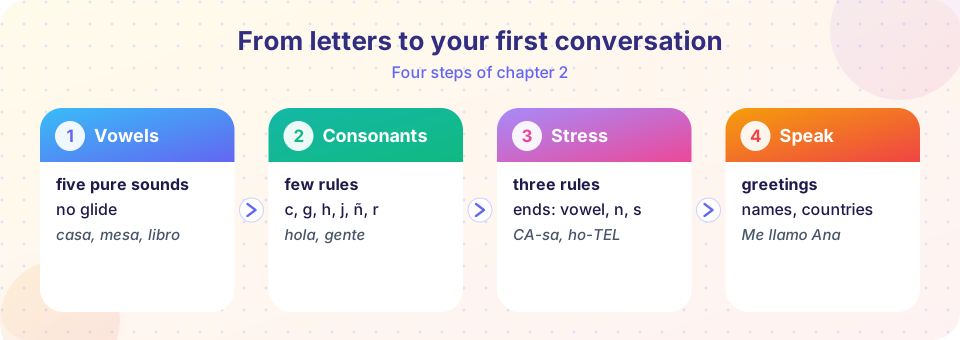
Chapter 2 overview: the Spanish alphabet, five pure vowels, consonant rules, stress and accent marks, and your first greetings and introductions in one clear map.
Spanish has one of the most learner-friendly sound systems of any major language. Where English hides its pronunciation behind spelling surprises, Spanish spelling is a fairly reliable guide to sound. Learn about thirty letter-to-sound rules once, and you can read aloud almost any Spanish word, even one you have never seen, with an accent that people understand.
This chapter has two goals. First, you learn the sound system: the alphabet, five vowels, the consonants that need care, and how to know which syllable to stress. Second, you use those sounds for real: greetings, goodbyes, introducing yourself and asking someone's name. By the end you can walk into a room and say hello properly.
From letters to sounds to stress to your first conversation.
Pure vowels. English vowels often glide: the o in go ends with a little w. Spanish o stays steady, a clean /o/. The same holds for the other four vowels. Learners who keep vowels short and pure sound much more natural.
Short, light consonants. Consonants like p, t and k come out without the puff of air English adds at the start of a word. Hold a tissue in front of your mouth and say pie: it flutters. Say pie the Spanish way, pi, and it should barely move.
Clear syllables. English reduces unstressed vowels to a vague "uh" sound (the a in about). Spanish keeps each vowel clear even when it is unstressed. Banana is ba-NA-na with three full a sounds.
Even rhythm. Spanish syllables tend to take roughly equal time, which gives it a machine-gun feel compared with English. Do not rush; say each syllable steadily.
A few symbols look strange at first but make sense quickly. The letter ñ (called eñe) stands for a sound like the ny in canyon: español, mañana. The marks ¿ ? and ¡ ! frame questions and exclamations at both ends: ¿Cómo estás?, ¡Hola!. The acute accent (´) marks stress or separates words with the same spelling. The dieresis (¨) appears only in güe and güi, such as pingüino, to say the u is pronounced.
Warm up with two small exercises: a drill on what you already know from this overview, and flashcards for the special letters.
Spanish sound habits
<style>:root{font-family:system-ui,-apple-system,"Segoe UI",sans-serif}body{margin:0;padding:16px;background:linear-gradient(135deg,#fffbeb,#fef2f2);color:#1e1b4b}button{border:0;border-radius:999px;padding:8px 16px;font:inherit;font-weight:600;cursor:pointer;background:#fff;color:#b45309;box-shadow:0 2px 8px rgba(180,83,9,.2)}button:hover{background:#fef3c7}.bar{display:flex;gap:8px;justify-content:center;align-items:center;margin-top:14px;flex-wrap:wrap}.muted{font-size:14px;color:#475569;text-align:center;margin-top:10px}.q{max-width:520px;margin:0 auto;background:#fff;border-radius:20px;padding:20px;box-shadow:0 10px 26px rgba(180,83,9,.15)}.prompt{font-size:22px;font-weight:700;margin:0 0 14px}.opts{display:grid;gap:8px}.opts button{text-align:left;border-radius:14px;background:#fffbeb;border:2px solid #fde68a;color:#1e1b4b}.opts button.ok{background:#d1fae5;border-color:#10b981}.opts button.no{background:#fee2e2;border-color:#ef4444}.fb{min-height:44px;margin-top:12px;font-size:15px;color:#334155}</style><divclass="q"><pclass="prompt"id="prompt"></p><divclass="opts"id="opts"></div><divclass="fb"id="fb"></div></div><divclass="bar"><buttonid="next">Next question</button></div><divclass="muted"id="score"></div><script>const items =[{"q":"How is the Spanish h pronounced in 'hola'?","options":["Like English h","It is silent","Like English k"],"answer":2,"why":"Hola is /ˈo.la/; h is silent in Spanish."},{"q":"Which sound does the letter ñ make?","options":["n, as in no","nk","ny, as in canyon"],"answer":3,"why":"Ñ is /ɲ/, like the ny in canyon."},{"q":"How many full 'a' sounds does 'banana' have in Spanish?","options":["Three","One","Two"],"answer":1,"why":"Each unstressed vowel stays clear: ba-NA-na has three full a sounds."},{"q":"Which marks frame a Spanish question?","options":["? at the end only","¿ at the start and ? at the end","¡ at the start"],"answer":2,"why":"Spanish opens the question with ¿ and closes it with ?."},{"q":"In standard Spanish, how do b and v sound?","options":["Different","Both like f","The same"],"answer":3,"why":"Vaca and baca sound alike."}];let k =0, right =0, tried =0, done =false;const$=(id)=> document.getElementById(id);functionshow(){const it = items[k];
done =false;$("prompt").textContent = it.q;$("fb").textContent ="";$("opts").innerHTML ="";
it.options.forEach((o, n)=>{const b = document.createElement("button");
b.textContent = o;
b.onclick=()=>pick(b, n);$("opts").appendChild(b);});$("score").textContent ="Score: "+ right +" / "+ tried;}functionpick(b, n){if(done)return;
done =true; tried++;const it = items[k], bs =$("opts").children;if(n === it.answer -1){ right++; b.className ="ok";$("fb").textContent ="Correct. "+ it.why;}else{ b.className ="no"; bs[it.answer -1].className ="ok";$("fb").textContent ="Not quite. "+ it.why;}$("score").textContent ="Score: "+ right +" / "+ tried;}$("next").onclick=()=>{ k =(k +1)% items.length;show();};show();</script>
Special letters and marks
<style>:root{font-family:system-ui,-apple-system,"Segoe UI",sans-serif}body{margin:0;padding:16px;background:linear-gradient(135deg,#fffbeb,#fef2f2);color:#1e1b4b}button{border:0;border-radius:999px;padding:8px 16px;font:inherit;font-weight:600;cursor:pointer;background:#fff;color:#b45309;box-shadow:0 2px 8px rgba(180,83,9,.2)}button:hover{background:#fef3c7}.bar{display:flex;gap:8px;justify-content:center;align-items:center;margin-top:14px;flex-wrap:wrap}.muted{font-size:14px;color:#475569;text-align:center;margin-top:10px}.card{max-width:440px;margin:0 auto;border-radius:22px;padding:26px 20px;min-height:150px;display:flex;flex-direction:column;align-items:center;justify-content:center;text-align:center;cursor:pointer;color:#fff;background:linear-gradient(135deg,#f59e0b,#ef4444);box-shadow:0 12px 28px rgba(239,68,68,.25)}.card.back{background:linear-gradient(135deg,#6366f1,#a78bfa)}.big{font-size:32px;font-weight:700}.small{font-size:15px;opacity:.92;margin-top:8px}</style><divclass="card"id="card"tabindex="0"role="button"aria-label="Flip the card"></div><divclass="bar"><buttonid="prev">Previous</button><buttonid="flip">Flip</button><buttonid="next">Next</button><buttonid="say">Listen</button><buttonid="shuf">Shuffle</button></div><divclass="muted"id="info"></div><script>const cards =[["ñ","like ny in canyon","español, mañana"],["¿ ?","question marks, both ends","¿Cómo estás?"],["¡ !","exclamation marks, both ends","¡Hola!"],["ü","dieresis: the u is pronounced","pingüino = peen-GWEE-no"],["´","acute accent: marks stress","café, canción, árbol"],["h","silent","hola, hotel, helado"]];let i =0, back =false;const$=(id)=> document.getElementById(id);functionshow(){const c = cards[i];$("card").className ="card"+(back ?" back":"");$("card").innerHTML = back
?'<div class="big">'+ c[1]+'</div>'+(c[2]?'<div class="small">'+ c[2]+'</div>':''):'<div class="big">'+ c[0]+'</div><div class="small">Click to flip</div>';$("info").textContent ="Card "+(i +1)+" of "+ cards.length;}functiongo(d){ i =(i + d + cards.length)% cards.length; back =false;show();}$("card").onclick =$("flip").onclick=()=>{ back =!back;show();};$("prev").onclick=()=>go(-1);$("next").onclick=()=>go(1);$("shuf").onclick=()=>{ cards.sort(()=> Math.random()-0.5); i =0; back =false;show();};$("say").onclick=()=>{try{const u =newSpeechSynthesisUtterance(cards[i][0].replace(/<[^>]*>/g,""));
u.lang ="es-ES";
speechSynthesis.speak(u);}catch(e){$("info").textContent ="Speech is not available in this preview.";}};show();</script>