


















Lesson 27 of 51 · Daily Life and Questions
Chapter 5 review: Daily life and questions
Review Spanish question words, numbers, time, dates, gustar, ordering food and reflexive daily routine verbs with a recap table, flashcards and a mixed quiz.
This review pulls together the four skills of chapter 5: asking questions, numbers and time, food and shopping, and daily routines. Look at the picture, read the recap table, practice with the drill and then try the ten-question quiz.
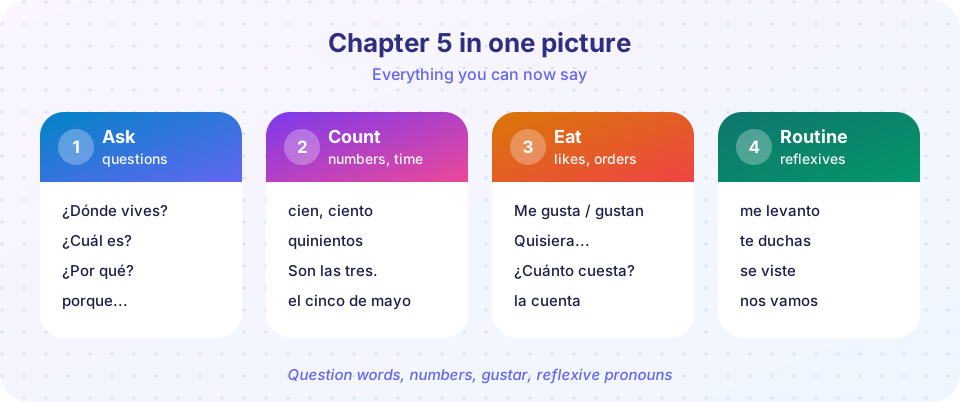
Recap table
| Lesson | Key ideas | Example |
|---|---|---|
| Question words | question word + verb + subject; qué / cuál; por qué / porque; accents | ¿Con quién hablas? |
| Numbers, time and dates | 16-29 one word; cien / ciento; es la una, son las dos; y, menos, cuarto, media | Son las cinco menos cuarto. |
| Food, restaurants and shopping | gusta / gustan; quisiera; pedir; cuesta / cuestan; tener hambre | Me gustan las uvas. |
| Daily routine and reflexive verbs | me, te, se, nos, os, se; stem changes; body parts with articles | Me lavo las manos. |
Four habits to keep
- Check the accent. Dónde asks; donde states. Por qué asks; porque answers.
- Let the noun decide. Cuántas hermanas, doscientas casas, me gustan las fresas. Agreement follows the noun.
- Count in layers. Break any number into hundreds, tens and units: trescientos cuarenta y cinco.
- Do not drop the reflexive pronoun. The subject can vanish, but me, te, se, nos, os must stay.
Mixed practice
Type the missing words. The exercise mixes all four lessons.
Worked examples
Example 1. Translate: "At what time do you usually go to bed?" Break it into pieces. "At what time" is ¿A qué hora...? ("a" stays in front). "usually" is normalmente or sueles, but normalmente is simpler. "go to bed" is the reflexive verb acostarse, and with tú it becomes te acuestas (o becomes ue). Answer: ¿A qué hora te acuestas normalmente? Reply: Normalmente me acuesto a las once y media.
Example 2. Say 3:50 pm at the market. The half hour has passed, so use the next hour minus ten minutes: Son las cuatro menos diez de la tarde. Many people would also say Son las tres y cincuenta when reading a digital clock, which is perfectly understood.
Example 3. Order for two people: —Para mí, la sopa. —Para mí, el pollo. —Y para beber, dos aguas, por favor. —¿Algo más? —No, gracias. La cuenta, por favor. This uses para mí twice and the polite closing.
Fix the mistakes
Each sentence below contains one typical error. Try to find it before you read the correction.
| Sentence | Correction | Why |
|---|---|---|
| ¿Dónde tú vives? | ¿Dónde vives? | Verb comes right after the question word; the pronoun is usually dropped. |
| Yo gusto el café. | Me gusta el café. | The coffee is the subject of gustar. |
| Son la una. | Es la una. | One o'clock is singular. |
| Me lavo mis manos. | Me lavo las manos. | Body parts take the definite article. |
| Cuántas hermanos tienes? | ¿Cuántos hermanos tienes? | Missing opening mark; the masculine plural agrees with hermanos. |
| Dos cientos libros. | Doscientos libros. | The hundreds are one word. |
Chapter review quiz
Quick check · 10 questions
of 10 answered You scored / 10 · perfect!
-
1. Which sentence is correct?
The preposition comes before the question word, and the verb follows it. -
2. Which word completes "¿___ es tu número de teléfono?"
Cuál chooses one among many possible numbers. -
3. What is "porque"?
One word, no accent: because. Why is por qué; the noun is porqué. -
4. Choose the correct time for 8:45.
Past the half hour: next hour menos cuarto. -
5. How do you write 2,500 in words?
Two thousand five hundred: dos mil quinientos. -
6. Which verb form fits: "A Ana ___ gustan los libros."?
For Ana (she), use the indirect pronoun le. -
7. What does "Tengo sed" express?
Thirst uses tener: tengo sed. -
8. What is the yo form of "acostarse" (present)?
Acostarse has an o to ue stem change: me acuesto. -
9. Which sentence is natural Spanish?
The reflexive pronoun shows possession; the body part takes the definite article. -
10. What is the correct Spanish for "twenty-one books"?
Uno becomes un before a masculine noun: veintiún libros.
Summary
- Question words carry accents and appear first; prepositions precede them.
- Numbers follow patterns; hours, days, months and dates are small fixed formulas.
- Gustar agrees with the thing liked; quisiera is the polite way to order.
- Reflexive verbs need a pronoun that matches the subject, and body parts take articles.
- You can now handle a restaurant, a market and a day-in-your-life conversation.
Next: Chapter 6: Past tenses
Track your progress
Create a free account to tick off lessons and pick up where you left off on any device.
of Spanish for Beginners lessons completed