


















Lesson 40 of 51 · Conversation and Culture
Chapter 8 overview: Conversation and culture
See what chapter 8 covers: travel and social dialogues, regional differences across the Spanish-speaking world, customs, holidays and etiquette, with a roadmap.
You have learned the building blocks: sounds, nouns, verbs, past and future. Now it is time to use them. Chapter 8 puts your Spanish into real situations (an airport, a hotel, a phone call, a party) and shows you the cultural background that goes with the language. Spanish is not a single uniform thing: it is spoken in about twenty countries by nearly half a billion native speakers, with different words, accents and habits. Learning a language means learning how people use it.
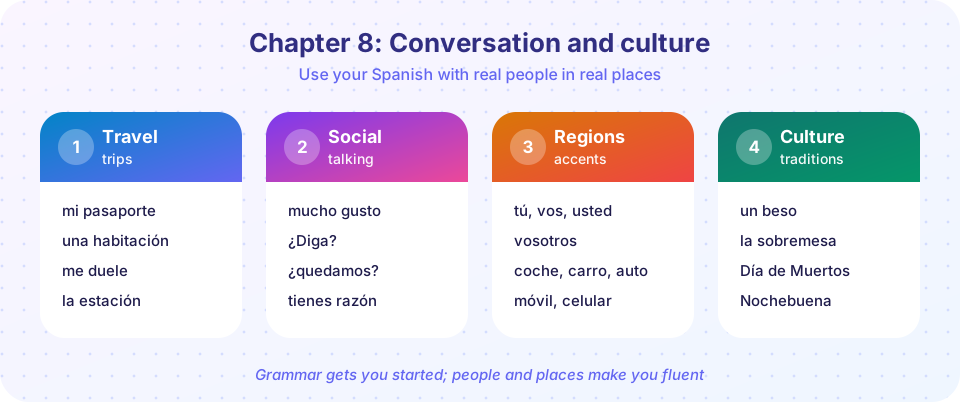
The big picture
A conversation is more than correct grammar. To handle a real exchange you need ready-made phrases, quick ways to ask for help when you do not understand, and a feel for what is polite in each place. This chapter works on all three.
- Dialogues teach you complete exchanges you can adapt: checking into a hotel, buying a ticket, calling a friend, accepting or refusing an invitation.
- Regional Spanish explains why the same thing can be called coche, carro or auto, why some people say vosotros and others ustedes, and how to understand speakers from different countries.
- Customs and etiquette explain greetings, names, mealtimes, holidays and traditions, so that your Spanish does not only sound right, it also feels right.
Chapter 8 at a glance
From grammar to real conversations
Survival phrases
Respect
Roadmap
- Travel dialogues: airport, hotel, trains and buses, health and emergencies.
- Social conversation: introductions, telephone calls, invitations, opinions and repairing a conversation.
- One language, many voices: tú, vos, vosotros, pronunciation, vocabulary and how to cope.
- Customs, etiquette and holidays: greetings, names, meals, festivals and cultural references.
- Chapter 8 review: a picture, a table, role-play practice and a quiz.
How to study this chapter
Read each dialogue aloud twice, once as each speaker. Then cover the English and try to say it from memory. After that, change one detail: a different city, a different day, a different price. Reusing a dialogue with new details is the quickest route to fluency. If you can, record yourself on your phone and listen back; you will spot mistakes quickly.
A website cannot replace talking with real people. Use these lessons to prepare, then look for language partners, a class or a conversation group, and do not be afraid of mistakes. Most Spanish speakers appreciate any effort you make, and the first conversations are always the hardest.
What you will be able to do
By the end of the chapter you should be able to book a room, buy a train ticket and describe a health problem; to pick up a phone, ask for someone and make plans; to understand why a Mexican friend says celular while a Spanish friend says móvil; and to avoid the most common cultural slips. These are exactly the situations that decide whether a first trip or a first friendship goes well.
Learning from dialogues
Dialogues are the most efficient way to learn spoken language, because they show forms in their natural home. When you study one, follow a simple routine. First read it for the gist without looking at the translation. Second, read the translation and match the sentences. Third, underline the chunks: ready-made groups of words such as ¿Tiene una habitación libre? or ¿De parte de quién? that you can reuse without building them from scratch. Fourth, close the book and act it out aloud, first with your own details and then with changes (otra ciudad, otro día, otro precio). Fifth, record the dialogue and play it back. If you repeat that cycle with each dialogue in this chapter, you will end it with fifteen or twenty conversation chunks that you can use immediately.
Pay attention to the register. In the dialogues, staff and strangers use usted with each other, friends use tú, and polite phrases such as por favor, gracias, perdone, disculpe appear constantly. In Spanish, politeness is not extra; it is built into the language.
Warm-up flashcards
Check your understanding
Quick check · 3 questions
of 3 answered You scored / 3 · perfect!
-
1. Which phrase asks someone to repeat what they said?
Puede repetir, por favor is the polite request to repeat. -
2. Why do some words differ between countries?
Spanish has regional variation in vocabulary, pronunciation and some grammar. -
3. What is a sobremesa?
The sobremesa is the relaxed conversation after eating.
Summary
- Chapter 8 turns your grammar into conversations and cultural awareness.
- Dialogues give ready-made, adaptable exchanges.
- Spanish varies by region in words, pronouns and accent, but speakers understand each other.
- Customs such as greetings, titles, mealtimes and holidays shape polite behavior.
Next: Travel dialogues
Track your progress
Create a free account to tick off lessons and pick up where you left off on any device.
of Spanish for Beginners lessons completed