


















Lesson 8 of 51 · Sounds, Greetings and Basics
Consonants and Pronunciation Rules
Master Spanish consonants: hard and soft c and g, the silent h, j, ll, ñ, the tap r and trilled rr, b and v, d and z, with a respelling helper and drills.
Most Spanish consonants sound like their English cousins: m, n, f, l, p, t, s and k are close enough that you will be understood from day one. A dozen letters need a rule or a small adjustment, and that is the topic of this lesson. The reward is large: once you know these rules you can read aloud any Spanish word without hesitation, because the same spelling always gives the same sound.
Think of the lesson as a lookup table plus a few muscle habits. The table gives you the rule; the habits (a light t, a tapped r, a soft d) come with a few minutes of practice per day.
What you will learn
- The hard and soft sounds of c and g, and how qu, gu and gü fit in.
- Silent h, jota j, the ll and y sound, ñ and ch.
- The difference between a tap r and a trilled rr.
- Why b and v sound the same, and how d, s, z and x behave.
Key terms
Aspiration: the puff of air English adds after p, t, k at the start of a word. Spanish does not.
Tap: one quick touch of the tongue tip on the ridge behind the teeth, as in the middle of the American English word butter.
Trill: a rapid series of taps, made by letting air vibrate the tongue tip.
Digraph: two letters for one sound (ch, ll, rr, qu).
Hard and soft c and g
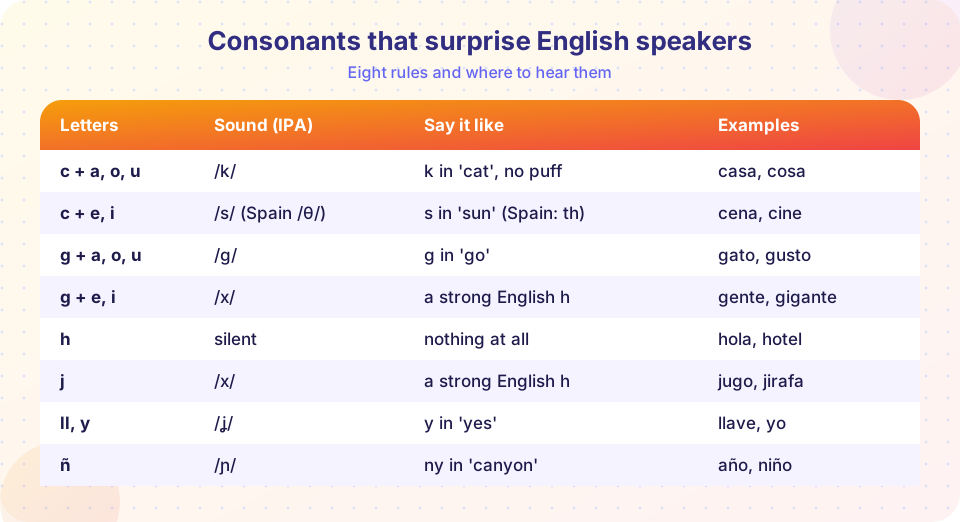
Both c and g have a hard sound before a, o, u and a soft sound before e and i. English works similarly (cat and city, go and gentle), so this should feel natural.
- c + a, o, u is /k/: casa, cosa, cuna.
- c + e, i is /s/ in Latin America and /θ/ (like th in thin) in most of Spain: cena (dinner), cine (cinema).
- g + a, o, u is /ɡ/ like go: gato (cat), gota (drop), gusto (taste).
- g + e, i is /x/, a strong breathy h, like clearing your throat softly: gente (people), gigante (giant).
What if you want the hard sound before e or i? Spanish inserts a silent u: gue and gui are /ɡe/ and /ɡi/ (guerra, war; guitarra, guitar). The same trick gives que and qui, always /ke/ and /ki/ (queso, cheese; quince, fifteen). To pronounce that u, write a dieresis: güe, güi as in pingüino (penguin) and bilingüe (bilingual).
The silent h
H is never pronounced on its own: hola /ˈo.la/, hotel /oˈtel/, hermano /eɾˈma.no/, helado (ice cream). It is a leftover of Latin spelling. The combination ch is different: it is a single sound like English ch in church: chico, mucho, leche.
j, ll, y and ñ
J is always the strong breathy /x/, like the g in gente: jugo (juice), jirafa (giraffe), rojo (red). The letter x in México and Texas is a historical spelling that is pronounced the same way: /ˈme.xi.ko/.
Ll and y (before a vowel) are pronounced like English y in yes in most regions: llave (key), calle (street), yo (I), playa (beach). In Argentina and Uruguay it sounds like sh or the s in measure, and in some regions ll is a separate sound /ʎ/ like lli in million. Any of these is understood.
Ñ is /ɲ/, like ny in canyon: año (year), niño (boy), mañana (tomorrow, morning). Do not drop the tilde: ano means anus, while año means year. This is a classic embarrassing mistake, so write the ñ.
r and rr
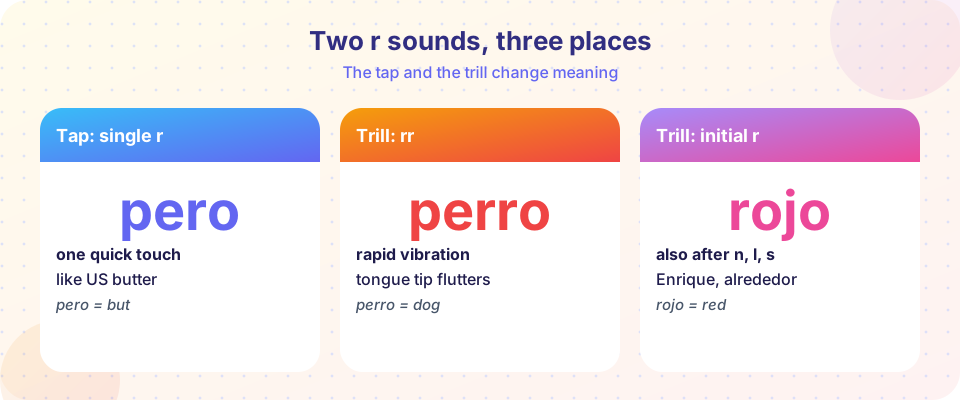
Spanish distinguishes two r sounds, and the difference changes meaning.
- Single r inside a word is a tap: pero (but), caro (expensive), hora (hour). Your tongue touches the ridge behind your upper teeth once, as in American English better or water said quickly.
- rr is a trill: perro (dog), carro (car, cart), guerra (war).
- r at the start of a word, or after n, l or s, is also trilled: rojo, rápido, Enrique, alrededor.
So pero (but) and perro (dog) differ only in tap versus trill. If you cannot trill yet, do not panic: children take years to master it, and the tap alone is understood in context. To practice, say butter quickly and notice where the tongue lands; then try to make that place vibrate by pushing more air. Try the tongue twister El perro de San Roque no tiene rabo, and the classic Tres tristes tigres tragaban trigo en un trigal.
b and v, d, s, z, x
B and v both stand for the same sound. At the start of a word or after m or n it is a /b/ like English b: bueno, vamos, un vaso. Between vowels it is softer, with the lips barely touching: lavar, haber. Do not use the English v with the teeth on the lip.
D is soft between vowels and at the end of a word: nada, ciudad sound like a gentle th in this, with the tongue barely touching the teeth. At the start of a word or after n or l it is like English d but with the tongue on the teeth: día, donde.
S is always /s/ as in sun, never /z/ like in rose: casa is KAH-sah, not KAH-zah. Z is /s/ in Latin America and /θ/ in Spain: zapato (shoe). X between vowels is usually /ks/: taxi, examen; before a consonant it often sounds like /s/: explicar.
W is rare (whisky, kiwi). K appears in kilo, kilómetro and loanwords.
Common misconceptions
"Spanish j is like English j." No. English j in judge does not exist in Spanish; Spanish j is a breathy /x/, so jugo sounds like HOO-go.
"The u in que and gue is pronounced." It is silent: que is /ke/, guerra is /ˈɡe.rra/. It sounds only with a dieresis or in gua, guo: agua, antiguo.
"Every r is trilled." Only rr and an initial r are. A single r inside a word is a tap.
"H is like English h." It is silent; j is the sound you want for English-style breathiness.
Try it
First a rule-based helper that rewrites Spanish words in a simple English-like spelling. It applies the rules from this lesson with Latin American c and z, and it ignores stress, so treat the output as a study aid, not a transcription.
Press Run (or Ctrl + Enter) to see the result here.
Program input · what you'd type while the program runs
Type the answers before you press Run, one per line. Each time the program reads a line (with input()), it gets the next line from this box.
Check your understanding
Quick check · 6 questions
of 6 answered You scored / 6 · perfect!
-
1. How is 'c' pronounced in 'cuna'?
C before a, o, u is /k/: cuna = KOO-nah. -
2. Which word has a trilled rr?
Double rr is always trilled; single r inside a word is a tap. -
3. How do you write the hard g sound before e in 'guerra'?
Gue and gui spell /ge/ and /gi/ with a silent u. -
4. How is the s in 'casa' pronounced?
Spanish s is /s/, so casa is KAH-sah. -
5. In Latin America, how is 'z' in 'zapato' pronounced?
Seseo: z is /s/ in Latin America and /θ/ in most of Spain. -
6. What does the dieresis do in 'bilingüe'?
Güe is /ɡwe/.
Summary
- C and g are hard before a, o, u and soft before e, i; use qu, gu and gü to adjust.
- H is silent; ch is one sound; j is a breathy /x/; ñ is ny.
- Single r is a tap, rr and initial r are trilled; pero and perro differ.
- B and v sound the same; d is soft between vowels; s is always /s/.
- In Latin America c and z before e, i are /s/; in Spain they are /θ/.
Next: Stress and Accent Marks
Track your progress
Create a free account to tick off lessons and pick up where you left off on any device.
of Spanish for Beginners lessons completed