


















Lesson 35 of 51 · Future, Commands and Subjunctive Basics
Chapter 7 overview: Future, commands and subjunctive
See what chapter 7 covers: the Spanish future and conditional, the present subjunctive, commands and polite requests, with a roadmap and flashcards.
You can now talk about the present and the past. Chapter 7 opens up the rest of the timeline and adds two new tools: commands (telling someone to do something) and the subjunctive (expressing wishes, doubts and feelings). These are the topics that make Spanish sound natural and polite.
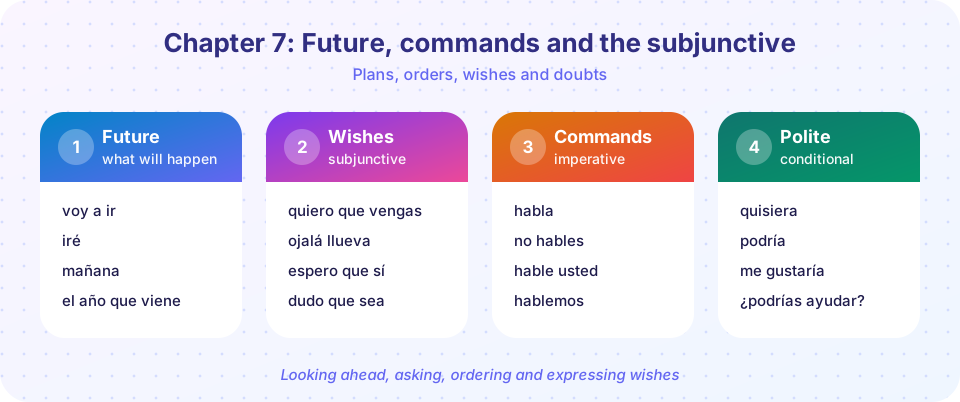
The big picture
- The future can be built three ways: with the present tense (Mañana trabajo), with ir a + infinitive (Voy a trabajar) and with the simple future (Trabajaré). Learners need all three, because native speakers use them all.
- The conditional (trabajaría) is the "would" form. It is the basis of polite requests such as ¿Podrías ayudarme? and Me gustaría un café.
- The subjunctive is a verb mood, not a tense. It appears in the second part of sentences like Quiero que vengas (I want you to come) and Espero que tengas suerte (I hope you are lucky).
- Commands (the imperative) tell people what to do: ¡Habla más despacio! ¡No corras! Siéntese, por favor. They borrow the subjunctive forms for most negative and formal commands.
Chapter 7 at a glance
Four tools for talking beyond facts
Three futures
The subjunctive trigger
Wish plus que plus a different subject
Roadmap
- The future and the conditional: ir a, the simple future, irregular stems, and polite would forms.
- Subjunctive basics: forms, the main triggers (wishes, emotions, doubt) and cuando with future meaning.
- Commands: informal and formal commands, negatives, pronouns and accents.
- Chapter 7 review: one picture, one table and ten mixed questions.
How to study this chapter
Do not worry about "mastering" the subjunctive in one sitting. Even advanced learners keep working on it for years. The aim here is to recognize the most common triggers (querer que, esperar que, es importante que, no creo que, ojalá), to produce the forms for a dozen frequent verbs and to use commands confidently. Practice with real situations: give your imaginary friend three recommendations (Te recomiendo que...), write a plan for next weekend (El sábado iré...), and write polite requests to a hotel receptionist (¿Podría darme otra toalla?).
Spanish speakers use the subjunctive constantly in everyday speech, so you will hear it in many places. At first just notice it: when you see que followed by an unfamiliar verb ending (-e in an -ar verb, -a in an -er verb), the subjunctive is probably at work.
What you will be able to do
After this chapter you should be able to make a plan (El sábado iré al mercado y luego voy a cocinar para mis amigos), give advice (Yo que tú dormiría más), say what you want other people to do (Quiero que me escribas) and give directions or instructions (Gira a la derecha; no cruces la calle aquí). You will also understand polite phrases in hotels, shops and offices, where the conditional and the subjunctive are everywhere: Quisiera una habitación doble, Le agradecería que me enviara la factura.
Why these topics belong together
At first sight the future, the subjunctive and commands look unrelated, but they share one idea: they all deal with things that have not happened yet. A plan is a future action, a wish is an action you hope will happen, and a command is an action you want the listener to perform. The same vocabulary appears in all three: mañana, pronto, cuando, antes de que, para que. Seeing the connection makes the grammar feel logical rather than random. When you meet a new sentence about something not yet real, ask what kind of "not yet" it is: a plan, a wish, a doubt or an order. The answer tells you which form to expect.
Warm-up flashcards
Check your understanding
Quick check · 3 questions
of 3 answered You scored / 3 · perfect!
-
1. Which structure expresses a near future?
Voy a estudiar is the everyday near future. -
2. What is a command?
The imperative gives orders, requests and advice. -
3. Which sentence uses the subjunctive?
Quiero que + subjunctive: a wish about another person.
Summary
- Chapter 7 covers the future, the conditional, the subjunctive and commands.
- The future can be formed with the present, ir a or the simple future.
- The subjunctive follows wishes, emotions and doubts with a change of subject.
- Commands use special forms and attach pronouns to affirmative commands.
Track your progress
Create a free account to tick off lessons and pick up where you left off on any device.
of Spanish for Beginners lessons completed