


















Lesson 31 of 51 · Past Tenses
The Spanish imperfect tense
Learn the Spanish imperfect tense: regular endings, the three irregular verbs ser, ir and ver, habitual actions, descriptions, age and time, with practice.
The imperfect is the tense of memory and scenery. It lets you say how things used to be: Cuando era niño, vivía en un pueblo pequeño. (When I was a child I lived in a small town.) It also paints the background of a story: Hacía sol y los pájaros cantaban. (It was sunny and the birds were singing.) It is the easiest past tense to form, because it has only three irregular verbs, so most of your effort will go into understanding when to use it.
What you will learn
- Conjugate regular verbs and ser, ir, ver in the imperfect.
- Use the imperfect for habits, descriptions, ongoing actions, age and time.
- Form the past progressive with estaba + -ando/-iendo.
- Recognize imperfect trigger words such as siempre and cuando era niño.
Key terms
Pretérito imperfecto: the imperfect, a past tense for habits, descriptions and ongoing actions. Acción habitual: a repeated action, "used to". Descripción: how things were, including weather, age and appearance. Gerundio: the -ando / -iendo form: hablando, comiendo. Marcador de frecuencia: siempre, todos los días, a menudo.
Forms
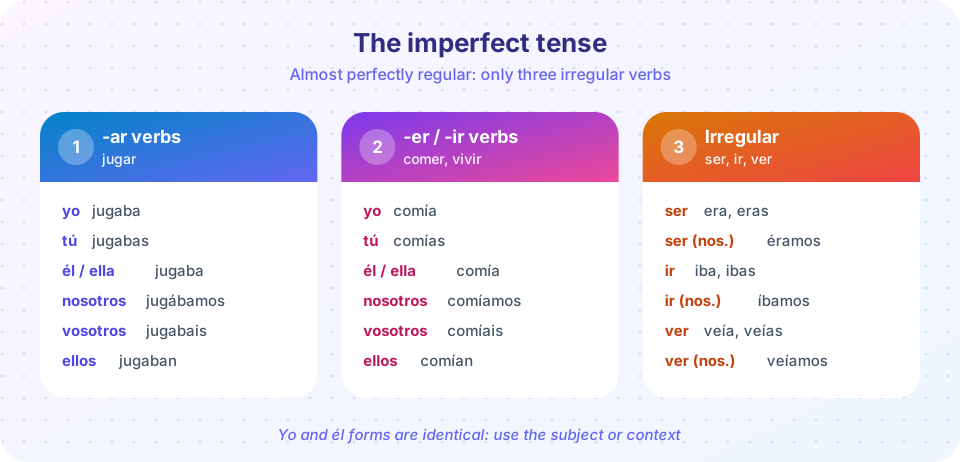
Take off the infinitive ending and add the endings below. The -ar endings contain -aba, and the -er/-ir endings contain -ía. Notice the accent on the first-person plural of -ar verbs (jugábamos) and on every -er/-ir ending (comía, comías, comíamos).
| Person | -ar (jugar) | -er (comer) | -ir (vivir) |
|---|---|---|---|
| yo | jugaba | comía | vivía |
| tú | jugabas | comías | vivías |
| él, ella, usted | jugaba | comía | vivía |
| nosotros | jugábamos | comíamos | vivíamos |
| vosotros | jugabais | comíais | vivíais |
| ellos, ellas, ustedes | jugaban | comían | vivían |
Because the yo and él/ella forms are the same, you often add the subject when it is not clear: Yo vivía en Quito y ella vivía en Lima.
Three irregular verbs
- ser: era, eras, era, éramos, erais, eran
- ir: iba, ibas, iba, íbamos, ibais, iban
- ver: veía, veías, veía, veíamos, veíais, veían
That is the whole list. Stem-changing verbs do not change their stem in the imperfect (pensar → pensaba, volver → volvía, dormir → dormía), and there are no spelling changes. Hay becomes había (there was/there were): Había mucha gente en la plaza.
Use 1: habitual actions
The imperfect says that something happened repeatedly and with no clear end, the English used to or would: Todos los veranos íbamos a la playa. (Every summer we used to go to the beach.) Mi abuela cocinaba los domingos. (My grandmother cooked on Sundays.) Typical words: siempre (always), todos los días, cada verano (every summer), a menudo (often), normalmente, a veces, nunca, de niño/a (as a child), cuando era joven, en aquella época (at that time).
Use 2: descriptions in the past
Use the imperfect to describe the scene: people, places, weather, feelings and states. La casa era grande y tenía un jardín. (The house was big and had a garden.) Hacía mucho calor. (It was very hot.) Estaba cansada y tenía hambre. (She was tired and was hungry.) Mi profesor era alto y llevaba gafas. (My teacher was tall and wore glasses.)
Use 3: age and time of day
When you say how old someone was or what time it was, use the imperfect: Tenía diez años cuando me mudé. (I was ten when I moved.) Eran las ocho de la noche. (It was eight in the evening.) Era la una y media. (It was one thirty.) These are the "background" facts against which the events happened.
Use 4: actions in progress
The imperfect shows an action that was going on, often interrupted or happening at the same time as another: Leía un libro cuando sonó el teléfono. (I was reading a book when the phone rang.) Mientras mi madre cocinaba, mi padre miraba la tele. (While my mother was cooking, my father was watching TV.) For emphasis you can build the past progressive with the imperfect of estar plus the gerund: Estaba leyendo cuando sonó el teléfono. Form the gerund with -ando (hablando) or -iendo (comiendo, viviendo). A few verbs change: leer → leyendo, dormir → durmiendo, pedir → pidiendo, ir → yendo.
Use 5: polite and indirect expressions
The imperfect also appears in polite requests and in reported speech. Quería preguntarle algo. (I wanted to ask you something. Softer than Quiero.) Me dijo que venía mañana. (He told me he was coming tomorrow.) You do not need to master these yet, but you will recognize them in conversations.
Common misconceptions
- "The imperfect means the action was incomplete or imperfect." The name only means the speaker does not focus on its beginning or end.
- "It translates only as used to." It can also be was/were -ing (Leía) or a simple past in English (Era alto = he was tall).
- "Irregular verbs in the present are irregular in the imperfect." Only ser, ir, ver are: tenía, hacía, decía, venía are regular.
- "Yo iba and él iba need extra words." They are identical; add the subject only if it is unclear.
From the present to the imperfect
A quick way to practice is to take a present-tense description and move it into the past. Present: Mi casa es grande, tiene tres habitaciones y está cerca del parque. Mis padres trabajan mucho y yo juego con mis amigos. Imperfect: Mi casa era grande, tenía tres habitaciones y estaba cerca del parque. Mis padres trabajaban mucho y yo jugaba con mis amigos. Each verb simply changes its ending, and the meaning shifts from "now" to "back then". Try it with your own home, school or street.
You can also use the imperfect to ask and answer questions about the past: ¿Dónde vivías de niño? (Where did you live as a child?) ¿Qué hacías los fines de semana? (What did you do on weekends?) ¿Cómo era tu escuela? (What was your school like?) The answers stay in the imperfect: Vivía en un pueblo. Jugaba con mis primos. Era pequeña y antigua. Because there is no focus on a single event, this tense is ideal for "tell me about your childhood" conversations, which are common when you meet native speakers.
A reading to analyze
Cuando yo era niña, mi familia pasaba los veranos en un pueblo cerca del mar. Nos levantábamos temprano, desayunábamos en la terraza y después íbamos a la playa. Mi abuelo siempre llevaba un sombrero blanco, y mi abuela nos preparaba bocadillos. Por la tarde, mis primos y yo jugábamos al fútbol hasta que se hacía de noche.
When I was a girl, my family spent the summers in a village near the sea. We got up early, had breakfast on the terrace and then went to the beach. My grandfather always wore a white hat and my grandmother made us sandwiches. In the afternoon my cousins and I played football until it got dark.
Every verb is in the imperfect: it is a memory of a repeated routine, not a story about one specific day. If the writer wanted to tell what happened on one particular day, the verbs would switch to the preterite.
Try it
Conjugate in the imperfect and compare the regular and irregular patterns. The last lines build short memories.
Press Run (or Ctrl + Enter) to see the result here.
Program input · what you'd type while the program runs
Type the answers before you press Run, one per line. Each time the program reads a line (with input()), it gets the next line from this box.
Fill in the imperfect forms.
Check your understanding
Quick check · 5 questions
of 5 answered You scored / 5 · perfect!
-
1. Which sentence describes a habit in the past?
Todos los domingos signals a repeated habit: imperfect. -
2. What is the imperfect of "ir" for nosotros?
Ir is irregular: iba, ibas, iba, íbamos, ibais, iban (with the accent). -
3. Which is the correct way to say "She was ten years old"?
Age uses tener, and age in the past is a background fact: tenía. -
4. What is the progressive of "Leía"?
The imperfect of estar plus the gerund gives the past progressive: estaba leyendo. -
5. Which verb is irregular in the imperfect?
Only ser, ir and ver are irregular: veía, veías...
Summary
- Imperfect endings: -ar → aba, abas, aba, ábamos, abais, aban; -er/-ir → ía, ías, ía, íamos, íais, ían.
- Irregular verbs: ser (era), ir (iba), ver (veía).
- Use it for habits, descriptions, age and time, and ongoing or interrupted actions.
- Form the past progressive with estaba + gerund.
Next: Preterite or imperfect?
Track your progress
Create a free account to tick off lessons and pick up where you left off on any device.
of Spanish for Beginners lessons completed