


















Lesson 36 of 51 · Future, Commands and Subjunctive Basics
The Spanish future and conditional
Learn three ways to express the future in Spanish: the present tense, ir a plus infinitive and the simple future, plus the conditional for polite requests.
How do you say what you are going to do tomorrow, next year or someday? Spanish gives you three options, all of them natural. Each option sounds slightly different, and together with the conditional (the "would" form) they let you plan, predict, promise and ask politely. This lesson teaches all four patterns and tells you when each one is the best choice.
What you will learn
- Use the present tense and ir a + infinitive for near-future plans.
- Form the simple future, including irregular stems.
- Use the future for predictions, promises and guesses about the present.
- Form and use the conditional for polite requests, advice and hypotheticals.
Key terms
Futuro simple: the simple future (hablaré). Perífrasis ir a + infinitivo: the "going to" structure. Condicional: the conditional (hablaría), "would". Raíz irregular: an irregular stem such as tendr-. Futuro de probabilidad: the future used to guess about the present.
Way 1: the present tense
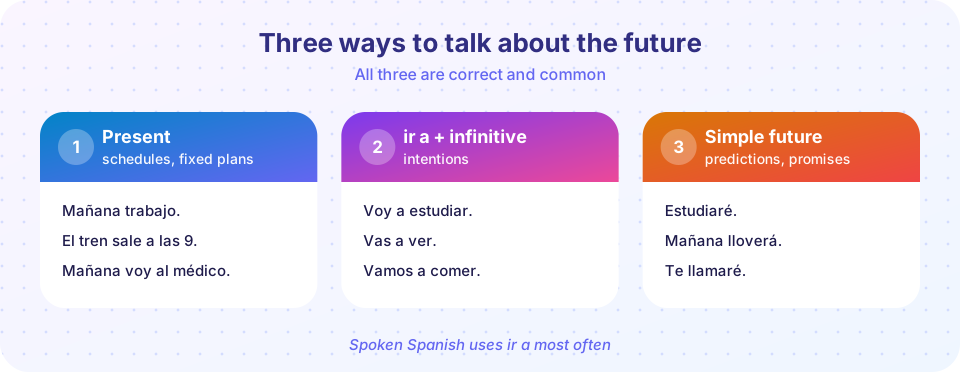
Like English, Spanish uses the present for scheduled or fixed plans, especially with a time word: Mañana trabajo hasta las seis. (Tomorrow I work until six.) El tren sale a las nueve. (The train leaves at nine.) El viernes voy al médico. (On Friday I am going to the doctor.) Time words such as mañana (tomorrow), esta noche (tonight), la semana que viene (next week), el año que viene (next year), pronto (soon) and dentro de dos días (in two days) make the meaning clear.
Way 2: ir a + infinitive
The most common spoken future is ir a + infinitive: the present of ir (voy, vas, va, vamos, vais, van), then a, then the infinitive of the action. It expresses intentions and things that are about to happen: Voy a estudiar esta tarde. (I am going to study this afternoon.) ¿Vas a venir a la fiesta? (Are you going to come to the party?) Va a llover. (It is going to rain.) Vamos a comer en casa. (We are going to eat at home.) Notice that the verb after a never changes. As a bonus, Vamos a + infinitive also means "Let's ...": ¡Vamos a bailar! (Let's dance!)
Way 3: the simple future
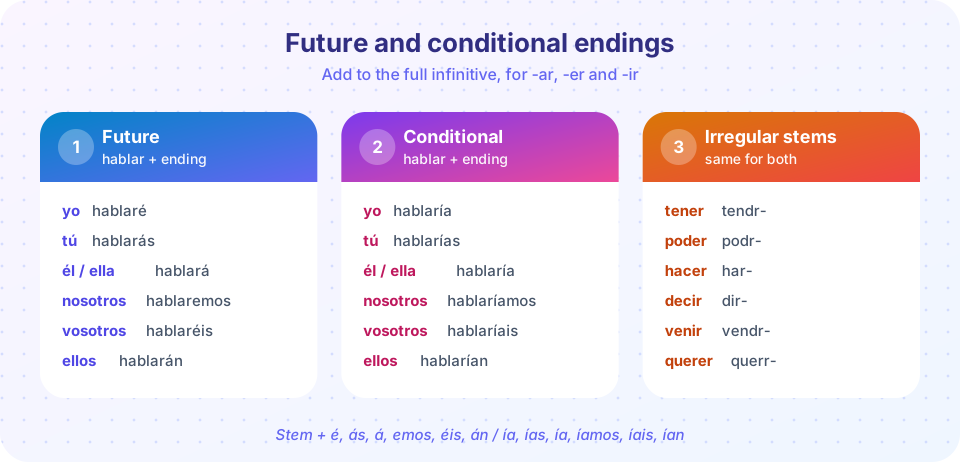
The simple future has one set of endings for every verb, added to the whole infinitive: -é, -ás, -á, -emos, -éis, -án. The accents mark the stress; the nosotros form (hablaremos) is the only one without an accent.
| Person | hablar | comer | vivir |
|---|---|---|---|
| yo | hablaré | comeré | viviré |
| tú | hablarás | comerás | vivirás |
| él, ella, usted | hablará | comerá | vivirá |
| nosotros | hablaremos | comeremos | viviremos |
| vosotros | hablaréis | comeréis | viviréis |
| ellos, ellas, ustedes | hablarán | comerán | vivirán |
Irregular stems
A dozen common verbs have a different stem, but the endings stay the same. The stems drop the vowel of the infinitive ending, or change in another way:
- tener → tendr-, poner → pondr-, salir → saldr-, venir → vendr-, valer → valdr- (a d replaces the vowel).
- poder → podr-, saber → sabr-, querer → querr-, haber → habr-, caber → cabr- (the vowel disappears).
- hacer → har-, decir → dir- (a bigger change).
Mañana tendré tiempo. Saldremos a las ocho. Haré la cena. Te lo diré luego. Compounds follow their base verb: mantener → mantendré, deshacer → desharé, prever → preveré.
What the simple future means
The simple future is a little more formal and often sounds like a prediction, a promise or a decision made on the spot: Mañana lloverá. (Tomorrow it will rain.) Te llamaré esta noche. (I will call you tonight.) Será un placer. (It will be a pleasure.) In writing it is very common; in speech, ir a often replaces it. A second, very frequent use is to guess about the present: ¿Dónde está Pedro? Estará en casa. (Where is Pedro? He must be at home.) ¿Qué hora será? (I wonder what time it is.) Tendrá treinta años. (He is probably thirty.)
After si (if) with a present-tense verb, the result clause usually uses the future: Si llueve, nos quedaremos en casa. (If it rains, we will stay home.)
The conditional: "would"
The conditional uses the same stems as the future, with the endings -ía, -ías, -ía, -íamos, -íais, -ían. These are the same endings as the imperfect of -er and -ir verbs. So the conditional of hablar is hablaría, hablarías, hablaría, hablaríamos, hablaríais, hablarían, and irregular verbs keep their stems: tendría, podría, haría, diría, vendría, querría.
Its main uses:
- Polite requests: ¿Podría ayudarme? (Could you help me?) ¿Te importaría cerrar la ventana? (Would you mind closing the window?)
- Wishes: Me gustaría viajar a Chile. (I would like to travel to Chile.) Querría hablar con usted. (I would like to talk with you.)
- Advice: Yo estudiaría más. (I would study more.) Deberías descansar. (You should rest.) Yo que tú, iría al médico. (If I were you, I would go to the doctor.)
- Hypotheticals: Con más dinero, compraría una casa. (With more money I would buy a house.)
- Past guesses: Tendría diez años cuando se mudó. (He must have been ten when he moved.)
You already know quisiera (the polite form) and me gustaría. Both are conditional-like and are the safest ways to ask for things in a shop or restaurant.
Common misconceptions
- "Will is always the simple future." For plans in speech, ir a or the present is often more natural: Mañana te llamo or Voy a llamarte.
- "The future endings replace the infinitive ending." They are added to the whole infinitive: hablar + é, not habl + aré.
- "Irregular future stems need irregular endings." The endings never change, only the stem: tendré, tendrás, tendrá...
- "Would is always the conditional." For habits in the past, would means used to: use the imperfect (Cuando era niño, jugaba al fútbol).
Putting the pieces together
Here is a short conversation that uses all the forms you have learned:
- —¿Qué vas a hacer este fin de semana? What are you going to do this weekend?
- —El sábado visitaré a mis abuelos y el domingo voy a descansar. ¿Y tú? On Saturday I will visit my grandparents and on Sunday I am going to rest. And you?
- —Yo trabajaré el sábado por la mañana, pero por la tarde saldré con unos amigos. ¿Te gustaría venir? I will work on Saturday morning, but in the afternoon I will go out with some friends. Would you like to come?
- —Me encantaría, pero no sé si podré. I would love to, but I don't know whether I will be able to.
Spot the three futures (visitaré, voy a descansar, trabajaré, saldré, podré) and the two conditional forms (gustaría, encantaría). Notice that Me encantaría is a warm and polite way to accept, while Me gustaría pero... often signals a polite refusal. Spanish speakers also say Ya veremos (we will see) when they are not sure, a useful phrase that is usually less definite than English "we will see".
Giving advice with the conditional
Advice is one of the most useful functions of the conditional. The structure Yo que tú + conditional (If I were you...) is very natural: Yo que tú, hablaría con ella. The verbs deber and poder in the conditional soften a recommendation: Deberías llamar a tu madre (You should call your mother), Podrías probar el pescado (You could try the fish). Compare the strength: Debes estudiar sounds like a rule; Deberías estudiar sounds like friendly advice.
Try it
This program prints future and conditional forms side by side. Compare the identical stems, then try adding a verb such as salir.
Press Run (or Ctrl + Enter) to see the result here.
Program input · what you'd type while the program runs
Type the answers before you press Run, one per line. Each time the program reads a line (with input()), it gets the next line from this box.
Complete the sentences with the future form or the conditional. Remember accents.
Check your understanding
Quick check · 5 questions
of 5 answered You scored / 5 · perfect!
-
1. Which phrase is the most common spoken way to say "I am going to study"?
Ir a + infinitive is the everyday near future. -
2. What is the future of "tener" for yo?
Tener has the irregular stem tendr-: tendré. -
3. What does "Estará en casa" often mean?
The future can express probability about the present. -
4. Which is the polite way to ask for help?
The conditional podrías softens the request. -
5. What is the conditional of "hacer" for nosotros?
Hacer has the stem har-: haríamos. Hacíamos is the imperfect, haremos the future.
Summary
- Three ways to say the future: present, ir a + infinitive, simple future.
- Future endings go on the full infinitive: -é, -ás, -á, -emos, -éis, -án.
- Irregular stems (tendr-, podr-, har-, dir-, vendr-, saldr-, querr-, sabr-) are shared by the conditional.
- The future can also express guesses; si + present is followed by the future.
- The conditional (-ía endings) gives polite requests, wishes, advice and hypotheses.
Next: Subjunctive basics
Track your progress
Create a free account to tick off lessons and pick up where you left off on any device.
of Spanish for Beginners lessons completed